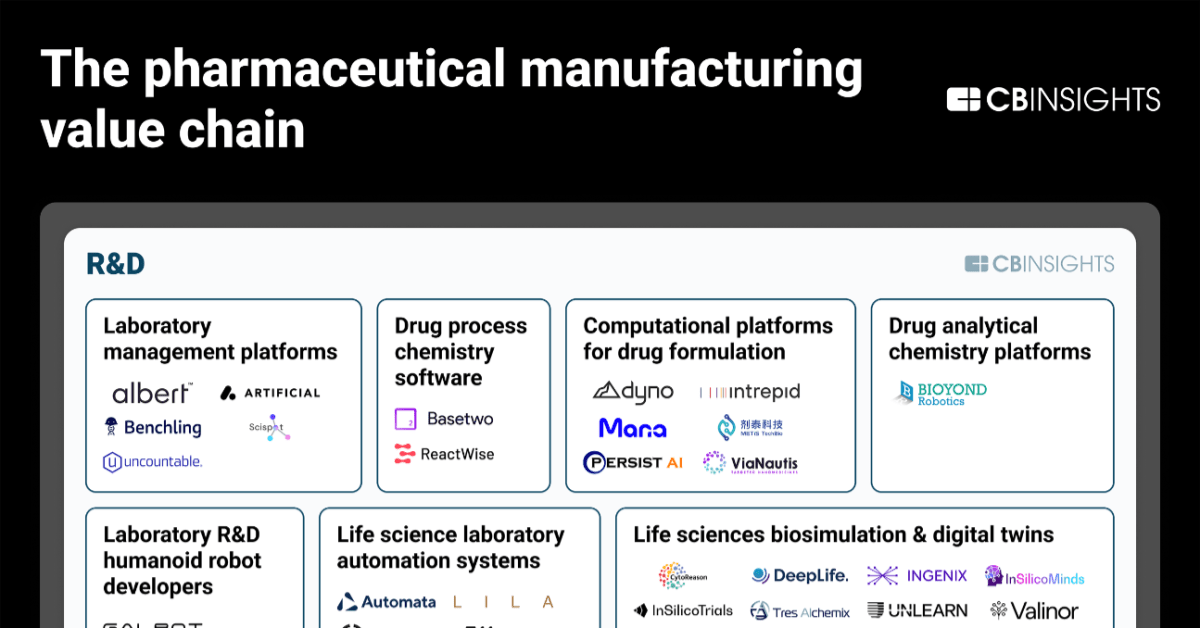
Your next prescription could arrive faster, cheaper—maybe even customized just for you. That’s the real-world ripple from pharma’s massive pivot: over $400B poured into new factories this year alone, all ripe for AI, robots, and digital wizardry.
Pharma giants aren’t just building plants; they’re greenfielding the future, embedding tech from day one. And with FDA green lights on AI easing old fears, it’s an arms race. Incumbents partner up, startups swarm in. But does this hype deliver for everyday folks buried in copays?
Why Your Meds Are About to Get a Tech Overhaul
Look, therapies aren’t pills anymore—they’re hyper-personalized cell treatments, gene edits, demanding insane precision. Traditional factories choke on that complexity. Enter 91 private companies, all post-2010, Mosaic-scored over 500 for winner potential. We’ve mapped ‘em across R&D, production, quality control, logistics.
These aren’t garage tinkerers. Hiring’s exploding—engineers from Tesla, ex-Google AI whizzes. Business ties? Pfizer pilots, Merck investments. Market dynamics scream momentum: complex drugs need flexible lines, not rigid assembly belts.
But here’s my edge: this echoes Detroit’s 1980s robot revolution. Back then, auto automation slashed costs 30% but sparked brutal layoffs. Pharma? Smarter play—$400B capex wave (that’s capital expenditure, folks) targets scale for personalized meds, not mass-produced statins. Prediction: drug prices drop 15-20% by 2030 if these startups stick landings.
“As therapies become more complex and personalized, companies that master integrating traditional production technologies with emerging automation, AI, and digital platforms will be best positioned to scale and deploy next-generation treatments ahead of competitors.”
Spot on. But corporate spin glosses the risks—regulatory U-turns, integration fails.
Short para: Winners hire fast.
Can These 91 Startups Actually Beat Big Pharma’s Inertia?
R&D first. Labs drowning in trial-and-error? Humanoid robots from firms like those in the map automate scale-up, tweaking formulations via AI. One startup’s digital twin simulates years of production in weeks—cut dev time 40%, per their pilots.
Production’s wilder. Flexible platforms swap cell therapies for biologics overnight. Novel bioreactors, self-optimizing via ML. Greenfield sites mean no legacy cruft—pure digital-native ops.
Quality control? AI eyes spot defects humans miss, real-time compliance dashboards slash FDA filing waits from months to days. Logistics rounds it: blockchain-tracked cold chains, drone last-miles for direct-to-patient.
Data backs the frenzy. 2025’s $400B isn’t fluff—GSK, J&J announcing multi-billion plants. Startups snag partnerships: think Repligen’s perfusion tech in Novartis lines. Mosaic scores climbing? That’s venture math saying 20-30% could unicorn.
Skepticism check: Many chase same prize—AI process optimization. Differentiation’s key, or it’s commoditized noise. My take? Logistics dark horses win big; supply snarls killed COVID vax rollouts.
Is Pharma’s AI Arms Race Worth the Hype—or Just Burn Rate?
Arms race, yes. But burn rates? VC cash flows hot—$2B+ into these categories last year. Incumbents like Roche buy in early, de-risking.
For real people: faster rare-disease drugs mean lives saved sooner. Oncologists rave about scaled CAR-T cells—costs halved already in pilots. Downside? Job shifts—lab techs to coders. But net: more treatments, less wait.
Historical parallel I spy: Semiconductors in the ’90s. Fab automation boomed yields, crashed chip prices. Pharma follows suit—expect biologics under $100K/patient soon.
Critique the PR: “Unlocking new capabilities” sounds sexy, but integration’s brutal. Legacy ERP systems clash with shiny digital twins. Failures loom—witness some 2023 pilots scrapped.
Still, momentum’s undeniable. FDA’s AI guidance? Game-enabler, clarifying validation paths.
And breathe. Trends: humanoid robots cross R&D-production, blurring lines.
One sentence: Watch logistics explode.
The Hidden Winners in This Market Map
R&D leaders: scale-up bots, formulation AI. Production: modular cleanrooms. QC: predictive analytics. Logistics: temp-controlled autonomy.
Unique insight—don’t sleep on quality control. It’s the chokepoint; real-time QA could save $50B/year in waste. Startups here grow Mosaic fastest.
Bold call: By 2027, top 10 from this map ink $1B+ deals. Pharma’s too slow solo.
🧬 Related Insights
- Read more: Google’s Scion: Orchestrating AI Agents Like a Conductor in a Frenzied Symphony
- Read more: AI Timelines Are Exploding Faster Than Forecasts—And We’re Barely Measuring It
Frequently Asked Questions
What is the pharmaceutical manufacturing value chain market map?
It’s a breakdown of 91 high-potential startups across R&D, production, QC, and logistics, fueling pharma’s $400B buildout with AI and automation.
Will AI in pharma manufacturing lower drug prices?
Likely yes—pilots show 20-40% cost cuts via efficiency; scaled, that hits patients via competition.
Which startups are leading pharma’s factory revolution?
Map highlights Mosaic >500 firms; R&D scale-up bots and QC AI detectors top momentum lists.
Wraps the map. Patients win most.