AI agents dominate now.
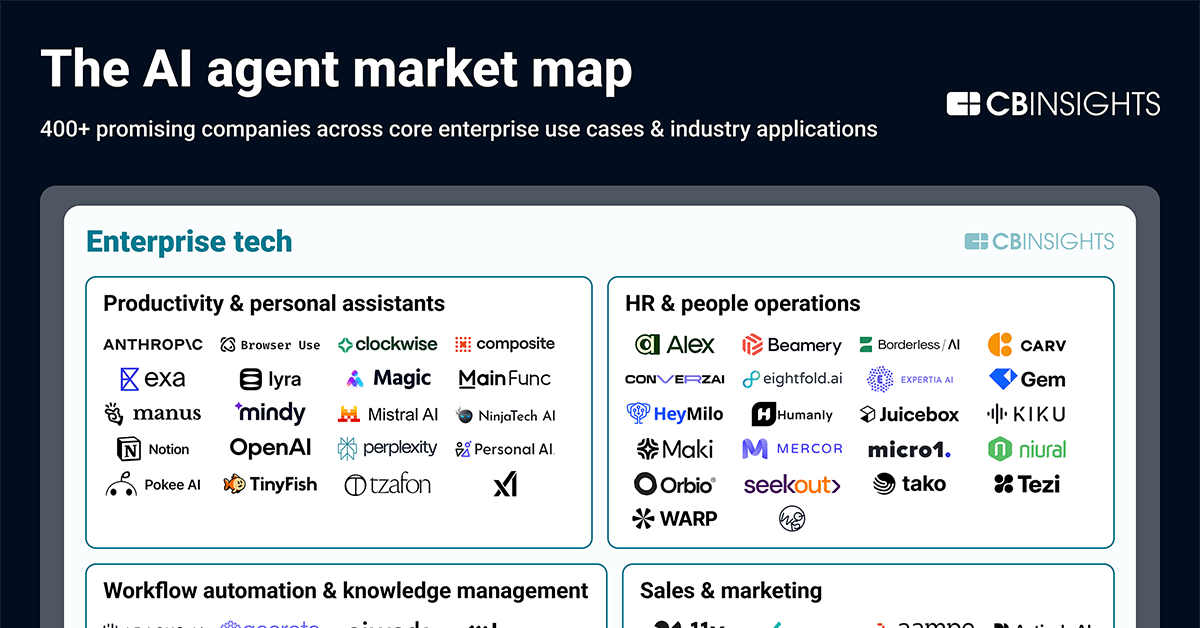
From 300 players in March 2025 to thousands today, the AI agent market map captures a frenzy. Tech giants chase acquisitions; one in five new unicorns builds agents. CB Insights mapped 400+ private standouts, scored on Mosaic health metrics above 600. Horizontal tools still lead 2-to-1, but vertical surges—like healthcare jumping from 7 to 47 firms—signal a pivot.
The private AI agent market is moving towards greater specialization. Horizontal AI agent startups outnumber verticalized solutions nearly 2-1 in the landscape. However, since we last published the map, industry-specific solutions have surged.
That’s the raw data. But here’s the thing: it’s not just growth. Top 20 revenue leaders—averaging 3.8 years old—cluster in software dev, with Cursor and Replit crushing it. Coding agents thrive in testable workflows, yet reasoning models spike inference costs. Preview that for sales, marketing, everywhere else.
Cybersecurity? Primed for exits.
Nullify and Strike Ready top M&A odds at 70%+. AI cyber deals hit records in 2025. Incumbents gobble startups to match morphing threats. Makes sense—agents automate SOCs, hunt vulns autonomously.
Who’s Leading the AI Agent Revenue Race?
Software dev owns it. Six coding agents in the top 20. Why? Clear tasks, quick wins. But don’t sleep on general workflow builders—no-code platforms letting biz users chain LLMs, tools, memory. That’s the biggest map chunk. Enterprise horizontals span data analytics, finance, sales, customer service, recruiting, legal, IT ops.
Productivity assistants target consumers too—browser research, time hacks. Then verticals: fintech for compliance, loans; healthcare for diagnostics, trials.
And look, this AI agent market map screams consolidation ahead. Remember the SaaS boom of 2010? Horizontals like Salesforce scaled first, but verticals (think Veeva in life sciences) carved $10B+ niches via specialization. My bet: agents follow suit. Incumbents acquire vertical winners—cyber, healthcare first—while horizontals face pricing wars as model costs climb. Unique twist? YC batches bet regulated sectors shun generalists. Smart, if inference bills don’t kill margins.
But is this sustainable?
Revenue lightning-fast, sure. Yet 1,700+ pool whittled to 400+ via Mosaic scores—weeding weaklings on funding, traction, team. Excludes infra like agent stacks. Focus: apps blending reasoning, memory, tools, planning.
Enterprise tech dominates. Data agents crunch spreadsheets autonomously. Coding ones debug, refactor. Finance bots reconcile ledgers. Sales? Prospecting, demos. Marketing personalizes at scale. CS handles tickets. Recruiting screens resumes. Security ops triage alerts. Legal reviews contracts. IT fixes tickets.
Why Vertical AI Agents Are Exploding in Healthcare?
47 firms now, from 7. Mature privates rebrand; newbies launch. Regs demand precision—generalists falter on HIPAA, FDA. Parallels early EHR software: specialists won by nailing workflows incumbents ignored. Prediction: healthcare agents hit $5B ARR by 2028, fueling 20+ exits. Hype? Partly—many tout ‘autonomy’ but deliver workflows. Still, surge beats stagnation.
Workflow automation bulges too. Agent builders empower no-coders. Knowledge managers query enterprise data. Crowded, competitive.
Cyber ops leads exit probs. Evolving attacks demand speed—agents deliver.
Fintech verticals automate investments, collections, compliance. Insurance too.
Short take: horizontals scale fast, verticals stick.
Top players grow amid cost pressures. Inference bills preview pain—dev agents feel it first. Broader market? Same fate unless pricing innovates.
CB Insights flags agentic workflows to full autonomy. All combine core traits: reasoning via FMs, memory RAG-style, tool APIs, planning loops.
Market signals future tech bets. Specialization rises; revenue skews young; cyber exits loom. But corporate spin calls it ‘reshaping’—really, it’s incumbents racing startups, with M&A as endgame.
Here’s my edge: this map echoes mobile app stores pre-2015. Explosion, then app store fatigue, platform winners. Agents? Platforms like agent builders win; apps get bolted on.
Dense reality check. Private market frothy—thousands claim ‘agents,’ few deliver autonomy. Mosaic filters help, but watch burn rates. Unicorns betting big? Risky if models commoditize.
Will AI Agents Face a Pricing Crunch Soon?
Yes. Dev leaders prove it. Reasoning hikes costs 10x. Categories like sales, vague tasks, amplify. Builders must layer efficiency—or perish.
Overall, bullish dynamics. But skepticism warranted: rebrands pad counts; true autonomy scarce.
🧬 Related Insights
- Read more: Jetpack Compose Meets Room: The Bulletproof CRUD Stack Android Devs Can’t Ignore
- Read more: AI Killed the Standup Meeting – Developers Finally Get Their Mornings Back
Frequently Asked Questions
What is the AI agent market map?
CB Insights’ visual of 400+ private AI agent startups, categorized by horizontal enterprise functions and vertical industries, scored on growth potential.
Which AI agent categories lead in revenue?
Software development tops, with young firms like Cursor and Replit averaging top-20 spots despite high inference costs.
Are AI agent startups good acquisition targets?
Cybersecurity agents lead, with Nullify and Strike Ready at 70%+ M&A probability amid record 2025 deals.