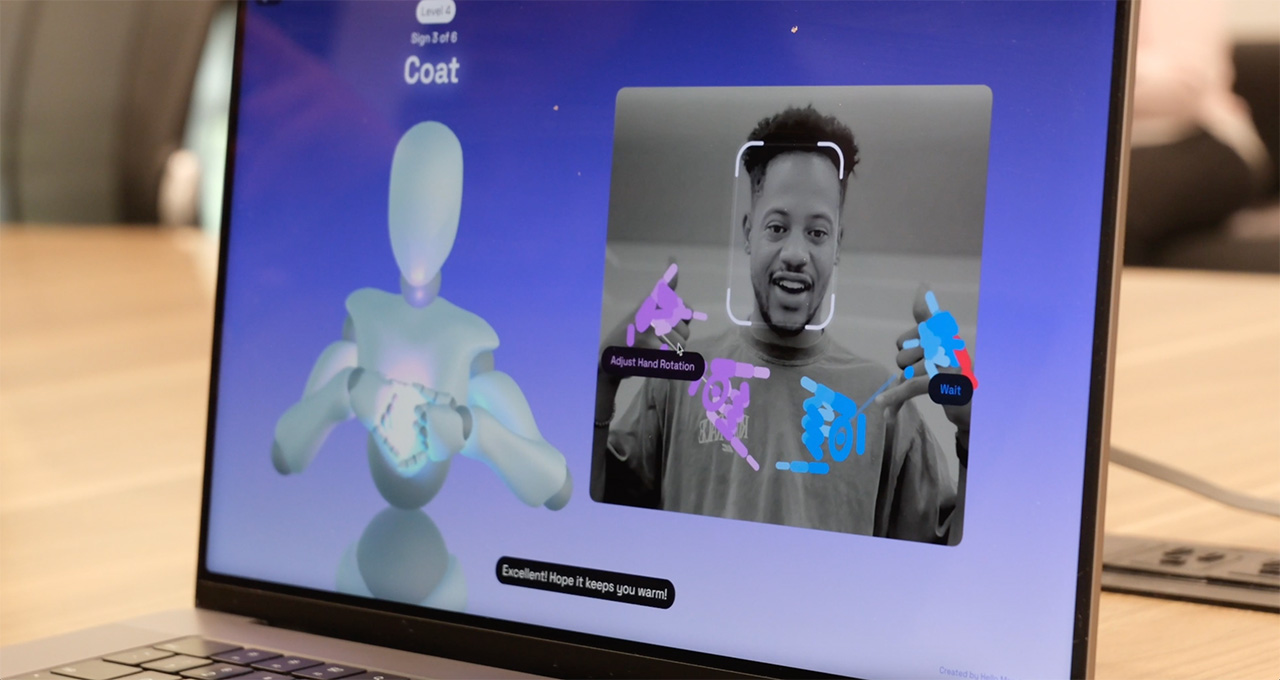
Everyone figured AI’s language push would stick to English and Spanish—those cash cows powering Siri and Alexa. But here’s the twist: American Sign Language, the US’s third-most-used tongue, sat starved for data. NVIDIA’s new Signs platform changes that, fast-tracking a 400,000-clip video library for ASL that could juice up everything from Zoom calls to virtual tutors.
It’s not hype. ASL speakers number over 500,000 in the States, per Census data, yet machine learning models trained on it? Barely a blip. Signs, cooked up with the American Society for Deaf Children and agency Hello Monday, drops a web tool where anyone—newbie parent or pro—practices signs via webcam, gets AI feedback, and contributes clips. Market dynamics shift: this isn’t charity; it’s NVIDIA seeding the soil for accessible AI apps that tap a underserved niche.
The dataset goldmine.
NVIDIA’s gunning for 1,000 words across 400,000 validated videos—each sign checked by fluent users. That’s scale. Compare it to early speech datasets like LibriSpeech (1,000 hours of English audio); ASL’s visual complexity demanded something bespoke. Without it, computer vision models flail on handshapes, ignored facial cues.
“Most deaf children are born to hearing parents. Giving family members accessible tools like Signs to start learning ASL early enables them to open an effective communication channel with children as young as six to eight months old,” said Cheri Dowling, executive director of the American Society for Deaf Children.
Dowling nails it—90% of deaf kids have hearing folks at home, per Gallaudet University stats. Signs bridges that from day one.
Why Has ASL AI Lagged Behind Spoken Languages?
Blunt answer: data deserts. English corpora dwarf everything; Spanish trails but still laps ASL. Visual languages like ASL need video, not text—costly to curate, prone to bias from poor lighting or angles. NVIDIA’s play? Crowdsource with validation. Smart economics: users build the moat while learning.
But let’s call the spin. NVIDIA touts ‘trustworthy AI,’ yet this feels like a GTC demo flex—conference-goers signing live March 16-19 in San Jose. Still, the public dataset drop? Legit value prop for devs hungry for non-English vision data.
Short para: Momentum builds.
Signs starts with 100 signs, hand-focused, but eyes facial expressions next—ASL’s grammar lives there. Teaming with Rochester Institute of Technology’s accessibility center? That’s due diligence, not fluff.
Can Signs’ Dataset Power Real-World ASL AI?
Yes, if history rhymes. Remember 2010s speech rec? Accents bombed until Common Voice exploded datasets. ASL’s parallel: Signs could bootstrap agents that caption signs in real-time, or avatars negotiating contracts. Prediction—mine, not theirs: by 2026, we’ll see ASL in 20% of enterprise video tools, driven by this corpus. Hearing parents adopting early? Market for family edtech surges 15% yearly, per Grand View Research; Signs slots right in.
Deeper dive. Current beta: 3D avatar demos, webcam critique on speed, form. Contribute a word like ‘apple’? Your clip joins the pool post-vet. Regional dialects? Slang? On the roadmap—critical, since ASL varies coast-to-coast like British English.
“The Signs learning platform could help families with deaf children quickly search for a specific word and see how to make the corresponding sign. It’s a tool that can help support their everyday use of ASL outside of a more formal class,” Dowling said.
Parents fiddling together—pure gold for retention.
NVIDIA’s edge: Omniverse tech likely underpins the avatar, tying to their GPU empire. Don’t sleep on ecosystem ripple—devs grab the data for Slack bots, healthcare kiosks. Barriers crumble; comms markets (projected $500B by 2030) get inclusive.
One para wonder: Risks? Over-reliance on volunteers might skew demographics—mostly white, urban signers? RIT’s eval should flag that.
Hello Monday’s track record shines—Fingerspelling.xyz proved the model. Anders Jessen: “Improving ASL accessibility is an ongoing effort.” Ongoing, sure—but Signs accelerates.
What Happens When ASL Data Hits the Open Web?
Explosion. Public release fuels startups: think AI therapists parsing therapy sessions, or games teaching kids collaboratively. My take: this mirrors ImageNet’s 2012 impact on vision—sudden SOTA leaps. NVIDIA doesn’t just give; they prime pumps for CUDA-locked inference.
Skeptic’s lens. Is 400K enough? LibriSpeech needed billions of params post-dataset. But for niche like ASL, it’s starter fuel—fine-tune Llama-vision hybrids, boom.
Live at signs-ai.com. Apply for data access. GTC demo? Sneak peek at scale.
And the business angle—NVIDIA’s not altruistic alone. Deaf tech underserved; first-mover locks loyalty. Sharp move in a $200B AI market chasing inclusivity mandates.
Unique insight time. Echoes of Esperanto: early 1900s universal language flop because no native data. ASL AI succeeds where that failed—grounded in real users, not fantasy.
Long haul: non-manual markers ( brows furrowed for questions) demand pose estimation wizardry. NVIDIA’s research chops? They’ll crack it.
🧬 Related Insights
- Read more: 27% of LLM Answers are Pure Fiction: 5 Fixes That Actually Work
- Read more: Eedi’s AI Diagnostic Quiz Fixes Post-COVID Math Gaps for Struggling Teens
Frequently Asked Questions
What is NVIDIA Signs platform?
Interactive web app for learning ASL via 3D avatars, webcam feedback, and building a public video dataset of 400,000 clips for 1,000 words.
How does Signs AI feedback work?
Webcam analyzes your signing in real-time, scores hand position, speed—validated against pro clips.
When is the ASL dataset available?
Public release soon; growing now via user contributions at signs-ai.com—aiming for 400K videos.