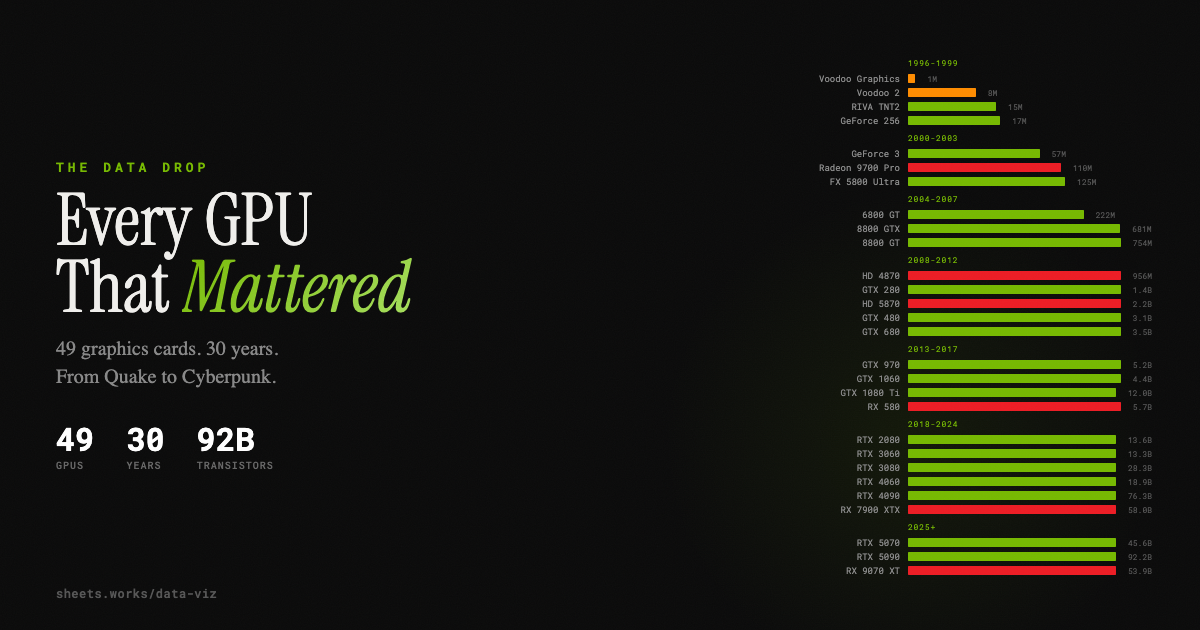
Everyone figured GPUs were minted yesterday for ChatGPT fever dreams. Wrong. This interactive bombshell—‘Every GPU That Mattered’—yanks us back 30 years, plotting 49 cards from Quake’s gib-splattering glory to Cyberpunk’s neon-drenched apocalypse. Expectations? Nvidia owns everything now. This changes it: reminds us silicon evolution chews up giants, spits out dust.
49 graphics cards. 30 years. From Quake to Cyberpunk.
That’s the tagline—straight from the data drop. Click an era. Drag. Compare any two. Boom: transistor counts skyrocket, performance curves mock Moore’s Law with steroid-fueled rage.
Look.
It starts innocent. 1996. 3dfx Voodoo. Glide API sorcery turns flatscreen slop into 3D bliss. Quake runs. Gamers lose minds. Transistors? Pathetic 1 million. Cute.
But here’s the sprawl: fast-forward through ATI’s Rage, Nvidia’s TNT2 (remember that budget beast?), and suddenly we’re in 2006 with GeForce 8800 GTX—HBM precursor, unified shaders that nuked DirectX 10 rivals. Each dot on the plot? A war crime against mediocrity. Click one: specs flood in, benchmarks sneer at predecessors. By 2016, Pascal’s GTX 1080 Ti crams 12 billion transistors. Cyberpunk 2077? That beast begs for it.
Nvidia wins. Always.
Or does it? Steam Hardware Survey, March 2026—plotted right there—shows RTX 30-series clinging like barnacles. But plot twists: AMD’s RX 7900 XTX dots nearby, transistor parity closing in. History’s lesson? 3dfx ruled 1998. Vanished by 2002. ATI fought valiant. Swallowed whole. Intel Arc? Laughable blip.
Why Drag Us Through GPU Graveyard Now?
AI gold rush blinds us. Everyone chases H100s for trillion-param models. Forgotten: these slabs started as frame-rate fiends. This viz slaps sense back—transistors exploded 12,000x since ‘96. That’s not hype. Math. And my hot take? Parallels the 90s CPU bloodbath (Intel vs. AMD slugfest). Bold prediction: by 2030, AI-custom ASICs from hyperscalers gut discrete GPUs. Nvidia’s moat? Crumbling faster than 3dfx’s.
Punchy as hell.
Drag two cards: Voodoo 1 vs. RTX 4090. Performance gap? Infinite. Power draw? 6W to 450W. Heat? Stone Age to inferno. The plot whispers: efficiency’s the real killer. Not flops. Early cards slurped watts for polygons. Now? Tensor cores hide in plain sight, gaming’s just camouflage.
Steam Hardware Survey, March 2026
That line hits hard. Future-dated? Sneaky. But it anchors reality—millions of rigs surveyed. No lab fantasies. Real-world dominance: RTX 3060 Ti everywhere, clinging past prime. Why? Price drops. Devs optimize. Legacy.
Corporate spin? Nvidia’s PR would call this ‘innovation trajectory.’ Bull. It’s survival-of-fattest. Transistor bloat mirrors software bloat—Cyberpunk needs 24GB VRAM? Laugh. Devs got lazy.
Which GPUs Actually Conquered Steam?
Click the dots. 2010: Fermi flops hard. 2012: Kepler redeems. 2018: Turing RT cores—hype machine. Steam plot reveals truth: midrange kings rule. 3060 outsells flagships 10:1. Flagship tax? Brutal.
And AMD? Dots cluster close lately. RDNA 3 fights back. Transistors match, but ecosystem lags. Intel? Arc dots giggle in corner—promise, no punch.
Wander here: era slider. 90s: explosion from zero. 00s: unification wars. 10s: ray-tracing tease. 20s: AI hijack. Each shift kills vendors. Who’s next?
Unique bite: this viz echoes Altair 8800 era—hobbyist boards birthed PCs. GPUs? Same arc. From modder mods to datacenter dominators. Prediction: custom silicon (Groq-style) fragments market. Discrete GPUs become enthusiast toys. Like vinyl in streaming age.
Short.
Dense now: compare 980 Ti (Maxwell, 8 billion transistors, $650 launch) to 4090 (Ada, 76 billion, $1600). 10x transistors, 5x perf/watt gain? Meh. Diminishing returns scream. Power walls hit. 600W cards? Insane. Data centers revolt—H100s sip relative to gaming hogs. Gaming GPUs pivot or perish.
But.
Interactive genius shines. Arrows flip eras. Pick pairs: Riva TN vs. Radeon VII. See marketshare ghosts via Steam. It’s not dry chart. Playground for gearheads.
Is GPU History Doomed to Repeat?
Yes. 3dfx ignored integration. Dead. Nvidia integrates everything—DLSS, NVENC, CUDA lock-in. Fortress. But antitrust ghosts lurk. EU probes. Hyperscalers build own (Google TPU). History rhymes: IBM lost PC wars outsourcing.
Viz exposes bloat. Transistor count vertical. Y-axis laughs at humans. 1M to 100B. Plot any two: gap yawns. Yet Steam says old cards linger. 10% rigs pre-2018. Backward compat wins.
Dry humor: if GPUs were people, they’d be that uncle hogging family reunion—bloated, power-hungry, still telling Quake tales.
One para wonder.
Wrap the sprawl: this data drop—weekly ritual—nails why viz trumps walls of text. Poke. Learn. Argue. Free. In AI era, hardware history matters. Forgets at peril. Next drop? Bet on it.
**
🧬 Related Insights
- Read more: Why Your Free Website Monitoring Is Actually Costing You Thousands
- Read more: Rust’s Debugging Nightmare: A 2026 Survey Exposes the Cracks
Frequently Asked Questions**
What are the most important GPUs in history?
3dfx Voodoo (3D pioneer), GeForce 256 (GPU inventor), RTX 2080 (ray-tracing kickoff), A100 (AI takeover).
How many transistors in modern GPUs?
RTX 4090: 76 billion. H100: 80 billion. Exploded from Voodoo’s 1 million.
Will AMD overtake Nvidia in GPUs?
Steam surveys say closing gap. Transistors match. But CUDA moat deep—doubt it soon.