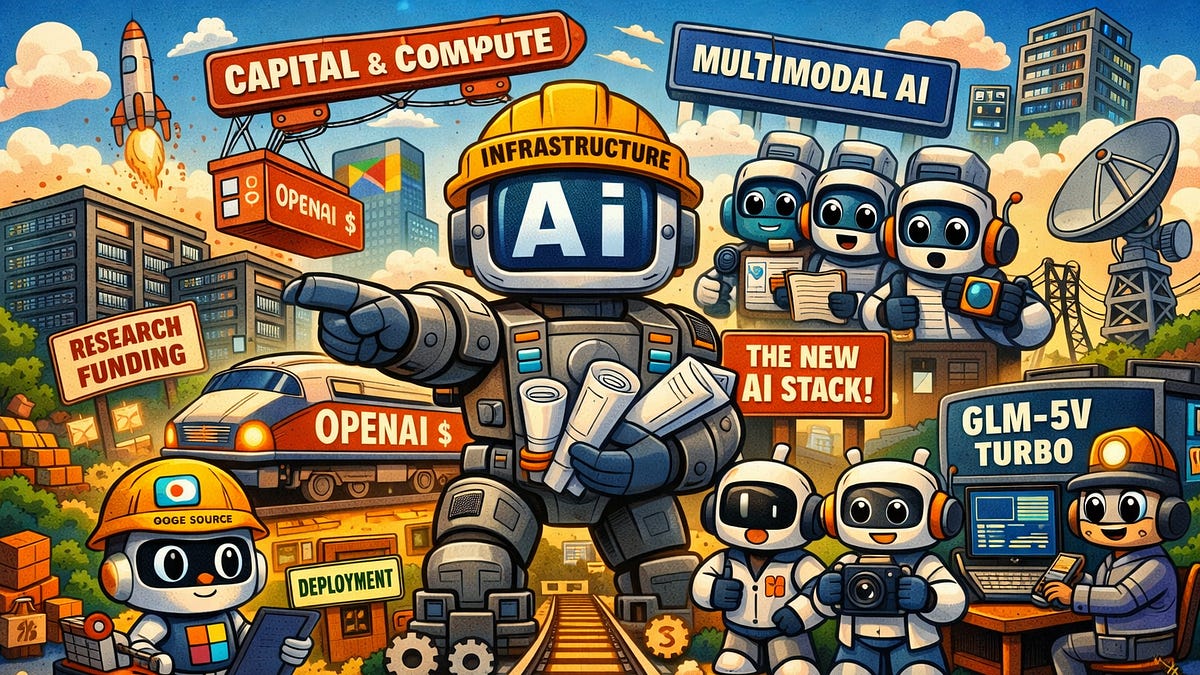
$157 billion valuation. That’s what OpenAI hit with its $6.5 billion funding round last week, a number that should make even the most starry-eyed VC pause and grab a stiff drink.
Look, I’ve been kicking tires in Silicon Valley for two decades, watching unicorns turn into bloated behemoths. And this? This reeks of the moment when AI stops being cute demos and starts looking like the next telecom bust—except with trillion-dollar server farms instead of fiber optic spaghetti.
Who’s Cashing In on the AI Gold Rush?
OpenAI’s haul isn’t just big money. It’s a screaming signal. Every frontier lab’s juggling two marathons now: cranking out smarter models, sure, but also bankrolling the beast—the training clusters guzzling GPUs like they’re going out of style, the inference rigs that make ChatGPT hum, the sales teams hawking enterprise dreams.
This week in AI was not really a product week. It was a market-structure week.
Damn right. The Sequence nailed it there. No killer apps dropped. Instead, we’re seeing the scaffolding: finance, deployment, compression. AI’s shedding its software skin, morphing into infrastructure. Think less App Store sparkle, more national electric grid—brutally capital-intensive, winner-take-most.
And here’s my hot take nobody’s whispering yet: this mirrors the cloud wars of 2006. AWS didn’t win by having the flashiest VMs; they won by owning the pipes everyone else rented. OpenAI’s playing that game, but with brains instead of bytes. Prediction? In five years, the real moats won’t be parameter counts—they’ll be who controls the cheapest, greenest compute at exascale.
Short para. Brutal economics ahead.
Microsoft jumped in with MAI-Transcribe-1, MAI-Voice-1, and MAI-Image-2. Not content playing cloud landlord to OpenAI’s tenant anymore—nope, they’re muscling into the model game itself. Speech that nails accents, voices that sound human(ish), images that pop. These aren’t bolt-ons; they’re the new OS primitives.
Imagine Office 2030: no more clunky menus. Your doc hears you ramble, transcribes flawlessly, generates visuals on the fly, chats back in natural voice. Microsoft’s betting big—vertically integrated, controlling the senses. Smart? Cynical me says yes, because why subsidize rivals when you can own the interfaces?
But wait—Google’s throwing curveballs with Gemma 4. Open weights, efficient as hell, begging developers to tinker. Not the behemoth du jour, but the scrappy toolkit for edge devices, custom fine-tunes, cost-slashing inference.
Why Open Models Like Gemma 4 Could Steal the Show
OpenAI scales up, Microsoft stacks modalities—Google? They’re arming the rebels. And in a market choking on API bills, that’s gold. Usability trumps benchmarks every time. Remember TensorFlow? It didn’t rule the world alone, but it greased every wheel.
GLM-5V Turbo sneaks in from the East, multimodal beast handling screens, files, code—stuff that lets agents actually do things, not just yak. Visual reasoning that navigates UIs? That’s agent era foreplay.
This week’s cacophony—funding fireworks, model volleys—masks the real plot. AI’s graduating from spectacle to substrate. Unavoidable layer under everything. Who wins? Not the smartest lab. The one that wires the world.
Skeptical pause. OpenAI’s flush now, but burn rate’s insane—$7 billion projected losses this year alone (yeah, I dug into the filings). Microsoft’s got Azure cash cow, but antitrust wolves circle. Google pushes open source to dodge monopoly raps, maybe. GLM? China’s play, geopolitics lurking.
Is This AI Boom Headed for a Bust?
History screams yes if you’re building empires on hype. Dot-com 2.0? Nah, worse—AI’s got real juice, but the tab’s $100 billion+ yearly on infra alone. Who foots it long-term? Enterprises grumble at costs; consumers won’t pay $20/month forever.
My bold call: consolidation incoming. Five players max survive the capex apocalypse. Rest get acquired or euthanized. That’s the infrastructure curse—scale or die.
Wrapping the brain scan bit from Meta’s FAIR lab—TRIBE v2, trained on 1,000+ hours of fMRI data, predicts brain zaps from video, audio, language. Cool science, replicates neuro classics. But practical? Neuroscience in silico sounds sci-fi; reality’s still pipettes and grants.
So, veterans like me see the spin: “world models” next week, agent rewrites, Gemma deep-dive. Fine. But strip the buzz—it’s about who monetizes intelligence without imploding.
🧬 Related Insights
- Read more: Evo 2 Hits NVIDIA BioNeMo: 9 Trillion Nucleotides of Genomic Power Unleashed
- Read more: LangSmith Fleet Skills: Codifying the Tribal Knowledge AI Agents Desperately Need
Frequently Asked Questions
What was OpenAI’s latest funding round amount?
$6.5 billion raised, pushing valuation to $157 billion—biggest private tech round ever, fueling their compute arms race.
Why is AI shifting to infrastructure?
Demos are cheap; scaling intelligence costs billions in GPUs and power. Winners will be those who build and rent the grid, not just the apps on top.
Is Gemma 4 better than closed models?
Not raw power, but openness means cheaper runs, customization—key for devs dodging API dependency.