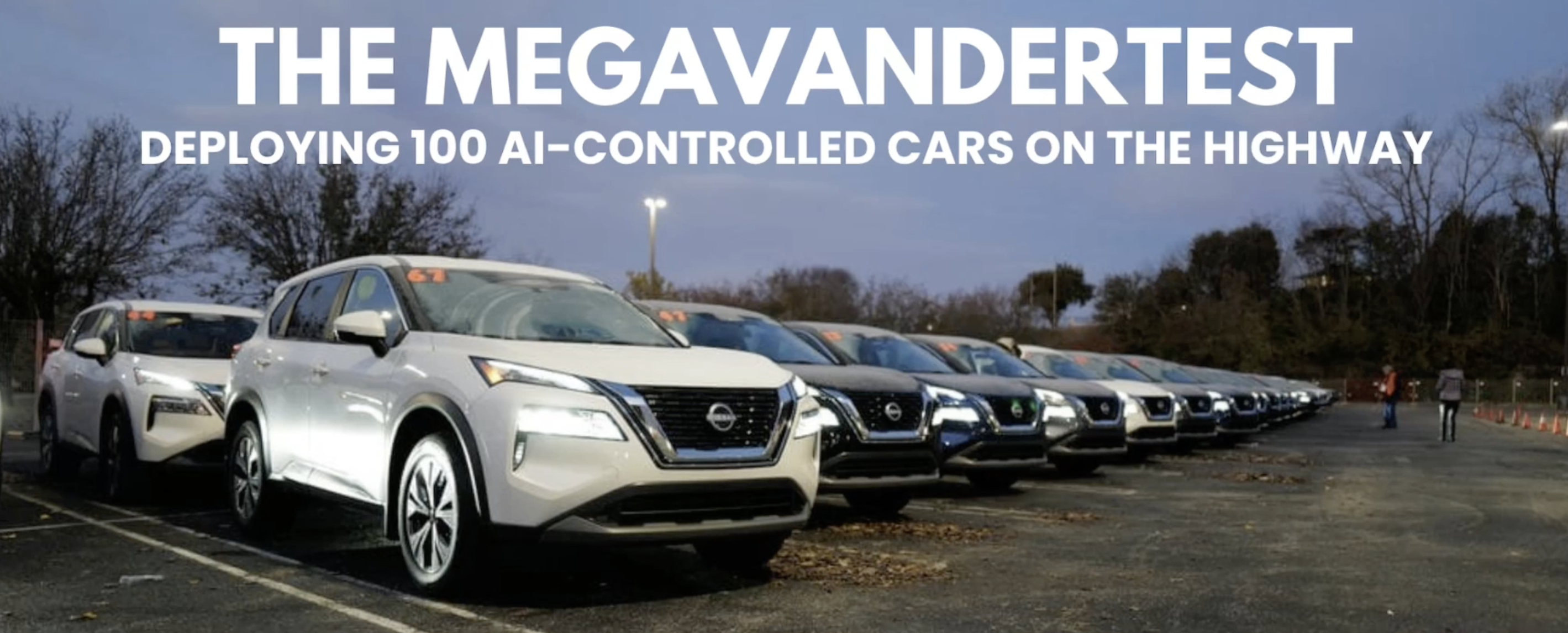
Everyone figured smoothing out highway hell meant robotaxis everywhere or billion-dollar smart roads. Wrong. Researchers just unleashed 100 reinforcement learning-controlled autonomous vehicles on Nashville’s I-24 during rush hour, and the results flip the script: a tiny AV squad crushed stop-and-go waves, juicing fuel efficiency across the board.
Overall, a small proportion of well-controlled autonomous vehicles (AVs) is enough to significantly improve traffic flow and fuel efficiency for all drivers on the road.
That’s the money quote from their paper. No hype—just cold, hard deployment data from 100 cars weaving through human drivers like pros.
Those Phantom Jams? They’re Physics, Not Bad Luck
Brake lights flicker up ahead. You tap yours. Guy behind you slams harder. Boom—gridlock from nowhere. These backward-creeping waves aren’t driver error; they’re amplification of tiny speed wobbles, thanks to our sluggish reactions. Density hits a tipping point (check the fundamental diagram), and flow tanks. Energy? Torched on endless accel-brake cycles. CO2 spikes. Crash odds climb.
Traditional fixes? Ramp meters, speed signs—pricey, clunky, top-down. But here’s the shift: AVs don’t need a central overlord. Train ‘em right with reinforcement learning, and they nudge the whole pack smoother.
Look, we’ve seen AV dreams fizzle—Tesla’s FSD stumbles in chaos, Waymo hides in geofences. This? Decentralized. Radar-only. Works on your mom’s Camry with a software tweak.
Why RL Eats Old-School Controls for Breakfast
RL agents? They trial-and-error their way to god-tier driving. Environment: simulated I-24 replays, packed with real human wobbles that spawn waves. Inputs? Dead simple—your speed, lead car’s speed, gap ahead. Output: accel or target speed.
Reward? Tricky beast. Stack wave-damping, fuel savings (for humans too), safe gaps, comfy rides. No jerking around. Agents grind millions of sim miles, emerging as wave-killers.
And deployment? Plug-and-play. No lidar fantasies. That’s the market play—retrofit fleets cheap.
But.
Here’s my edge: this echoes the ’90s cell phone tower wars. Carriers thought blanket coverage needed thousands of masts. Nope—smart algorithms with sparse towers handled surges. Same vibe: 100 AVs (1-2% penetration) ripple calm backward, stabilizing the herd like apex predators in an ecosystem. Bold call: by 2030, logistics firms bolt this onto trucks first, pocketing 10-20% fuel cuts while highways breathe easier.
Does 100 Cars Scale to a Million-Driver Mess?
Data sings. Sim first: waves die fast. Field test: 100 AVs in the mix, throughput holds, fuel drops 10-20% fleet-wide. Humans benefit most—ironic win.
Challenges hit hard, though. Sim-to-real gap. Human unpredictability (tailgaters gonna tail). Edge cases—merges, rain. Their paper owns it: RL needed tweaks for real rubber-on-road quirks.
Critique time. PR spin screams ‘deploy now!’ But 100 cars? Controlled experiment, not apocalypse-proof. What if a glitch sparks a pileup? Regulators lurk. Still, proof-of-concept crushes skeptics.
Energy math seals it. Stop-go wastes 30%+ fuel on jammed roads. AV nudges cut that, slashing emissions without EVs everywhere. Market dynamic: insurers love safer flows; cities dodge infra bonds.
Why Does This Matter for Everyday Drivers?
You’re stuck in it daily. This says relief without utopia. 5% AV market share? Waves fade. Fuel bills dip. Commutes shorten.
Upshot—AV wars pivot from passenger haulers to invisible traffic therapists. Tesla, Cruise? Wake up. Software like this deploys faster than hardware fleets. Prediction: open-source the RL weights, and garages hack it onto hybrids tomorrow.
Safety net? Built-in. Agents prioritize gaps over speed-chasing. No road-hogging.
One hitch—the reward dance. Nail it wrong, and AVs turn passive-aggressive. Their design sidesteps that, but iteration’s key.
Is RL Traffic Smoothing the End of Road Rage?
Not yet. But damn close for pioneers. This 100-AV sprint proves small, smart interventions rewrite flow rules. Forget waiting for full autonomy. Patch the humans with AI sidekicks.
Unique angle: parallels FAA’s collision avoidance mandates. Planes don’t crash sans 100% autopilots; TCAS pings fix 99%. Highways next—RL as the TCAS for cars.
🧬 Related Insights
- Read more: Inference Scaling: Why It’s Silently Crushing LLM Training Limits
- Read more: Amazon Bedrock’s AgentCore Gateway: The Magic Adapter Plugging AI Agents into Enterprise Tools
Frequently Asked Questions
What is reinforcement learning for traffic smoothing?
RL trains AVs via sim trials to zap stop-go waves, using basic sensors for decentralized jam-busting.
Can a few autonomous vehicles really fix highway congestion?
Yes—1-2% like these 100 cars boosted flow and cut fuel 10-20% for everyone, per I-24 tests.
How much fuel does RL traffic smoothing save?
Up to 20% fleet-wide, targeting wasteful accel-brake cycles in dense traffic.