What if scaling AI indefinitely demands not bigger chips, but orbiting power plants tapping endless sunlight?
It’s a question lurking under every hype-filled forecast about the next model. And yeah, scaling AI is wildly underestimated—not because of compute shortages, but energy. Pure, unfiltered juice.
Look. We’ve got hyperscalers dumping trillions into datacenters that guzzle power like 747s on takeoff. But grids? They’re wheezing. Coal plants rebooting, natural gas spiking, nuclear promises decades away.
This weekend’s frenzy over Elon Musk’s latest transcript hammered it home. SpaceX isn’t just rockets; it’s the unlock for AI’s bottleneck.
When SpaceX goes public in an IPO later in 2026 (maybe as early as June), the promise of the future isn’t just about datacenters, it’s about harnessing more of the Sun’s energy to fuel AI at a scale that isn’t currently possible with the U.S. energy grid constraints.
That’s the catalyst. Boom.
Why Does Scaling AI Demand a Space Rethink?
Short answer: math. Training GPT-5 equivalents? We’re talking gigawatts. A single frontier model chews through a small city’s electricity yearly. Multiply by dozens—OpenAI, Anthropic, xAI—and grids buckle.
But here’s the deeper why. Current datacenters hit 50-60% efficiency tops, bleeding heat and waste. Cooling alone? A nightmare. Throw in capex ballooning to $1 trillion by 2027, and it’s clear: terrestrial fixes patch, don’t scale.
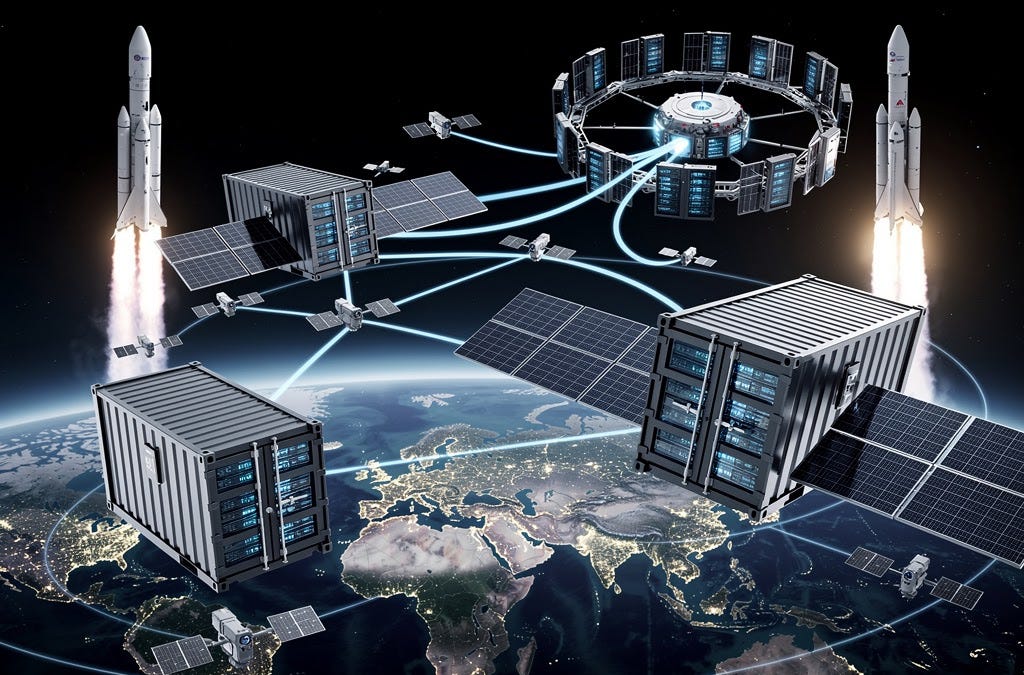
Enter space. Zero atmosphere means perfect radiative cooling—no fans, no water. Sunlight 24/7, no clouds, no night. Beam power via microwaves or lasers to Earth-orbit hybrids. Suddenly, energy’s not a cost; it’s abundant.
And manufacturing? Lunar regolith for silicon wafers, zero-g crystals purer than anything Earth spits out. Rockets? Reusable Falcons slashing launch to pennies per kilo.
Skeptical? Fair. But 75 years post-Clarke and Asimov dreaming orbital futures, tech’s ripe. Starship prototypes stacking, orbital refueling tested. It’s not sci-fi; it’s engineering.
One punchy parallel my dives uncovered: think 19th-century railroads. They didn’t just move goods—they redefined industrial scale, pulling coal and iron from frontiers. SpaceX’s stack? Railroads for compute, mining solar from orbit, delivering AI supremacy. That’s the unique shift: not incremental chips, but infrastructural rails to infinity.
Is SpaceX’s IPO the Trigger for Orbital AI?
Bet on it. Musk’s vision merges xAI under SpaceX umbrella—subsidiary compute beast. Post-IPO cash flood? Billions for Starlink 2.0, but twisted orbital: datacenters humming in vacuum.
Imagine: OpenAI hyperscaling on Azure, Anthropic on AWS, but xAI? Planetary cloud from LEO. Absurd edge if compute-is-king holds (and it will, till architectures flip).
Critique the spin, though. Musk’s timelines? Famously elastic—Starship full reuse was ‘22, now ‘25-ish. Yet evidence mounts: 2024’s 100+ launches, propellant plants scaling. By late 2020s, lunar bases normative? My bold call: first orbital AI pod live-tested 2028, production 2030. Hype? Sure. But underestimated? Absolutely.
Dirty datacenters today—gas-gulping monsters—accelerate this. China hoarding semis, US grids strained; space sidesteps geopolitics, taps universal sun.
Pioneering feels lonely. No 2026 blueprints exist. But watch: VCs sniffing, Blue Origin lurking, even hyperscalers whispering orbital pilots.
How Lunar Factories Flip the AI Supply Chain
Strip it bare. Semis need ultrapure silicon. Earth? Quakes, dust, gravity warping crystals. Moon? Endless regolith, robotic fabs in vacuum. Zero-g assembly for cooling-efficient chips—think blades slicing airless heat away.
Energy? Vast solar arrays, no transmission loss. Mine helium-3 for fusion kickers (longer-term wild card). Launch costs plummet to $10/kg—datacenter pallets orbiting weekly.
Why now? AI’s exponentiating flops demand it. GPT-4? Petaflops. GPT-whatever-next? Exa, zetta. Grids can’t; space can.
Risks? Radiation hardening, latency (LEO mitigates to ms), debris. Solvable—error-correcting codes evolve, Starlink proves low-latency constellations.
Here’s the thing—and my contrarian nudge: this isn’t Musk monopoly. Nation-states eye it. China’s Tiangong, India’s Gaganyaan. AI arms race goes cosmic. US lags? Compute crown slips.
Trans-orbital manufacturing. Say it slow. It’s the architectural pivot: AI not earthbound, but solar-systemic.
So, civilization-ready? Rockets multiply, but politics, regs? Hurdles. Yet energy crisis forces hands. Scale AI or stall.
🧬 Related Insights
- Read more: Tech’s AI Gold Rush: Jobs Axed, Payoff Elusive
- Read more: Voice AI’s Ambient Computing Surge: 2027’s Real Breakthrough or Hype?
Frequently Asked Questions
What are orbital datacenters for AI scaling?
Vacuum-based servers in low Earth orbit, cooled by space, powered by constant solar—no earthly grid limits, endless scaling potential.
Will SpaceX IPO fund orbital AI infrastructure?
Likely—trillions needed for AI compute; space solar unlocks it cheaper than trillion-dollar terrestrial capex. Musk’s xAI merger hints yes.
Can space really solve AI’s energy crisis?
Yes, via 24/7 sun, perfect cooling, lunar fabs. First tests late 2020s; full scale 2030s if launches accelerate.