GPU selection is one of the most consequential decisions in any AI infrastructure strategy. NVIDIA's A100 and H100 represent two generations of data center GPUs purpose-built for AI workloads, and understanding their differences is critical for making cost-effective procurement and deployment decisions.
This comparison examines both GPUs across the dimensions that matter most for AI practitioners: raw performance, memory architecture, cost efficiency, and workload suitability.
Architectural Overview
NVIDIA A100
Released in 2020, the A100 is based on the Ampere architecture and represented a major leap in AI compute capability. It was the first GPU to introduce third-generation Tensor Cores with support for the TF32 precision format, which simplified the transition from FP32 to mixed-precision training without code changes.
The A100 is available in 40GB and 80GB HBM2e memory configurations, with the 80GB variant becoming the standard for large model training. It supports PCIe Gen4 and the proprietary NVLink interconnect for multi-GPU communication.
NVIDIA H100
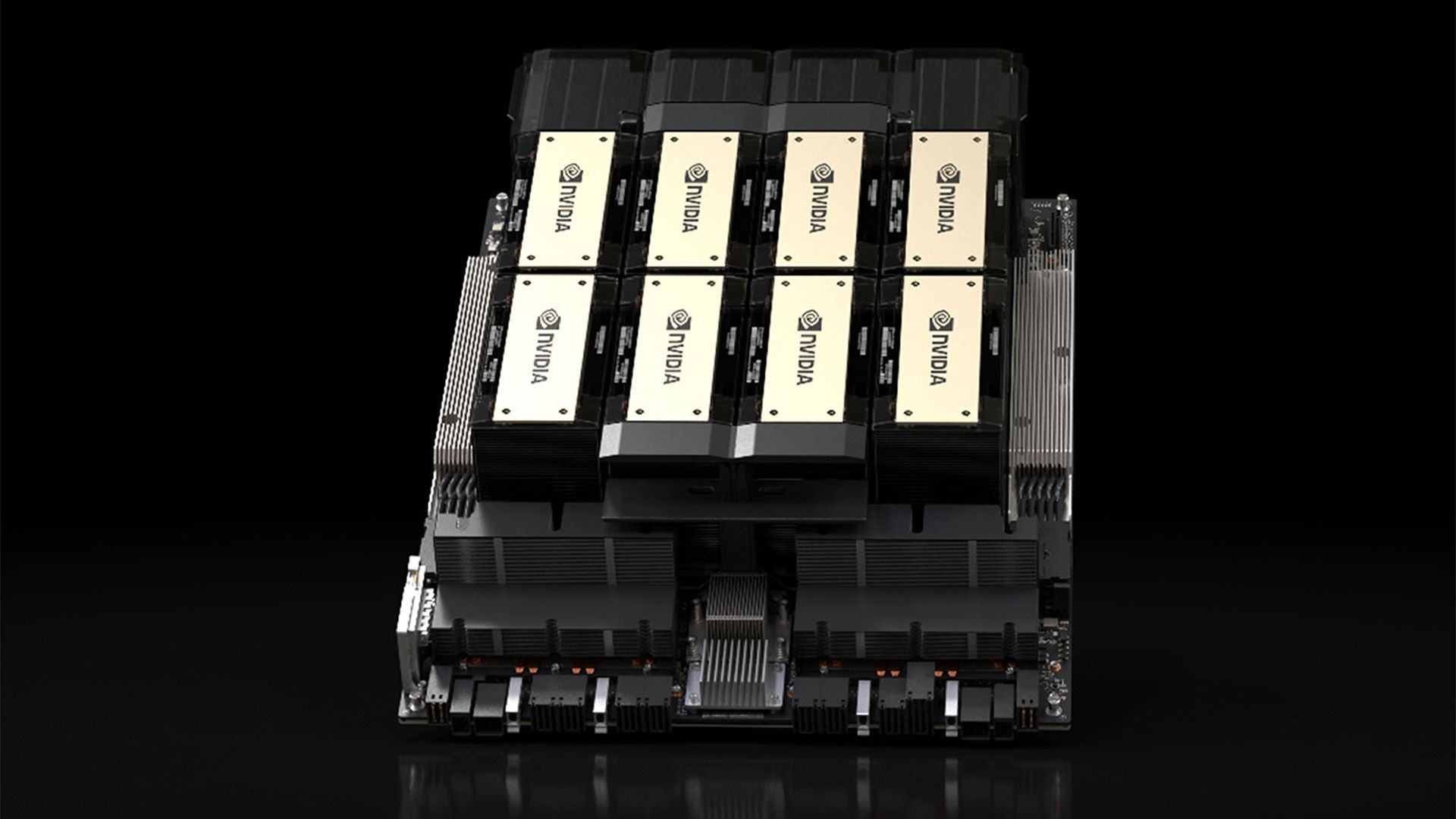
Released in 2022, the H100 is based on the Hopper architecture and introduced several innovations specifically targeting large language model workloads. Its fourth-generation Tensor Cores added native support for FP8 precision, and it introduced the Transformer Engine, hardware-level support for dynamically managing precision during transformer computations.
The H100 comes in SXM5 and PCIe Gen5 variants, with 80GB of HBM3 memory offering significantly higher bandwidth than the A100's HBM2e. It also introduces NVLink 4.0 with NVSwitch, providing 900 GB/s of bidirectional bandwidth between GPUs.
Performance Comparison
Training Performance
The H100 delivers substantial training speedups over the A100 across all precision levels:
- FP32 training: The H100 offers approximately 3x the FP32 FLOPS of the A100 (67 TFLOPS vs 19.5 TFLOPS on the SXM variants).
- FP16/BF16 training: The H100 delivers roughly 2x the performance at mixed precision, with up to 990 TFLOPS with sparsity compared to the A100's 624 TFLOPS.
- FP8 training: The H100's native FP8 support pushes theoretical throughput to nearly 2,000 TFLOPS with sparsity, a capability the A100 lacks entirely. For transformer-heavy workloads, the Transformer Engine can dynamically switch between FP8 and FP16 within individual layers to maintain accuracy while maximizing throughput.
In practical large model training benchmarks (MLPerf), the H100 typically achieves 2.5x to 3x the throughput of the A100 for GPT-3 class model training, depending on cluster size and configuration.
Inference Performance
For inference workloads, the performance gap is similarly significant:
- The H100's FP8 inference capabilities are particularly impactful, enabling faster execution with lower memory requirements compared to FP16 inference on A100.
- For LLM inference specifically, the H100's higher memory bandwidth (3.35 TB/s vs 2 TB/s for the 80GB models) is often the deciding factor, as autoregressive text generation is typically memory-bandwidth-bound rather than compute-bound.
- Batch inference throughput on the H100 can be 3-4x higher for transformer models compared to the A100, depending on model size and batch configuration.
Memory Architecture
Both GPUs offer 80GB in their top configurations, but the underlying memory technology differs substantially:
- A100 80GB: HBM2e memory with 2 TB/s bandwidth. This was considered excellent at launch and remains capable for many workloads.
- H100 80GB: HBM3 memory with 3.35 TB/s bandwidth, a 67% improvement. This higher bandwidth is critical for LLM inference, where the speed at which model weights can be read from memory directly determines tokens-per-second throughput.
For models that fit within 80GB, the H100's bandwidth advantage translates directly into faster inference. For larger models requiring multi-GPU deployment, the H100's NVLink 4.0 (900 GB/s bidirectional) offers a significant advantage over the A100's NVLink 3.0 (600 GB/s) for cross-GPU communication during distributed training.
Cost Analysis
The cost picture is nuanced and depends heavily on whether you are buying, renting, or using cloud instances:
Capital Expenditure
H100 SXM5 GPUs carry list prices significantly higher than A100 SXM variants. However, the price premium has been moderating as supply has improved. When evaluating purchase prices, the relevant metric is cost per unit of useful compute, not the sticker price per GPU. On a per-TFLOPS basis, the H100 often offers better value despite the higher per-unit cost.
Cloud Instance Pricing
Major cloud providers offer both A100 and H100 instances. H100 instances typically cost 50-100% more per hour than equivalent A100 instances. However, if your workload runs 2.5x faster on H100, the total cost for a training run is actually lower on H100 despite the higher hourly rate.
The calculation shifts for inference workloads with variable demand. If you are paying for instances that sit partially idle, the cheaper A100 instances may offer better economics.
Total Cost of Ownership
Beyond GPU costs, consider:
- Power consumption: The H100 SXM draws 700W compared to the A100 SXM's 400W. Higher performance per watt, but higher absolute power draw.
- Cooling infrastructure: H100s in SXM form factor increasingly require liquid cooling, which adds infrastructure costs compared to air-cooled A100 deployments.
- Time-to-result: For competitive AI development, the time savings from faster training can have significant business value beyond raw compute economics.
Workload-Specific Recommendations
Large Model Training (Billions of Parameters)
H100 is the clear choice. The combination of FP8 support, Transformer Engine, higher memory bandwidth, and faster NVLink makes the H100 substantially more efficient for training large transformer models. The speedup typically justifies the cost premium.
Inference at Scale
H100 preferred, but A100 remains competitive. For high-throughput LLM serving, the H100's memory bandwidth advantage is decisive. But for smaller models or lower-traffic deployments, A100 instances offer a compelling price-performance ratio, particularly as A100 spot prices continue to decrease.
Research and Experimentation
A100 often sufficient. For smaller-scale experiments, model prototyping, and academic research, A100s provide excellent capability at lower cost. Many research breakthroughs continue to be developed on A100 clusters.
Fine-Tuning Existing Models
Either GPU works well. Parameter-efficient fine-tuning methods like LoRA have modest compute requirements relative to pre-training. A100s are typically sufficient, and the H100's advantages are less pronounced for these shorter, smaller-scale training runs.
Looking Ahead
NVIDIA's B100 and B200 GPUs based on the Blackwell architecture are entering the market, further shifting the performance landscape. The A100 is moving into the value tier, and the H100 is becoming the mainstream choice for serious AI workloads.
For organizations making infrastructure decisions today, the key question is not which GPU is faster in absolute terms, but which delivers the best return on investment for your specific workload profile, scale requirements, and deployment timeline. Both GPUs remain highly capable, and the right choice depends on careful analysis of your particular circumstances.