Imagine you’re a dev at a Fortune 500, knee-deep in Naftiko Framework alerts because your AI agent just torched the budget calling some forgotten SaaS API a thousand times. That’s real people today — not VCs high-fiving over ‘agentic AI.’
This alpha drop from Naftiko hits at the perfect storm: enterprises drowning in 1,295 SaaS apps and 14,000 internal APIs, with AI ones exploding 807% year-over-year. Agents gobble it all, ungoverned. Boom — runaway costs, security nightmares.
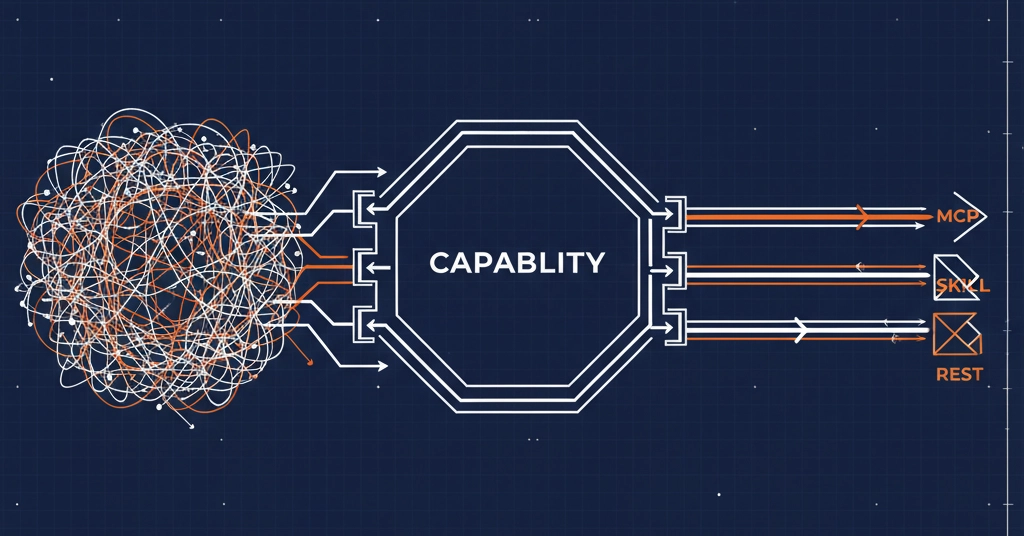
Naftiko says, hold up. Treat those APIs as ‘strategic inventory,’ not debt. Package ‘em as YAML-declared ‘capabilities’ that agents can sip safely via MCP, Skills, or REST. Apache 2.0, Java-based, declarative. No code-gen, no drift — the YAML is the runtime.
Does Naftiko Framework Actually Solve API Sprawl?
Look, I’ve seen this movie. Back in 2005, SOA promised the same: govern your services, reuse everywhere. Vendors hawked ESBs like candy. Enterprises bought in, then watched integration hell mutate — not vanish. Naftiko’s spec-driven integration (SDI) feels familiar, but sharper for AI. Specs as executable truth. Lint ‘em, refine ‘em live. Bidirectional feedback from prod.
Here’s their pitch, straight up:
The spec is the integration. Not a description of it, not documentation written after the fact — the actual runnable artifact. The Naftiko Engine reads this YAML at runtime and serves it as a live MCP server.
Smart. No more ‘docs aging like bananas.’ But YAML fatigue is real. Devs already juggle Kubernetes, Helm, OpenAPI specs. Another declarative layer? Fine if it glues APIs to agents without custom code.
Take their Shipyard example. Consumes a registry API, exposes MCP tools. call: registry.list-ships wires it. Output params reshape payloads — camelCase imoNumber, drop junk. Agent sees clean schema, not raw mess.
Four abstraction levels: raw HTTP forwarding up to functional clients. No rip-and-replace. Meets APIs where they sprawl.
But here’s my unique gripe — and prediction: Naftiko nails the tech, ignores the politics. Who owns the ‘capability’ YAML? The API team? Agent builders? Compliance? In my 20 years, that’s where tools die. Enterprises won’t standardize on open-source YAML without a dictator — or a big vendor wrapper. Watch: some iPaaS giant forks this in 18 months, slaps a UI on, charges enterprise bucks.
Why AI Agents Need This Yesterday
Agents aren’t chatbots. They’re loose cannons phoning every endpoint. MCP sprawl on API sprawl? You’re rebuilding chaos, now with LLM loops.
Symptoms scream familiarity:
-
Prototypes die pre-prod.
-
Security bottlenecks everything.
-
Token costs vanish into black holes.
Naftiko’s capability unit shifts that. YAML declares consumes/exposes. Engine spins up governed servers. Context engineering — right data, shaped right — becomes spec evolution, not runtime hacks.
And — plot twist — agents could propose spec tweaks. Humans validate. That’s the AI integration dream, if it lands.
Skeptical? Yeah. Java? Solid, but verbose for quick hacks. Alpha 1 means rough edges. Shipyard tutorial’s cute, but scale to 14k APIs? Governance tooling’s embryonic.
Still, props. Better than ad-hoc MCP servers or aging gateways.
The Money Trail: Who’s Cashing In?
Always ask: who profits? Naftiko’s open-source play screams ‘platform bettor.’ Shipyard.dev folks? Betting devs flock, then monetize hosted engine, linting SaaS, or certs.
Enterprises? They’ll love cost predictability if it sticks. But history says: free tools gather dust unless they solve org charts.
My bold call: if Naftiko hits 1k GitHub stars in six months and lands one Fortune 100 pilot, it’s legit. Otherwise, fades like Apigee hype circa 2012.
🧬 Related Insights
- Read more: Telegram’s TON Wallet: Crypto Payments Hiding in Plain Sight for Billions
- Read more: Claude Just Reverse-Engineered a Gym App’s API — And Built the Export Tool You Need
Frequently Asked Questions
What is Naftiko Framework and how does it work?
Naftiko’s an open-source Java framework turning API sprawl into governed YAML ‘capabilities’ for AI agents. YAML specs declare upstream APIs and agent-exposed surfaces (MCP/REST); engine runs ‘em live, no code-gen.
Will Naftiko replace API gateways or iPaaS?
Nah, complements ‘em. Focuses on AI-agent integrations with spec-driven governance, not full traffic mgmt. Think lightweight layer for agent context.
Is Naftiko Framework production-ready?
Alpha 1? Not yet — prototypes and early builds. Needs maturity for 14k-API beasts, but Apache license invites community hardening.