AI’s infrastructure moment has arrived.
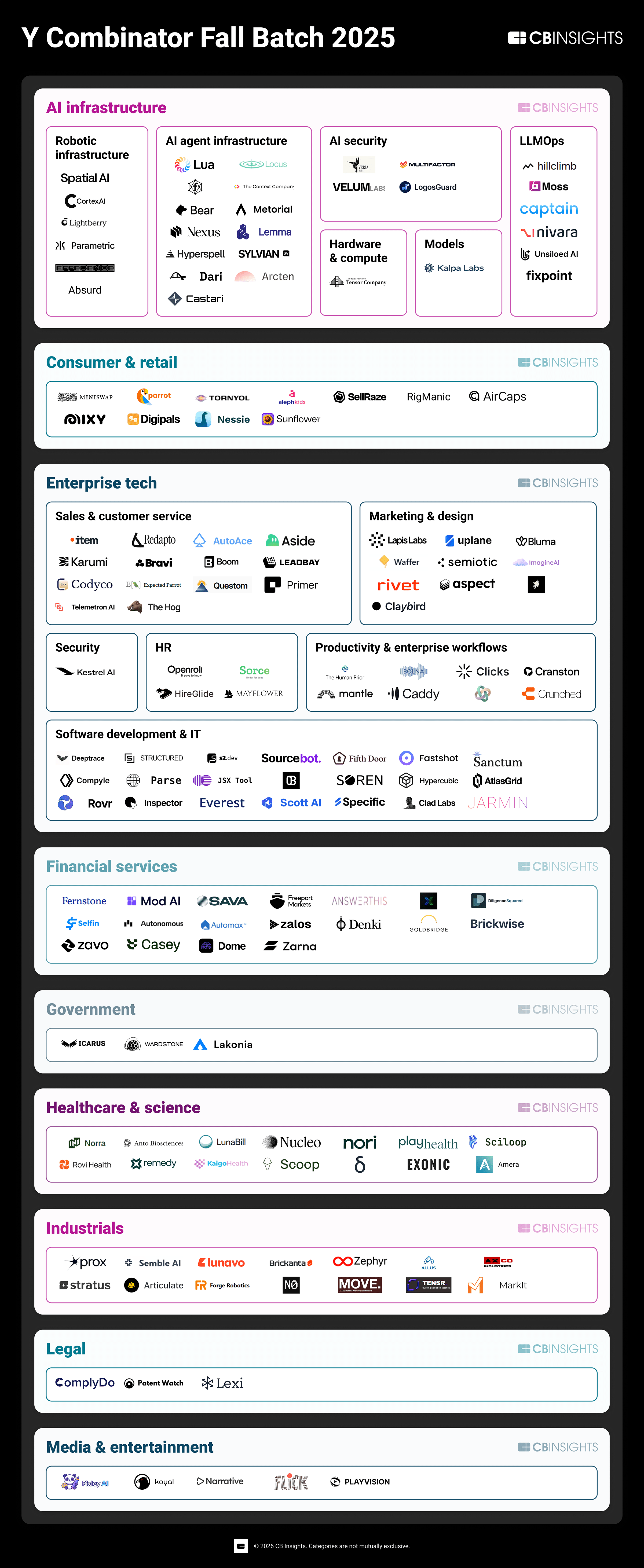
Y Combinator’s Fall 2025 batch—155 companies strong—lays it bare. No more slapping LLMs on apps for a quick demo. These founders, backed by YC’s sharp-eyed curators, zero in on the gritty underbelly: deploying agents that don’t flake out, robots that learn from real scrapes, workflows that own the endgame. It’s a map to where venture dollars flow next, and yeah, it’s seismic.
Look, early AI pilots crashed hard against reality—memory lapses, integration hell, data droughts for physical systems. Founders saw it firsthand. Now? They’re welding the fixes. CB Insights sliced this cohort into 19 categories, and the signal screams infrastructure.
Why Does YC’s Fall 2025 Batch Scream ‘Infrastructure’?
Because 92% weave AI into their core—no outliers hawking chatbots as saviors. AI’s table stakes. The differentiator? Stacks that make agents production-ready. Take the 13 startups hammering agent infrastructure: Hyperspell’s memory systems (agents forgetting less), Metorial’s integration platforms, Castari’s dev tools, The Context Company’s observability. Locus even bolts on payments.
“AI agent pilots are exposing infrastructure gaps, driving demand for a production-ready tech stack.”
That’s straight from the original analysis—spot on. Enterprises won’t juggle 20 tools; they’ll consolidate around unified platforms. Watch for M&A waves here, the kind that minted Snowflake from data chaos.
Short version: agents scale or die.
But here’s my angle—the one they gloss over. This mirrors the cloud wars of 2010. Back then, everyone built apps; value accrued to AWS et al. for the pipes. AI’s replaying it, but faster, messier. Physical AI amps the stakes.
How Physical AI Exposes Training’s Hidden Empire
Software agents guzzle text data like it’s free. Robots? Nah. They crave physics simulations, rare real-world footage—costly, scarce stuff. YC’s batch nails this: Parametric’s reinforcement learning models, Spatial AI and Cortex AI crafting datasets and sims.
Control the training stack, control autonomy. It’s not sexy PR spin about ‘general intelligence’—it’s owning the data flywheel. Partnerships brew: model devs linking arms with sim providers. Deployments explode, and suddenly, these YC kids aren’t just tinkering.
And fintech? Agents aren’t assisting; they’re owning workflows.
Six of 16 fintech plays go full agentic. Zarna and DiligenceSquared automate diligence for private markets—sourcing to close. Zalos plugs into ERPs for invoicing drudgery. Manual hell becomes autonomous end-to-end. Humans? Oversight only.
Coding tools splinter too. 21 dev startups, but no generalists. JSX Tool for browser React, Fifth Door for games, Scott AI for spec design. Core code gen’s commoditized (hello, Cursor, GitHub Copilot). Winners niche down, hitting lifecycle gaps incumbents ignore.
Is This Batch a Crystal Ball for AI’s Future?
Damn right. YC’s a leading indicator—strategy teams already mining it for threats, partners, buys. But dig deeper: this cohort predicts consolidation. Agent infra? Few platforms win. Training data? Moats form quick. Fintech agents? Banks acquire to skip the build.
My bold call—and it’s mine: by 2027, we’ll see an ‘AI Stack Inc.’ emerge, bundling observability, memory, sims into one beast. Echoes of early internet’s Akamai for content delivery. Hype said bandwidth was it; reality crowned the delivery kings. AI’s delivery kings rise now.
Enterprise agents falter without memory—Hyperspell fixes that, persisting context across sessions. Observability? The Context Company traces agent decisions, debugging black boxes. It’s plumbing, but the kind that leaks billions if ignored.
Robotics training’s brutal. Simulations must mimic chaos—bumps, slips, weird lighting. Cortex AI generates that synthetic gold. Parametric trains on it. Result? Bots generalizing beyond labs, hitting warehouses, streets.
Fintech’s shift thrills me most. Agents owning diligence? Private equity’s wet dream. No more juniors drowning in PDFs. Zarna’s AI associates crank it out, human-free.
Dev tools fragment smartly. Why wrestle generalists when JSX nails React in-browser? Niche owns the tail of the workflow.
Skeptical? Fair. YC batches hype themselves. But 92% AI tilt isn’t fluff—it’s response to pilots bombing. Early OpenAI demos wowed; production humbled. Founders adapt.
Verticals deepen too. Health, legal—agents everywhere, but infra glues ‘em.
What Happens When AI Infra Consolidates?
Winners tower. Losers? Acquired or dust. Enterprises demand one-stop: deploy, monitor, scale. Locus adds payments—smart, closing loops.
Physical AI’s data moat rivals oil. Who’s got the rigs? These YC upstarts.
Workflow ownership flips power. Fintech agents don’t assist; they run the show.
Coding niches bloom as generals saturate.
This batch? Roadmap. Ignore at peril.
🧬 Related Insights
- Read more: AI SLOP Detector v3.1: The Tool That Busted Its Own Scoring Flaws
- Read more: RuleForge: The AI That Eats Board Game Rulebooks and Spits Out Dev Bundles
Frequently Asked Questions
What startups are building AI agent infrastructure in YC Fall 2025?
Thirteen key ones: Hyperspell (memory), Metorial (integration), Castari (dev platforms), The Context Company (observability), Locus (payments), and more tackling scaling pains.
How is physical AI training different in this batch?
Focus on sims and real-world data via Parametric, Spatial AI, Cortex AI—enabling robots to adapt beyond labs, unlike text-fed software agents.
Will YC Fall 2025 predict AI acquisitions?
Yes—infra plays like agent tools and training stacks scream buyout targets for Big Tech hungry for production-ready AI.