Everyone figured LLMs would swallow the world’s knowledge and spit out perfect answers. Right? Wrong. Turns out, these models – trained on yesterday’s data – hallucinate like drunk uncles at a wedding, confidently spewing nonsense about current events or your company’s internal wiki.
RAG changes everything. Retrieval-Augmented Generation isn’t some buzzword salad; it’s the plumbing that makes AI apps usable. Without it, your fancy chatbot’s just a pricey parrot.
I’ve seen this movie before. Back in the early 2000s, search engines were keyword vomit until Google bolted on PageRank and result snippets – suddenly, relevance. RAG’s that for LLMs: fetch first, generate second. No retraining. No fine-tuning. Just shove the right docs into the prompt at runtime.
Why Were We Even Surprised?
Look, Silicon Valley hyped LLMs as omniscient brains. ‘Ask anything!’ they said. But cutoffs kill ‘em – post-2023 events? Fabricated. Private data? Nope. Paste it in? Token limits laugh at you.
Here’s a gem from the insiders:
LLMs do not know things in the traditional sense. They generate text by predicting what is most likely to come next based on patterns in training data. When the correct information is missing, the model may still produce a confident-sounding but incorrect answer. That behavior is known as a hallucination.
Spot on. That’s why RAG exists. Retrieve relevant chunks, augment the prompt, generate grounded response. Simple. Effective.
But here’s my unique take, one you won’t find in the PR decks: this is why vector database startups like Pinecone and Weaviate are printing money. LLMs are the shiny frontend; RAG’s the backend cash cow. I’ve covered enough database wars to know – the plumbing always wins. Bold prediction? By 2026, RAG infra will be a $10B market, while LLM hosts scramble for scraps.
How RAG Actually Works (Without the Diagrams)
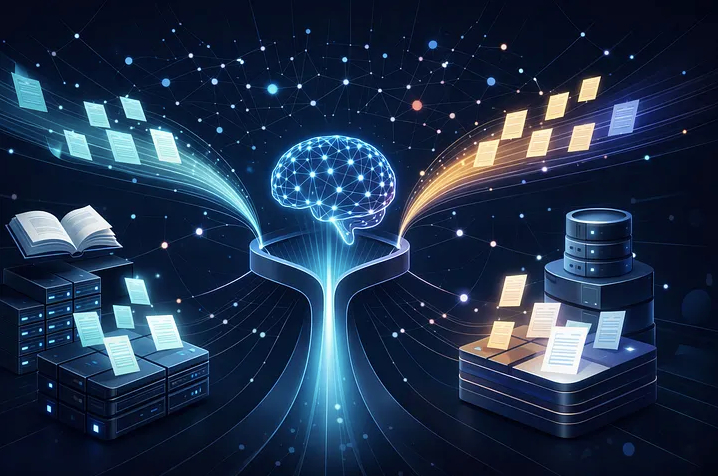
Data intake. Chunk it up – don’t feed the whole novel. Embed into vectors. Shove in a vector DB. User queries? Embed that too. Similarity search pulls top matches. Boom – context to LLM.
It’s efficient. Index once, query fast. No repeated token burns on massive docs.
Take a company wiki bot. ‘Password reset?’ Without RAG: generic BS. With it: exact policy yanked from the DB, prompt fattened, accurate answer. Hallucinations plummet. Noise? Gone – just the good chunks.
Skeptical me asks: does it fix everything? Nah. Bad embeddings? Garbage in, garbage out. Chunking wrong? Misses context. But damn, it’s better than vanilla LLMs.
Is RAG Hype or Hero?
Pros: Cuts hallucinations. Scales to enterprise data. Cheap long-term.
Cons? Production’s a beast – hybrid search, reranking, agentic loops. And those vector DBs? Vendor lock-in city.
Everyone expected plug-and-play AI. RAG says, ‘Build a pipeline first.’ Changes the game for devs – less magic, more engineering. Who’s making money? Not OpenAI. It’s the Pinecones, the ChromaDB open-source forks, the embedding API hustlers.
I’ve been around since Web 2.0. Remember when NoSQL was gonna kill relational DBs? Same vibe. RAG’s essential now, but it’ll evolve – multi-modal, real-time updates. Don’t bet the farm.
Why Does This Matter for Developers?
If you’re building AI apps – chatbots, search, agents – RAG’s your baseline. Skip it? Your users bail on bad answers.
Start small: LlamaIndex or LangChain wrappers. Pick a vector store – PGVector if you’re cheap, Pinecone if you want managed. Embed with OpenAI or Hugging Face.
But watch costs. Queries stack up, embeddings ain’t free. And latency? Optimize or die.
Cynical truth: this isn’t ‘democratizing AI.’ It’s shifting spend from inference to retrieval infra. VCs love it.
Paragraph. Just one sentence: RAG works.
Now, deeper: enterprises hoard docs in SharePoint hellholes. RAG cracks ‘em open. Internal tools? Suddenly viable. But security – who audits retrieved chunks? Leaks waiting to happen.
And the PR spin? ‘Grounded responses!’ Sure, until your vector DB hiccups.
Who’s Actually Profiting from RAG?
Follow the money. LLM providers? Commoditized. Winners: vector DBs (valuations soaring), embedding models (voyage.ai, etc.), orchestration tools (Haystack, LlamaIndex).
My hot take – parallel to Elasticsearch’s hayday post-Google search. Lucene under the hood, millions on top. RAG’s FAISS/Pinecone moment.
Dev tip: self-host where you can. Don’t feed the beasts.
🧬 Related Insights
- Read more: The AI You Already Use Might Be the Perfect One—Here’s Why
- Read more: Playwright Meets Axe Core: The QA Shift That Could Slash Web Accessibility Lawsuits
Frequently Asked Questions
What is RAG in AI apps?
Retrieval-Augmented Generation: fetch relevant docs via embeddings, stuff into LLM prompt. Grounds answers in real data.
How does RAG fix LLM hallucinations?
By giving the model actual context at query time, not relying on fuzzy training recall. Reduces confident BS by 70-90% in benchmarks.
Does RAG require retraining LLMs?
Nope. Zero. Just index your data once, retrieve on the fly.