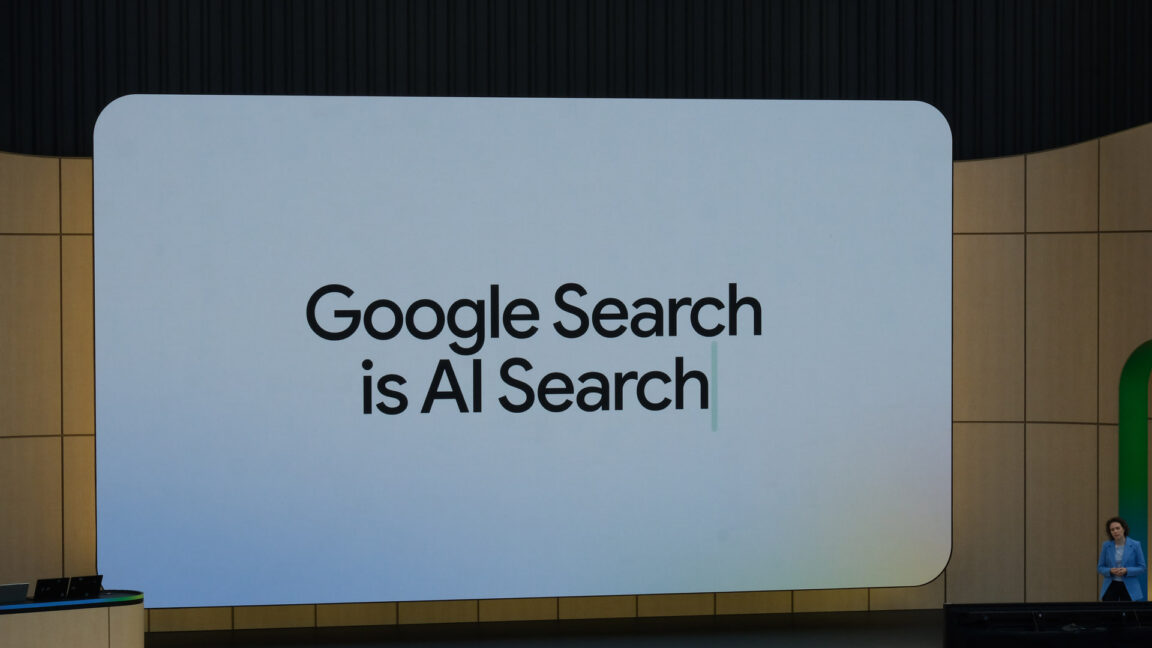
So, Google’s decided that search is now AI search. Riveting. It’s not exactly a revelation after last year’s pivot and this year’s I/O fanfare. Liz Reid, the search VP, said it herself, and honestly, who’s going to argue with the overlords of information when they’ve got the whole internet in a chokehold? They’re pushing this thing hard, and all the internal numbers, the ones that matter to the folks in Mountain View, apparently scream “success!” It’s the classic tech giant playbook: if you’re big enough, you can pretty much declare anything a win.
They kicked the tires on this AI Mode thing about a year back, and now it’s supposedly mainstream. You hear the grumbles, sure—people complaining about how AI is messing with their familiar Google. But Google? They’re getting exactly what they wanted: more searches. Reid dropped the bombshell at I/O 2026 that AI Mode usage is doubling every quarter. A billion users. Every month. It sounds impressive, right?
Here’s the dirty secret: it’s not that hard to see why usage is up. This AI Mode is designed to be conversational, nudging you with follow-up questions. Every single one of those prompts, each little interactive turn, gets logged as a search. It’s like the company actively engineered a way to boost its core metric. And let’s not forget the relentless push—those prominent links, those gentle (or not-so-gentle) nudges to use the chatbot over the old-school blue links. Plus, unlike so many of Google’s other AI experiments, this one’s free. Everyone gets the full AI treatment, no premium subscription required.
It feels like you can’t escape the AI Mode these days, and I/O 2026 only promised more integrations. AI Overviews, while flashy, now feel more like a placeholder, a warm-up act for the real AI Mode takeover. Google’s touting a “smoothly” new experience that mashes AI Mode and AI Overviews together. Most of your searches now spit out an AI Overview, and they’re rolling out a mobile feature that lets you slide from an Overview directly into that chatty AI Mode—now even on your desktop. It’s an aggressive embrace, no doubt.
Is This the Future, or Just Clever Metrics?
The narrative from Google is clear: AI is the future of search, and users are loving it. The doubling quarterly usage numbers and the billion monthly users paint a picture of enthusiastic adoption. But let’s peel back the shiny veneer. When every conversational turn becomes a quantifiable search, the metric itself becomes suspect. It’s a classic case of gaming the system, or perhaps, more cynically, defining success in a way that guarantees it.
This isn’t just about user preference; it’s about Google reshaping user behavior to fit its evolving product. They’re not just answering questions anymore; they’re orchestrating dialogues, and each dialogue line is a data point that boosts their core business. It’s brilliant, in a slightly terrifying, all-consuming kind of way.
“Google search is AI search.”
That single sentence, delivered at I/O, is the entire ballgame. It’s a declaration of intent and a clear signal that any objections—any worries about the quality of information, the loss of traditional web traffic for publishers, or the potential for AI hallucinations—will be drowned out by the sheer momentum of their AI-first strategy.
Who’s Really Cashing In Here?
Let’s cut through the jargon. The proclaimed success of AI Mode is measured in search volume, and that directly impacts Google’s advertising revenue. More searches, more ad impressions, more money. It’s elegantly simple for Google shareholders. For users, the jury is still out. Are they getting better, faster answers? Or are they being drawn into a more complex, interactive system that ultimately serves Google’s bottom line more than their immediate need for information?
The push towards agentic AI in search, as hinted at for 2026, suggests a future where the AI doesn’t just answer; it acts. Imagine an AI that books your restaurant reservation or plans your entire vacation based on a few conversational prompts. Sounds convenient, sure. But it also means Google isn’t just an index; it’s becoming an intermediary, a gatekeeper for more and more of our digital interactions. That’s a massive leap in power and, inevitably, revenue potential, especially if those actions come with a transactional component.
The real danger isn’t necessarily that AI will break search; it’s that Google’s definition of ‘better search’ is increasingly conflated with ‘more profitable search’. And if that means a slightly more convoluted user journey that racks up more searches, then so be it. This isn’t about the user’s journey; it’s about Google’s revenue journey.
A Glimpse into the Agentic Future
Google’s 2026 vision for search isn’t just about AI overviews or conversational modes; it’s about agentic AI. This means AI systems that can take actions on behalf of the user. Think about planning a trip: instead of just getting links, the AI could potentially book flights, hotels, and activities, all within the search interface. This level of integration promises unprecedented convenience.
However, it also represents a significant shift in how we interact with the web. If Google’s AI agents are doing the booking, the purchasing, the interacting—who is really gaining control? And more importantly, who is getting paid? The implications for the broader internet ecosystem, particularly for publishers and small businesses who rely on direct traffic, are immense. When the AI handles the transaction, the original source might become an afterthought, or worse, entirely bypassed.
This evolution positions Google not just as an information provider, but as a direct service provider and transactional platform. The revenue streams could diversify far beyond advertising, potentially including commissions on bookings or fees for more advanced agentic capabilities. It’s a bold move, aiming to capture more of the value chain that currently exists outside its direct control.
The move towards agentic AI is the logical, albeit ambitious, next step in Google’s quest to embed itself deeper into every aspect of user activity. It’s a strategy that use its dominance in search to expand its influence into e-commerce, travel, and beyond. The question isn’t if this will happen, but how thoroughly it will reshape our digital lives—and our wallets.