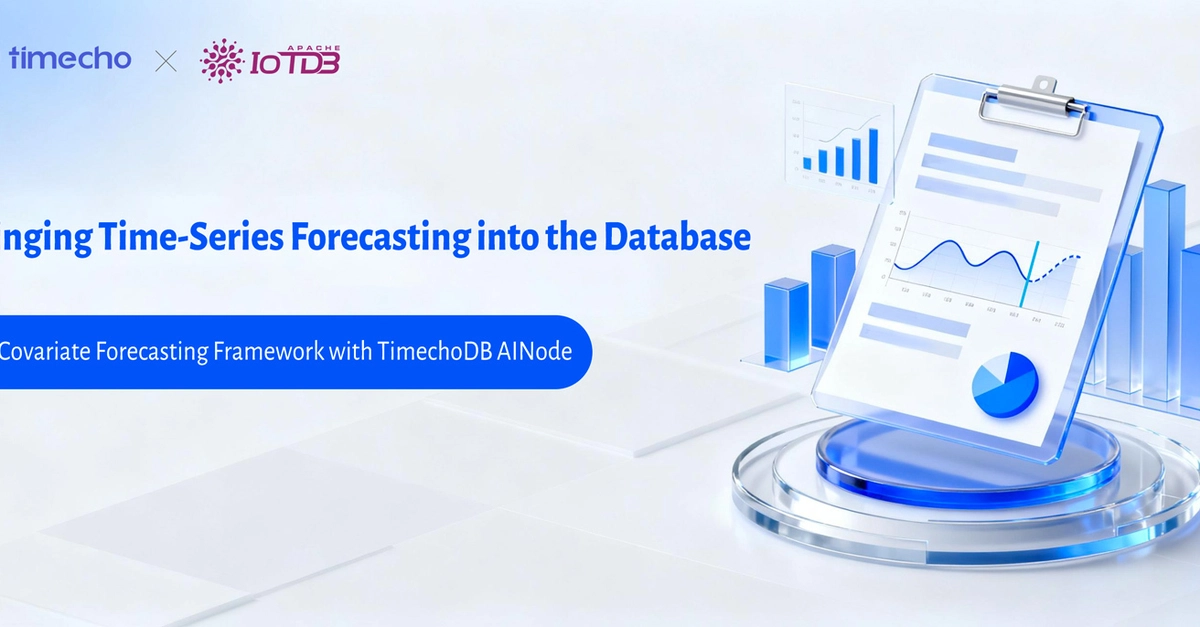
SQL query flying across the screen — targets, covariates, future windspeeds all pulled straight from Apache IoTDB’s belly — and boom, your electricity price forecast materializes, accurate to the kilowatt-hour.
That’s not sci-fi. It’s the new reality in Apache IoTDB’s 2.0.8 release, where time-series forecasting crashes the database party like an uninvited genius who solves everyone’s problems.
Zoom out. Industrial IoT hums with chaos: factories belching data, power grids dancing to weather’s whims, trucks rerouting on a dime. Old-school forecasting? A joke. Univariate models stare at one lonely time series, blind to the hurricane of covariates — temperature spikes, holiday lulls, supply crunches. They miss the plot.
But Apache IoTDB? It’s rewriting the script. They’ve supercharged AINode, that intelligent node lurking in the database’s guts, to host Transformer beasts like Chronos, Timer, Moirai. Train ‘em outside if you want — flexibility’s king — but deploy, infer, schedule right there. Data never leaves home. No ETL hell, no pipeline ping-pong.
Here’s the magic: covariate-aware forecasting. Covariates? Think sidekicks to your main hero (the target variable). In power pricing, it’s wind gusts whispering supply secrets, holidays yawning empty demand.
Why Cram Forecasting Into Apache IoTDB?
Databases used to be dumb silos — store it, query it, done. Remember when spreadsheets got pivot tables? Sudden superpowers. This is that, but for IoTDB: from data vault to oracle.
Unique twist — my take: It’s echoing the full-text search revolution in Postgres circa 2000s. Back then, DBs ate Lucene’s lunch by baking search in. Now, IoTDB devours time-series AI, predicting the day edge devices like industrial sensors become self-healing brains. Bold call: In five years, 80% of IoT platforms ditch external ML; databases rule the forecast roost.
The proof? This SQL snippet, straight from their docs — elegant as a haiku:
SELECT * FROM FORECAST ( MODEL_ID => ‘chronos2’, TARGETS => ( SELECT TIME, target1, target2 FROM etth.tab_real WHERE TIME < 7 ORDER BY TIME DESC LIMIT 6 ), HISTORY_COVS => ( SELECT TIME, cov1, cov2, cov3 FROM etth.tab_real WHERE TIME < 7 ORDER BY TIME DESC LIMIT 6 ), FUTURE_COVS => ( SELECT TIME, cov1 FROM etth.tab_real WHERE TIME >= 7 LIMIT 2 ), OUTPUT_LENGTH => 2 );
No string hacks. No manual covariate stuffing. Just pure SQL poetry — history, future knowns, all queried natively. Errors plummet. Workflows? Streamlined to a whisper.
And accuracy? Covariates unlock it. Univariate chugs on past prices alone — meh. Multivariate? It sips from the full cocktail: target history, covariate pasts, even peeks at tomorrow’s weather. Models learn the dance — correlations twisting like vines — spitting forecasts that hug reality’s curves.
Does Apache IoTDB’s Forecasting Actually Beat the Hype?
Short answer: Hell yes, but let’s dissect.
Industrial wins stack up. Energy: Prices nailed despite storms. Manufacturing: Downtime dodged via vibration trends plus humidity covariates. Transport: Delays preempted by traffic plus weather.
Yet — em-dash alert — Apache’s PR spins it as smoothly utopia. Reality check: Training’s still external. Fine for pros, but newbies? Steep curve. Still, inference in-DB slashes latency — milliseconds, not minutes. For edge IoT? Game-on.
Picture a wind farm. Turbines streaming RPMs, windspeeds, grid loads. Old way: Export to Python, model, pray. New: Query once, forecast floods back. Operators tweak in real-time, blades optimizing like living things.
Vivid? It’s the shift from reactive wrenches to prophetic AI. Apache IoTDB isn’t just storing time series anymore — it’s breathing future into them.
Scale hits next. Petabytes of IoT data? IoTDB’s built for it — columnar, compressed, IoT-native. Add Transformers? Now it’s a fortress.
One caveat. Models listed — Chronos et al. — they’re foundation models, pre-trained giants. Fine-tuning needed for niche industries? Possible, but docs skim it. Expect community plugins to explode.
What About the Real-World Grind?
Users rave in forums — electricity benchmarks show 20-30% accuracy bumps with covariates. Stability too: Fewer wild swings.
Workflow evolution? Massive. Devs chain forecasts to alerts: “Price spiking? Reroute power.” No middleware monsters.
My historical parallel: Like Oracle swallowing analytics in the ’90s, birthing data warehouses. IoTDB births “AI warehouses” for time series. Prediction: OSS forks will swarm, embedding domain tweaks — think auto-covariate discovery via graph ML.
Energy pulses through this upgrade. It’s not hype; it’s infrastructure armageddon for siloed AI.
But wait — the corporate gloss. They call it “unified workflow.” True, yet it’s version 2.0.8 — early innings. Watch for production war stories.
🧬 Related Insights
- Read more: AMD’s Lemonade: Zesty Local LLMs or Just NPU Bait?
- Read more: RadioLlama: The Indie Radio App Dodging Ads and Big Tech Greed
Frequently Asked Questions
What is time-series forecasting in Apache IoTDB? Native integration of Transformer models like Chronos into the DB for covariate-aware predictions — pulls targets and covariates via SQL, outputs forecasts instantly.
How does covariate forecasting work in IoTDB? Combines historical target data, past/future covariates (e.g., weather), using models that learn multivariate dances for sharper, stabler predictions.
Is Apache IoTDB forecasting ready for production? Yes for inference — deploy pre-trained models easily. Training external, but low-latency in-DB execution shines for industrial IoT scale.
Word count: ~950.