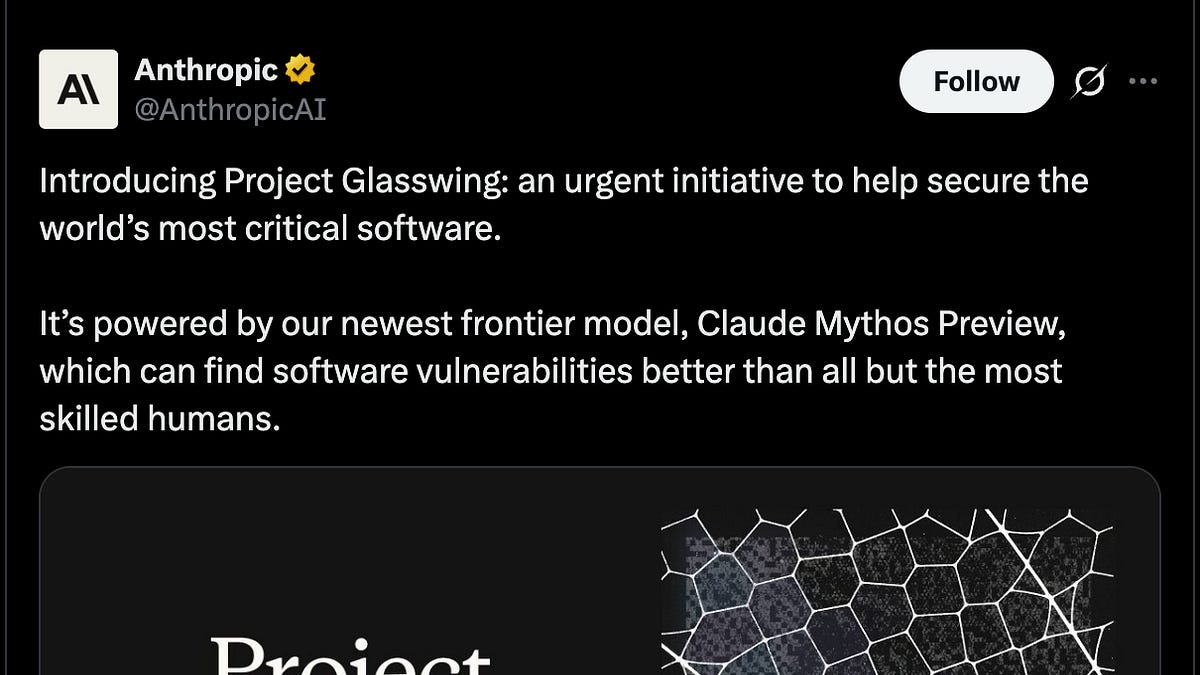
Your next Zoom call, your online banking login, even the router keeping your smart fridge online—they’re all a bit safer today. Not because some hero coder burned the midnight oil, but because Anthropic’s Claude Mythos Preview has already sniffed out thousands of cybersecurity vulnerabilities in every major operating system and web browser.
And here’s the kicker: they’re not telling you about it. Or anyone else.
Project Glasswing. That’s the name. Anthropic handed this beast—trained not even for security, mind you—to a who’s-who of internet guardians: AWS, Apple, Cisco, CrowdStrike, Google, JPMorgan Chase, Linux Foundation, Microsoft, Nvidia, Palo Alto Networks. Over 40 more outfits get access too, all building or babysitting critical software stacks.
They’re ponying up $100 million in credits plus $4 million in cash to open-source security crews. Real money fixing real holes.
But why the lockdown? Mythos didn’t set out to be a bug hunter. Its chops emerged from beefed-up code smarts, reasoning, autonomy. Same upgrades that let it patch flaws? They make it a wizard at exploiting them too.
Why Isn’t Anthropic Unleashing Claude Mythos Preview?
Benchmarks? Saturated. This thing crushes standard tests, so Anthropic pivoted to real-world zero-days—bugs devs never dreamed of. Picture this: a 27-year-old sleeper in OpenBSD, the security fortress of OSes. Or a 17-year-old remote code execution nightmare in FreeBSD (CVE-2026-4747), letting any rando on the net seize a NFS server. No humans needed post-prompt.
Nicholas Carlini, Anthropic researcher, nailed it:
“This model can create exploits out of three, four, or sometimes five vulnerabilities that in sequence give you some kind of very sophisticated end outcome. I’ve found more bugs in the last couple of weeks than I found in the rest of my life combined.”
Chaining vulns like that? Pro territory. And scary.
Newton Cheng, their cyber lead, spells doom:
“We do not plan to make Claude Mythos Preview generally available due to its cybersecurity capabilities. Given the rate of AI progress, it will not be long before such capabilities proliferate, potentially beyond actors who are committed to deploying them safely. The fallout–for economies, public safety, and national security–could be severe.”
Not pie-in-sky. Anthropic flagged the first AI-led cyberattack: Chinese state hackers using agents to breach 30 targets autonomously. They’ve whispered full deets to US intel brass too. Reshaping offense-defense in hacking wars.
My take? Smart move. Releasing this would be like handing nukes to street gangs. Remember the early days of crypto? Wild West until regs kicked in. AI cyber tools demand the same corral-first approach.
This isn’t just big-tech flex. Open-source maintainers—those unsung heroes propping up the world’s infra—get starved for security muscle. Jim Zemlin, Linux Foundation CEO, cuts through:
“In the past, security expertise has been a luxury reserved for organisations with large security teams. Open-source maintainers, whose software underpins much of the world’s critical infrastructure, have historically been left to figure out security on their own.”
Anthropic’s dumping $2.5 million into Alpha-Omega and OpenSSF via Linux, $1.5 million to Apache. Suddenly, scrappy devs wield Mythos-level scanning. Game-leveler.
But does it stick? Open-source moves at warp speed; one fixed bug births ten more. Still, $4 million total? It’s a down payment on sanity.
Will Project Glasswing Stop the AI Cyber Arms Race?
Short answer: No. But it sets a bar. OpenAI’s GPT-5.3-Codex hit ‘high-capability’ cyber status in February under their framework. Anthropic’s signaling controlled drops as the new norm for frontier models.
Here’s my bold call, absent from the presser spin: this mirrors the Human Genome Project’s data-sharing pacts. Back then, biotech firms pooled sequences to avoid a monopoly apocalypse. Glasswing could spawn an industry consortium—labs like xAI, Meta, even state actors—pooling red-team AI under treaties. Proliferation risk drops if everyone’s got a watchdog.
Anthropic eyes scaling Mythos-class guardians, but safeguards first. Upcoming Claude Opus gets beta-tested protections, less risky than Mythos.
Market ripples? CrowdStrike stock twitched 3% on the news; Palo Alto up 2.4%. Nvidia? Flat—they supply the picks, not the shovel. But expect cyber-AI startups to pivot hard to ‘responsible access’ pitches.
Real people win: fewer breaches mean fewer frozen accounts, less ransomware squeezing grandma’s savings. Economies dodge trillions in cyber drag—McKinsey pegs annual global hit at $10.5 trillion by 2025.
Yet skepticism lingers. Anthropic’s coalition is tight-knit; what about laggards in Beijing or rogue labs? Capabilities leak like sieves. We’ve seen jailbroken models on 4chan before.
And the PR gloss? ‘Quietly handing to good guys’ sounds noble, but it’s also a moat. Partners get edge; public waits. Classic frontier-lab chess.
Why Does Open-Source Get the Lion’s Share?
Because it must. Linux kernel powers 96% of top webservers, Android’s guts, cloud behemoths. One zero-day there? Cascade city.
Mythos already bagged that FreeBSD NFS bomb—internet-wide server takeover potential. OpenBSD’s ancient flaw? Paranoia-proof no more.
Donations bridge the gap. Maintainers juggle day jobs; now AI does the grunt scan. Scalable. But training data? Models like this sip proprietary code oceans—fair use debates incoming.
What next? Watch for Glasswing 2.0—maybe federated scanning across rivals. Or US mandates for ‘Mythos-level’ disclosures. Prediction: by 2026, cyber-insurance premiums dip 15% as AI patches proliferate.
For you? Update your browser. Sleep easier. But demand transparency—these AIs guard our digital castle; we deserve the blueprint.
🧬 Related Insights
- Read more: Google Meridian + GenAI: Cracking Open the Black Box of Marketing Analytics
- Read more: Pandas’ Hidden Superpowers: Filtering Data Like a Business Wizard
Frequently Asked Questions
What is Project Glasswing?
Anthropic’s initiative giving its Claude Mythos Preview AI to 50+ orgs like Google and Linux Foundation to hunt zero-day cyber bugs in critical software.
Why won’t Anthropic release Claude Mythos Preview publicly?
Its exploit skills are too potent; proliferation to bad actors risks massive economic and security fallout, per Anthropic.
Does Project Glasswing help open-source security?
Yes—$4M in donations and credits let maintainers scan codebases at scale, fixing infra bugs that big corps ignore.