Inference just turbocharged.
Nvidia’s Rubin CPX isn’t some incremental tweak — it’s a sledgehammer to the inefficiencies plaguing AI serving. Picture this: you’re revving up a massive language model for a user query. That initial “prefill” burst? It’s all about raw compute power, churning through tokens in parallel, not slurping bandwidth like a decode phase later on. So Nvidia built a chip that’s fat on FLOPS, skinny on pricey HBM memory. Boom — 20 PFLOPS of FP4 compute, but just 2TB/s bandwidth and 128GB GDDR7. Cheaper, faster prefill. And in rack-scale glory, it pairs with their VR200 beasts for disaggregated inference that feels like the future arriving early.
Why Rubin CPX Feels Like AI’s V8 Engine
Think of traditional GPUs as all-purpose sedans — great for highways (training), okay for city streets (inference). But prefill? That’s drag-strip acceleration. You don’t need massive HBM fuel tanks when you’re not guzzling bandwidth. Nvidia gets it. The Rubin CPX swaps luxury HBM for workhorse GDDR7, slashing costs while delivering the FLOPS punch.
By contrast, a dual-die R200 packs 33.3 PFLOPS but 20.5 TB/s bandwidth and 288GB HBM. Overkill for prefill. Nvidia’s move echoes the automotive world’s engine specialization — why lug a Ferrari V12 for grocery runs?
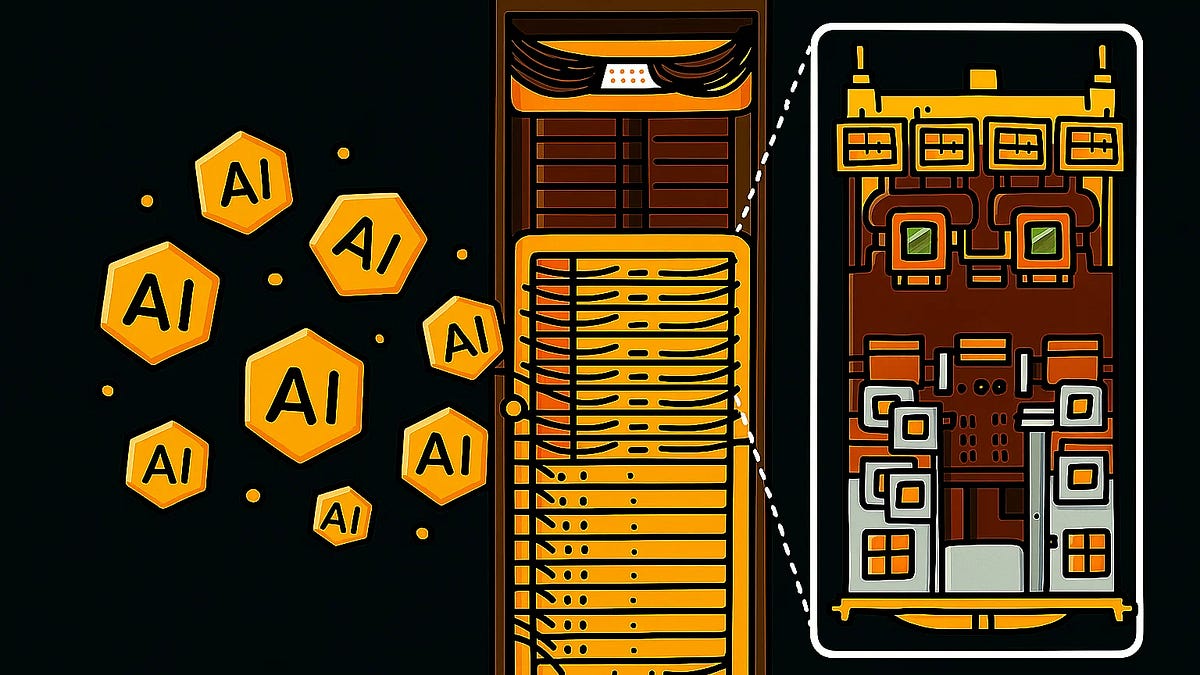
Here’s the kicker. This expands their VR200 family into hybrid racks: NVL144 CPX mixes 72 R200s with 144 CPXs per 18 trays. Or go dual-rack: one standard, one pure CPX with 144 of the specialists. Disaggregation unlocked.
The Prefill-Decode Divide: Bandwidth’s Dirty Secret
Inference splits into two beasts. Prefill: compute feasts on parallel token gen, KV-cache building sips memory. Decode: autoregressive trickle, bandwidth-hungry as it streams tokens one-by-one.
Only with hardware specialized to the very different phases of inference, prefill and decode, can disaggregated serving achieve its full potential.
Nvidia nailed it there. HBM’s premium — now the fattest BOM slice in Blackwell — gets wasted on prefill. Escalate that to racks? You’re torching TCO. Rubin CPX flips the script: lower perf per dollar? Nah, higher. Competitors like AMD, scrambling with their rack emulations, just got lapped.
But wait — GDDR7 trends help too. Cheaper, scaling fast. HBM stays king for decode, but this duo act? It’s poetry.
Can AMD and ASICs Catch Nvidia’s Rubin CPX?
Short answer: not soon. AMD’s software hustle is valiant, but hardware specialization? They’re redrawing roadmaps, just like Oberon’s NVL72 did last year. Custom silicon dreams? Back to square one, investing in prefill chips now.
Nvidia’s rack gap? Canyon-wide. Their Oberon leap crushed 72-GPU dreams; CPX doubles down. Prediction: by Rubin era (2026?), disaggregated serving becomes table stakes, but Nvidia owns 90%+. Competitors delay shipments, burn cash — echo of Intel’s x86 stranglehold in the ’90s, but for AI accelerators.
And here’s my unique spin: this isn’t just hardware. It’s the transistor curve bending toward AI specificity, like GPUs supplanted CPUs for graphics. Rubin CPX signals the platform shift where inference pools specialize like factory lines — prefill zones humming compute, decode zones bandwidth orgies. Humanity’s AI sidekick? Cheaper, everywhere sooner.
Look, the memory wall’s crumbling. H100’s 80GB/3.4TB/s to GB300’s 288GB/8TB/s? Tripled capacity, 2.5x bandwidth in three years. But inference prefill underutilizes it. CPX rights that wrong.
Rack Breakdown: From Trays to TCO Triumph
VR200 NVL144 CPX: 72 logical R200s + 144 CPXs across 18 trays (4 R200s + 8 CPXs each). Power-hungry? Sure, but perf per watt soars for mixed workloads.
Dual rack Vera Rubin CPX: Separate inference rack with 144 CPXs (8 per tray). Disaggregated PD (power delivery) shines — no more monolithic behemoths.
BOM-wise, GDDR7 trims costs. HBM’s BOM dominance? Tempered. Expect lower TCO claims Nvidia’s teasing — higher throughput, same power envelope.
Energy pulses through me thinking of clusters like this. Imagine data centers as living organisms: CPX neurons firing prefill sparks, R200s handling the sequential hum. Scalable. Efficient. Inevitable.
Future-Proofing Inference: Roadmaps Rewritten
Disaggregated serving? Full potential here. Prefill farms of CPXs feed decode powerhouses. Token throughput explodes; latency plummets. For devs, it’s serving at scale without bankruptcy.
Competitors? Pivot time. AMD’s MI300X racks inch forward, but specialization lag means years behind. ASICs for hyperscalers? Custom prefill now mandatory, inflating dev cycles.
Bold call: Nvidia’s ecosystem lock-in deepens. CUDA + these racks = moat. By 2027, Rubin Ultra racks could serve planetary-scale models, TCO halved.
Power budgets? Tricky without full specs, but CPX’s lighter memory eases cooling, PD demands. Rack-scale wins on density.
🧬 Related Insights
- Read more: Vector Databases: The Cosmic Map Turning AI’s Fuzzy Dreams into Laser-Focused Reality
- Read more: LangSmith Fleet: LangChain’s Bold Bet on Enterprise Agent Armies
Frequently Asked Questions
What is Nvidia’s Rubin CPX?
A prefill-optimized GPU with 20 PFLOPS FP4 compute, 128GB GDDR7, and low 2TB/s bandwidth — perfect for inference’s compute-heavy start, slashing HBM waste.
How does Rubin CPX rack change AI serving?
It enables disaggregated racks mixing CPX prefill specialists with R200 decode beasts, boosting perf per TCO via phase-specific hardware.
Will Rubin CPX beat AMD in inference?
Likely yes, short-term — forces AMD to build their own prefill chips, delaying catch-up by years.