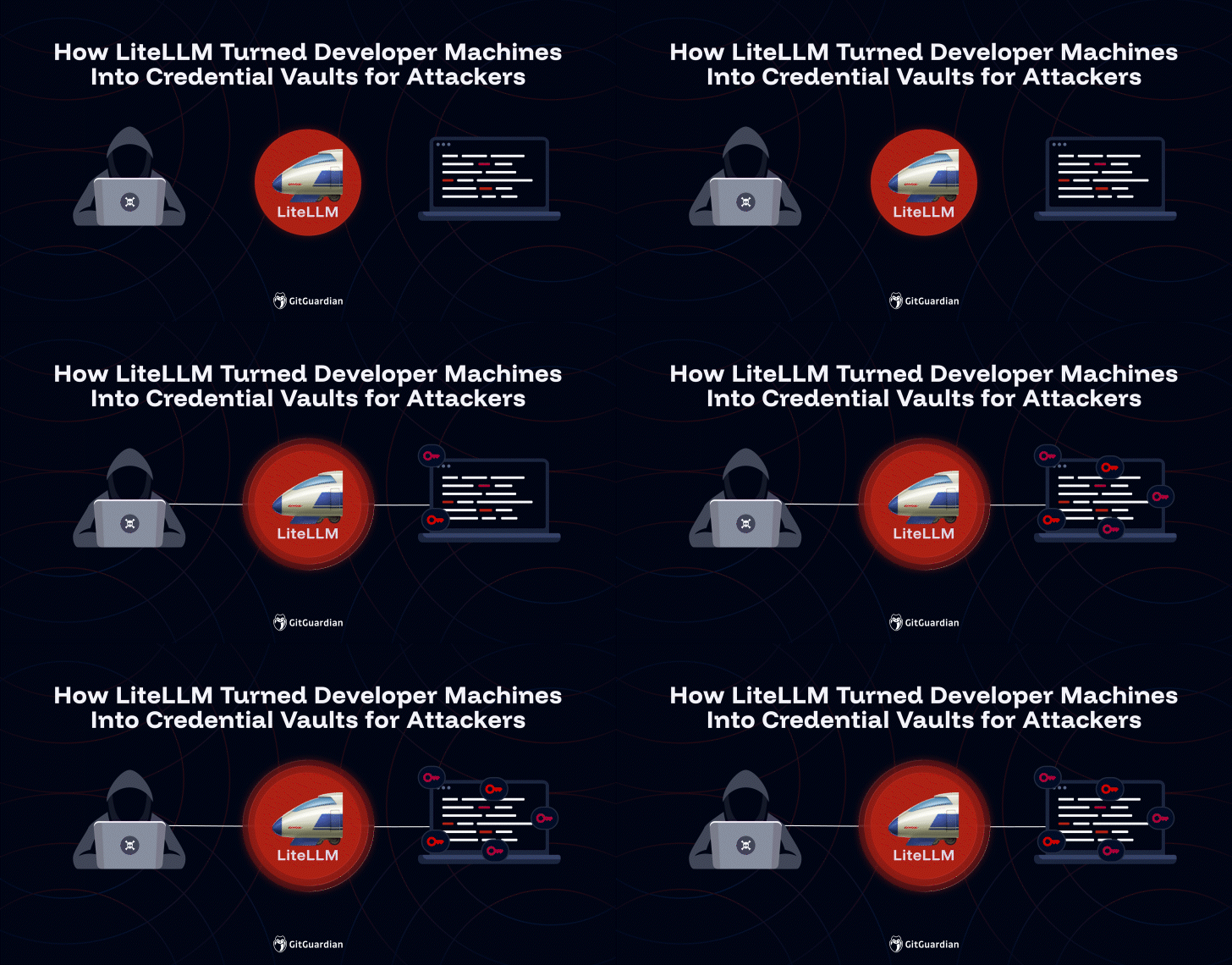
Ever wondered why your cutting-edge AI app might be whispering secrets to total strangers?
That’s the nightmare unfolding right now with the LiteLLM supply-chain attack — a stealthy compromise that’s rippling through thousands of companies, starting with AI hiring whiz Mercor.
Picture this: LiteLLM, that slick proxy layer gluing together a dozen LLM providers like OpenAI, Anthropic, and beyond — it’s the unsung hero making AI chats smoothly. But last week? Boom. A tainted update via Trivy, the popular vuln scanner, slipped malicious code into LiteLLM’s proxy. Not a direct hit on LiteLLM’s core, mind you, but enough to taint downstream users. Mercor blinked first publicly, confirming they’re “one of thousands of companies” caught in the web.
And here’s the kicker — this isn’t some isolated oopsie.
Why Did LiteLLM’s Supply Chain Suddenly Turn Toxic?
Trivy, built by Aqua Security, got compromised mid-May. Attackers injected a backdoor into its GitHub releases, specifically version 0.53.0. LiteLLM, relying on Trivy for scanning Docker images during its Python SDK builds, pulled the poisoned pill. Result? Every LiteLLM install post-that pulled in the malware — a sneaky loader fetching payloads from hacker-controlled servers.
Mercor spilled the beans on X (formerly Twitter), saying they detected odd network calls from their infra. Quick pivot: they yanked the bad version, scanned everything, and — phew — no data exfil so far. But thousands more? Still in the dark, potentially.
“We were one of thousands of companies affected by the LiteLLM supply-chain attack as the fallout from the Trivy compromise continues to spread.”
That’s Mercor co-founder Saku Kekaluhi, dropping truth bombs while the industry scrambles.
Look, as an AI evangelist, I live for this platform shift — LLMs aren’t tools; they’re the new OS, the electricity grid of intelligence. But supply chains? They’re the rickety power lines no one inspects until the blackout hits.
Is Your AI Startup’s Stack LiteLLM-Vulnerable Right Now?
Short answer: probably. LiteLLM’s everywhere — 10k+ stars on GitHub, powering agentic workflows, RAG pipelines, the works. If you’re pinning versions loosely or auto-updating deps, you’re exposed. The attack vector? Trivy’s signed releases fooled everyone; even GitHub’s security couldn’t flag it fast enough.
Mercor’s case screams first domino. They use LiteLLM for their AI-driven hiring platform — matching candidates to jobs via spectral analysis of resumes and roles. Imagine: hacker peeks at your job app data? Career sabotage on steroids.
But rewind to my unique twist here — this echoes the 2018 EventStream fiasco in npm, where a dev’s machine got pwned, tainting 500k+ packages. Back then, it was JavaScript’s wake-up. Today? Python’s AI ecosystem. Bold prediction: by Q4, we’ll see nation-state fingers in similar LLM proxies. Why? AI’s the new C4ISR — command, control, intel baked in.
Energy surging yet? Good. Because fixing this demands wonder-level rethinking.
Shift to software bill of materials (SBOMs) — not buzz, necessity. Tools like Syft or even Trivy (ironic, post-fix) can map your deps. Mercor did the right thing: isolate, scan, rotate creds. But scale that to thousands? Chaos.
And the hype check — LiteLLM’s team moved fast, yanking the bad build, issuing alerts. Kudos. But their PR spin? “Isolated incident.” Nah. Thousands impacted says otherwise. Corporate understatement at its finest.
So, what’s next in this AI supply-chain thriller?
How Deep Does the LiteLLM Ripple Go — and Can AI Fix Its Own Mess?
Downstream victims: anyone pip-installing LiteLLM post-May 22. That’s dev environments, CI/CD, prod proxies. Network logs show C2 traffic to sketchy IPs — exfil potential huge.
Vivid analogy time: think of LiteLLM as the airport hub for AI flights. Trivy’s hack? A rogue baggage handler slipping trackers into every suitcase. Mercor’s just the first passenger noticing the extra weight.
Unique insight alert — parallel to SolarWinds 2020, but turbocharged for AI. SolarWinds hit 18k orgs, mostly gov. This? Pure commercial AI goldmine. Hackers could’ve pivoted to prompt injection via tainted proxies, turning your helpful bot into a spy. We’re not there yet, but the vector’s primed.
Mercor’s skepticism shines: they didn’t panic-post; audited first. Sharp move for a startup chasing $100M ARR in AI recruiting.
Here’s the thing — AI’s platform shift means trusting black-box deps is suicide. We’re building cathedrals on sand. Solution? Air-gapped builds, reproducible envs via Nix or Docker multi-stage. And — wild idea — AI-powered anomaly detection in deps. Use LLMs to fuzz SBOMs for risks preemptively.
But.
Scale hits walls. Open-source moves at warp speed; security lags.
Mercor’s wake-up call — or opening shot?
Prediction: 2024 sees AI Supply-Chain Defense Funds, VC pouring into tools like Protect AI or Endor Labs. Hype? Maybe. But necessary as oxygen.
Whew. Pace yourself; the future’s electric.
🧬 Related Insights
- Read more: F5 BIG-IP RCE Bug Sparks Patch Panic
- Read more: Apple’s Terminal Lifeline: macOS Now Blocks ClickFix Paste Bombs Before They Explode
Frequently Asked Questions
What is the LiteLLM supply-chain attack?
A compromise via tainted Trivy scanner in LiteLLM’s Python SDK, injecting malware into thousands of installs since late May 2024.
Did Mercor lose any data in the LiteLLM attack?
No confirmed exfil — they detected and remediated quickly, but the risk was real for candidate data.
How do I check if my code uses vulnerable LiteLLM?
Audit your requirements.txt or pyproject.toml for LiteLLM >=0.3.x post-May 22; scan with updated Trivy or pip-audit.