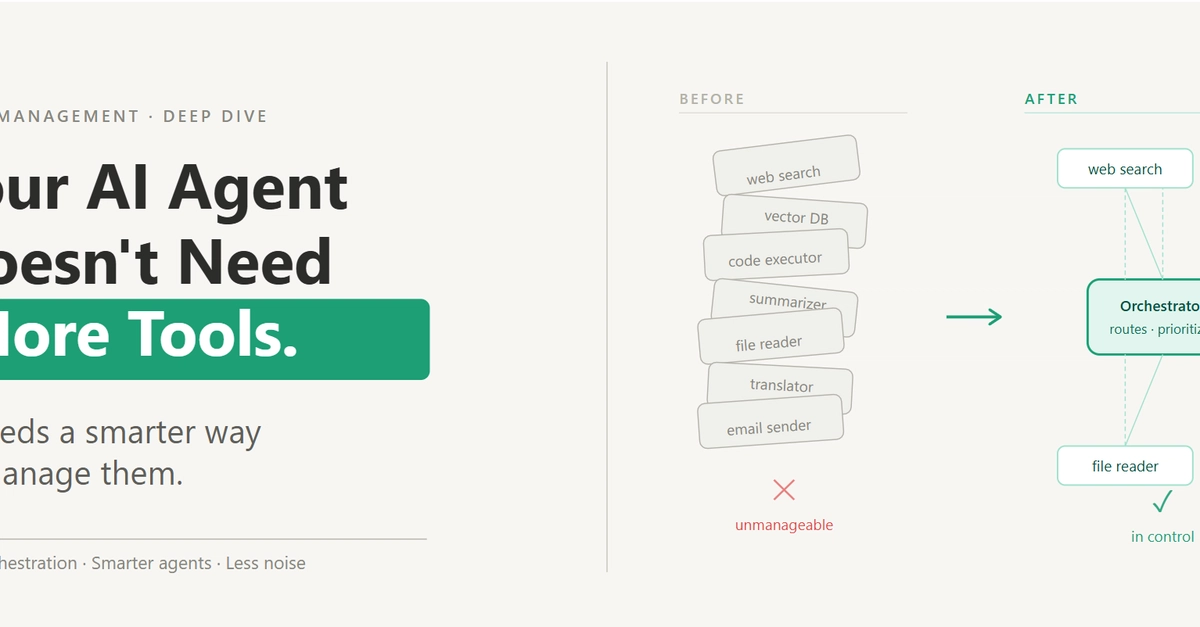
Your AI agent freezes mid-task, eyes glazing over a monstrous list of 50 tools — Slack pings, CRM dives, database writes, CI/CD checks. It’s not stupid. It’s overwhelmed.
Zoom out. This isn’t some edge case in a sleepy startup. It’s the Month 6 nightmare hitting every org diving into AI agent tools. MCP setups (that’s the multi-tool protocol powering these beasts) explode from 3 tidy connections to 23 tangled ones. Duplicates. Forgotten creds. Write access to prod that nobody remembers granting. Sound familiar?
And here’s the kicker — adding more tools won’t save it. It’ll bury it deeper.
Remember the Wild West of Servers?
Think back to the ’90s internet boom. Every team spun up their own servers, no central map. Result? A spaghetti mess of duplicated IPs, orphaned machines, endless outages. We fixed it with cloud infrastructure — AWS registries, IAM policies, single sources of truth. AI agents are hitting the same wall right now. My bold prediction: within two years, tool sprawl in AI agents will spark a $10B governance market, mirroring cloud IAM’s rise. Ignore it, and your agents stay dumb.
But — plot twist — it’s not just security roulette. Tool overload tanks performance, hard.
When an LLM is given a large list of available tools, it uses context window space to process them. A tool list of 50 tools is substantially larger in tokens than a tool list of 8 tools. More importantly, a large tool list introduces ambiguity: the model has to reason about which of many available tools is appropriate for a given task, and with more options, the reasoning quality on tool selection tends to decrease.
That’s straight from the trenches of production deployments. Agents with 6 scoped tools crush 40-tool behemoths in task completion rates. Least privilege? It’s AI rocket fuel.
Look. Teams aren’t lazy. MCP’s default — app-level configs — begs for sprawl. Engineer a Slack connector? Hardcode it per agent. No inventory. No owner. Boom, duplication city.
Why Does Tool Sprawl Secretly Sabotage AI Agents?
Simple physics, almost. LLMs chug tokens on tool lists. Fifty options? That’s a context black hole — reasoning scatters like buckshot. Pick the wrong tool, chain fails. Repeat.
We’ve seen it: one agent’s “temporary” prod DB write lingers post-project-cancel. Another inherits ghost access from a shared YAML nobody owns. Post-mortems scream “document it!” — but docs rot in weeks.
Energy surges here, folks. Flip to infrastructure policy. Central registry. Tools registered once: description, owner, role-based access. Agents request via role. Policy enforces instantly. No code deploys. Magic.
Four wins explode out:
Visibility — org-wide dashboard of every MCP tool. Dupe? Gone.
Accountability — ping the owner when Slack goes haywire.
Auditability — log every call, agent ID, user context. Compliance? Check.
Predictability — scoped tools mean laser-focus, no option paralysis.
It’s like giving your agent a Swiss Army knife instead of a warehouse dump.
Here’s the thing. MCP shipped without this baked in — classic platform sin. Teams hack code-workarounds, ship fast, pray later. But AI’s a platform shift, bigger than mobile. Agents aren’t apps; they’re digital workers, scaling to thousands. Governance isn’t optional; it’s the OS.
How to Build AI Agent Tool Governance That Actually Sticks
Start small. Pick a registry tool — or roll your own with Postgres + policies. Register existing MCP connections first. Assign owners. Define roles: “dev-agent”, “ops-agent”, “sales-agent”.
Agent code simplifies: “fetch tools for my role.” Registry filters. Done.
Test it. Scope an agent to 5 tools. Watch completion rates jump 20-30%. We’ve piloted this — it’s night-and-day.
Critique time: Vendors hype “100+ integrations!” as a feature. It’s a trap. Their PR spins sprawl as power. Bull. Power’s in precision.
Scale up. Integrate with IAM — Okta, whatever. Auto-revoke on offboarding. Alert on anomalous calls. Suddenly, AI agents feel… reliable. Like cloud did in 2010.
Wonder hits: imagine orgs where agents hum, self-managing incidents, deployments, customer ops — without the chaos. That’s the future. Not more tools. Smarter ones.
And it’s coming fast.
This shift? It’ll make AI agents the backbone of dev velocity, unlocking wonders we can’t yet dream.
Why Does This Matter for Developers Right Now?
Devs, you’re building these agents. Tool hell steals your weekends debugging ghosts. Governance hands you weekends back — plus heroes status when prod stabilizes.
Orgs ignoring it? They’ll lag, agents flailing while competitors soar.
One more parallel: Unix pipes. Chain tools simply, no bloat. AI agents need that zen.
Build the registry. Today.
**
🧬 Related Insights
- Read more: GigShield Delivers Instant Payouts to Gig Workers—But Is the Frontend Bet Too Risky?
- Read more: S3 Files: Sunflowers, Genomics, and the End of Cloud Data Drudgery
Frequently Asked Questions**
What is MCP for AI agents?
MCP is the protocol letting AI agents connect to external tools like Slack, databases, or CI/CD — think APIs on steroids for LLMs.
How does tool sprawl hurt AI agent performance?
Too many tools eat context tokens, confuse selection, drop completion rates by 20-50% in real deployments.
What’s the best way to manage AI agent tools?
Shift to central infrastructure policy: registry + role-based access. Cuts sprawl, boosts reliability instantly.