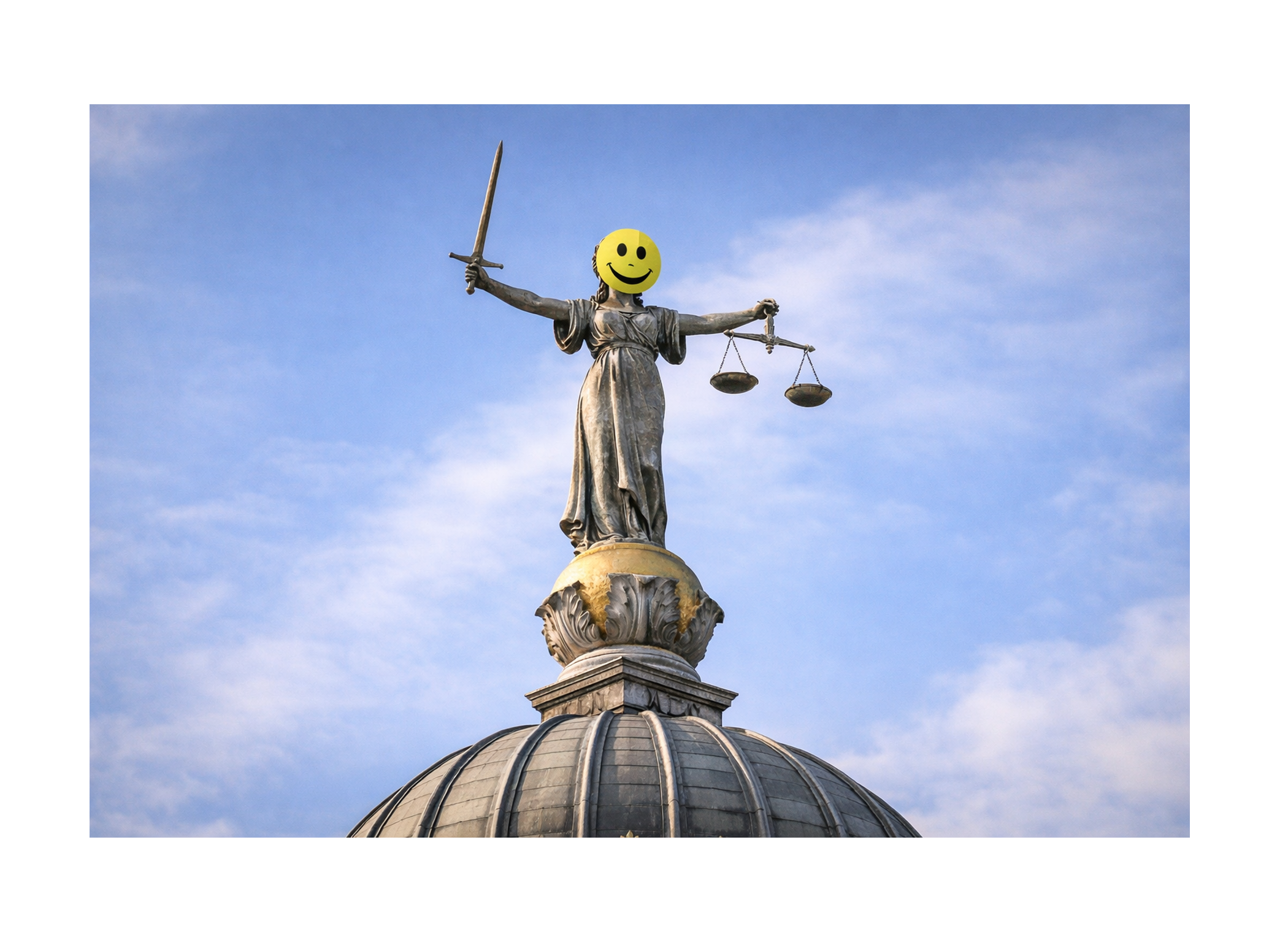
What if calling someone ‘guilty’ was deemed too mean for courtrooms?
That’s the premise of Artificial Lawyer’s latest April Fools’ gem, where the UK Ministry of Justice (MoJ) supposedly axes the guilty verdict to shield criminals from ‘emotional distress.’ Absurd? You bet. But here’s the thing—it slices right into the empathy-over-evidence drift reshaping law today.
And look, as someone who’s chased legal tech stories from Silicon Valley boardrooms to Brussels hearing chambers, this fake interview with ‘Max Feelgood,’ Director of Judicial Improvement, feels less like a joke and more like a mirror. It’s got that Wired-level zing: provocative, a tad paranoid, zero punches pulled.
The setup’s brilliant. Police arrest as usual (for now). Trial rolls on. Then, bam—the judge picks ‘Not Guilty’ or ‘Not Really Guilty.’ No sulking defendants. No stigma. Prisons? Obsolete. Courts? Pointless. Cops? Redundant. Lawyers? Who needs ‘em when contracts mean squat without enforcement?
“The justice system cannot cause harm. That’s the key point. What’s the point in a legal system if we end up upsetting people by telling them that they are guilty? It’s such a negative approach.”
Feelgood’s words—pure satire gold. An 83.5% approval from inmates, per their survey. One Belmarsh holdout who likes the grub. It’s Monty Python meets policy wonkery.
Is the UK Actually Banning Guilty Verdicts?
Short answer: No.
This dropped April 1st, flagged loud and clear as a prank. Artificial Lawyer’s editor even muses it “can’t quite believe it’s going to end well.” Smart hedge—because elements ring true. Remember those US DAs dropping charges to dodge ‘trauma’? Or Scotland’s hate speech laws tiptoeing around offense? Satire amplifies the signal.
But dig deeper. Why does this land? Because justice systems worldwide grapple with ‘victimhood inflation’—where perpetrators flip to protected class. MoJ’s fictional pivot: criminals as ‘real victims,’ prison food too awful, stigma a no-go. It’s a reductio ad absurdum of therapeutic jurisprudence, where feelings trump facts.
Here’s my unique angle, one the original skips: this echoes the Therapeutic Justice wave of the 1990s, post-Ritalis v. Chen, when US courts started prioritizing healing over retribution. Back then, it birthed drug courts, restorative circles. Fine for minor stuff. But scale it to felonies? Anarchy, as the interview gleefully concludes. Prediction: we’ll see AI legal tools baked with this bias—algorithms scoring ‘harm caused by verdict’ before ruling.
Why Does This Satire Sting Legal Tech So Much?
Legal AI’s having a moment. Tools like Harvey, Casetext’s CoCounsel, even LexisNexis hybrids promise faster, fairer justice. But fairness? That’s squishy.
Train these on empathy-first datasets—say, post-2020 reform rulings—and watch ‘guilty’ get softened to ‘Not Really Responsible.’ Imagine an AI judge weighing emotional distress metrics. Defendant’s therapy notes? Admitted. Victim impact? Downplayed if it ‘traumatizes’ the bar.
We’ve seen previews. Predictive policing AIs dinged for bias, now recalibrated for ‘equity’ over accuracy. Contract review bots flag ‘harsh’ clauses. Verdict drafters? Next frontier. What if OpenAI’s legal fine-tuner prioritizes ‘positive holistic outcomes,’ Feelgood-style?
The how: architectural shift from binary logic (guilty/innocent) to probabilistic spectra (how upsetting?). Why? Datasets skewed by activist judges, PR-sensitive firms. Result: a system where truth bends to avoid lawsuits—from criminals, naturally.
One punchy para: Corporate hype alert—MoJ’s real-world ‘modernisation’ pushes digital courts, AI triage. This satire calls the bluff.
But wait—cost savings! Prisons shuttered, billions freed for ‘initiatives.’ Anarchy’s upside-sold. Logical endpoint: no laws needed, since no enforcement. Feelgood nails it: “Think of the happiness we’ll create.”
Could AI Fix This Mess—or Make It Worse?
My bold call: satire like this accelerates objective AI judging. Humans waver—empathy floods, politics intrude. Code it right: immutable rules, evidence-weighted, zero feels. Blockchain verdicts? Immutable, tamper-proof. No ‘Not Really’ wiggle room.
Yet risk looms. If Big Tech infuses ‘safety’ layers—à la content mod—AI parrots the softness. We’ve got EU AI Act looming, risk-classing high-stakes legal tools. Will it mandate ‘non-upsetting’ outputs? Watch.
England & Wales rollout by summer, per the gag. Rest of UK by year-end. Laughable. But in legal tech’s race to automate justice, who’s really joking?
The deeper why: society’s trading retribution for rehabilitation, efficiency for equity. Satire exposes the cliff-edge.
🧬 Related Insights
Frequently Asked Questions
What is the MoJ guilty verdict ban?
It’s a fake April Fools’ story from Artificial Lawyer satirizing overly empathetic justice reforms—no real ban happening.
Will this affect UK courts or legal tech?
No actual change, but it spotlights tensions in AI-driven justice: balancing fairness, feelings, and facts.
Is ‘Not Really Guilty’ coming to AI legal tools?
Not yet—but watch for ‘harm-minimizing’ features in verdict generators. Satire warns of empathy creep.
