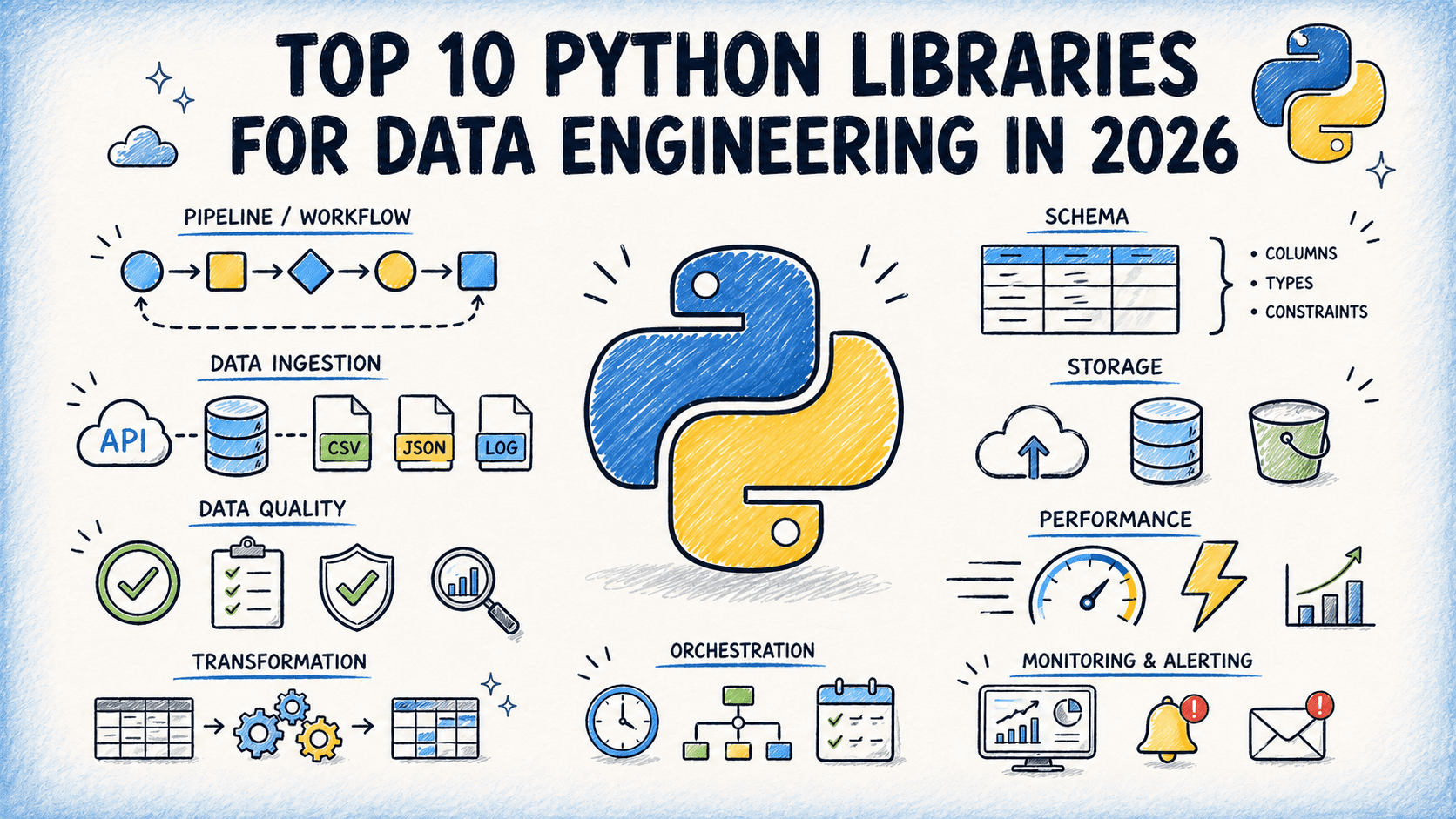
Is your data engineering toolkit still stuck in 2023? You might be falling behind. As data volumes explode and expectations for pipeline speed and reliability skyrocket, the usual suspects in the Python ecosystem are starting to show their age. This isn’t about reinventing the wheel; it’s about recognizing that the tools shaping the cutting edge of data engineering in 2026 are often the ones you haven’t heard of. The truth is, efficiency isn’t just about raw processing power anymore; it’s about intelligent orchestration, smoothly data ingestion, unwavering data quality, and smart storage. These are the battlegrounds where Python’s latest libraries are now claiming victory.
We’re talking about tools that tackle the perennial pain points head-on: the messy business of SQL transformations, the drudgery of building custom connectors, and the sheer complexity of real-time stream processing. This isn’t just an incremental upgrade; it’s a fundamental shift in how data engineers can approach their work, freeing them from boilerplate and allowing them to focus on actual insights and business value. The race is on to adopt these advancements before your competitors do.
Orchestration: Taming the Workflow Beast
Pipeline orchestration and workflow management. Two words that often conjure images of late-night debugging sessions and inscrutable error logs. Prefect steps into this arena not just as another scheduler, but as a thoughtful reimagining of how we define, run, and monitor our data flows. It wraps ordinary Python functions in a layer of observability and resilience, meaning your existing code can become production-ready with minimal fuss. The beauty lies in its native Python approach; you’re not fighting a separate DSL or a complex infrastructure setup just to get started. Its clean UI offers real-time insights into what’s happening, a feature that frankly, should be standard but often isn’t.
And then there’s SQLMesh, which takes on the notoriously thorny problem of SQL transformations. Anyone who’s grappled with dbt will recognize the underlying ambition, but SQLMesh aims for a deeper semantic understanding. This isn’t just about running SQL queries; it’s about understanding the lineage, the dependencies, and precisely what needs to be rebuilt when a change is made. The ability to test changes in virtual environments without touching production data is a significant leap forward, addressing a critical risk factor in many data teams. The fact that it supports multiple execution engines makes it remarkably versatile.
SQLMesh is an open-source data transformation framework that extends the ideas behind dbt with semantic understanding of your models and true CI/CD for SQL pipelines.
Ingestion: Beyond the Connector Treadmill
Building custom ingestion scripts and connectors is, let’s be blunt, soul-crushing work. It’s time-consuming, error-prone, and frankly, a poor use of a data engineer’s valuable skills. dlt (data load tool) offers a compelling alternative. By auto-generating schemas and handling schema evolution, it dramatically reduces the burden of managing data structure. Its support for incremental loading and deduplication means you’re not reinventing common patterns. And the growing library of pre-built sources and destinations? That’s where the real time savings lie. Imagine plugging into a new data source with just a few lines of Python – that’s the promise.
For those wrestling with real-time data streams, the options have historically been limited to cumbersome enterprise solutions or DIY Kafka consumers. Bytewax, built on a Rust foundation but presenting a native Python API, injects a welcome dose of elegance into stream processing. It embraces a dataflow programming model, allowing for stateful, functional definitions of complex streaming logic. This makes it a practical, Python-native alternative for teams who find Flink or Spark Streaming to be overkill or simply too divorced from their primary development language. Its focus on windowing and state management out-of-the-box addresses core real-time processing needs effectively.
Data Quality and Schema: The Unsung Heroes
Maintaining data quality and managing schemas are often afterthoughts, or worse, manual processes that lead to downstream chaos. Libraries like Soda Core (though not explicitly detailed in the provided snippet, it’s a critical player in this space) are vital for defining and automating data quality checks. Imagine setting up tests that run automatically against your data, flagging anomalies before they impact business decisions. This proactive approach is the hallmark of mature data engineering practices. Schema management, too, is shifting from static definitions to dynamic, evolving systems, ensuring that pipelines can adapt to changes without breaking.
Storage and Serialization: Speed Demons
Moving data quickly and storing it intelligently are fundamental. While explicit mentions of serialization libraries like Apache Arrow or formats like Parquet are absent from this specific list, their influence is pervasive. Libraries that facilitate efficient data transfer and storage, often leveraging these underlying technologies, are paramount. Think about how much time is saved when data serialization and deserialization are near-instantaneous, or when data can be queried directly from optimized columnar storage formats without expensive ETL steps. This is where the rubber meets the road for performance gains.
The Future is Python-Powered
The trajectory is clear: Python, with its ever-expanding ecosystem, is solidifying its position as the lingua franca of data engineering. These ten libraries—or at least, the types of solutions they represent—are not just niche tools. They are foundational shifts in how we build, manage, and scale data infrastructure. For organizations aiming for agility, reliability, and efficiency in 2026 and beyond, understanding and adopting these emerging Pythonic solutions isn’t optional; it’s essential for survival. The data engineer of tomorrow will be fluent in these tools, orchestrating complex systems with fewer lines of code and more strategic oversight. The question isn’t if you’ll need these libraries, but how quickly you can integrate them into your workflow.
🧬 Related Insights
- Read more: Anthropic’s Unreleased Beast: The AI That Finds Bugs Too Well
- Read more: Stablecoin FX Matches Interbank Rates in Brazil – The Quiet Revolution in LATAM Payments
Frequently Asked Questions
What does dlt stand for? dlt stands for ‘data load tool’.
Is Prefect hard to learn? Prefect is designed for ease of use, allowing you to turn ordinary Python functions into observable pipeline components with minimal boilerplate.
Can Bytewax process data in real-time? Yes, Bytewax is a Python stream processing framework built for real-time data. It supports stateful stream processing logic and integrates with messaging systems like Kafka.