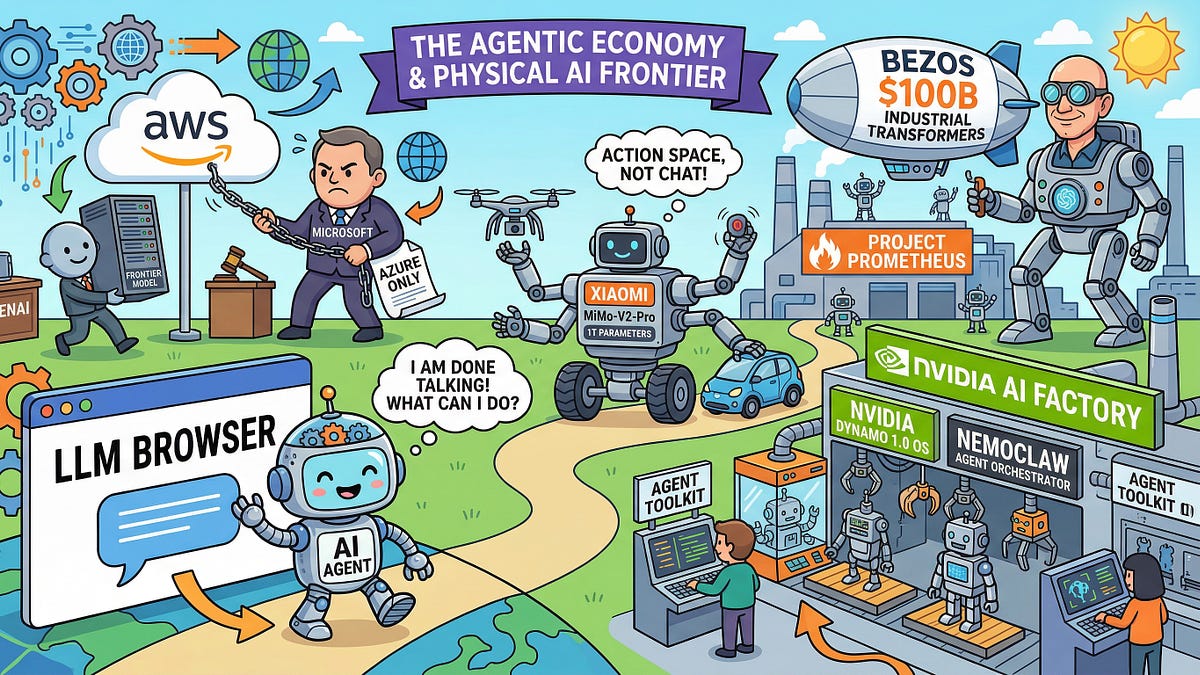
Jensen Huang strides onstage at GTC 2026, screen blazing with code — not GPUs, but an open-source beast called Dynamo 1.0.
It’s not another chip reveal. No, this is NVIDIA declaring war on its own hardware legacy, thrusting itself into the squishy heart of agentic infrastructure — the software glue that turns data centers into throbbing AI factories.
Zoom out. The AI world’s gone feral. Chatbots? Yesterday’s toys. Everyone’s chasing what AI does: orchestrating robots, rewiring supply chains, evolving codebases without human babysitting. And NVIDIA’s grabbing the conductor’s baton.
Dynamo 1.0? Think Linux for AI hyperscalers. Distributed, fault-tolerant, it schedules agent swarms across clusters, auto-scales inference, even self-heals when models hallucinate their way into dead ends. Paired with NemoClaw — that’s their enterprise agent orchestrator — and a fresh Agent Toolkit, NVIDIA’s blueprinting the nervous system for tomorrow’s economy. They’re not peddling silicon; they’re renting the OS that makes it breathe.
How Does NVIDIA’s Agent Stack Actually Work?
Here’s the architecture shift that Huang buried in hype. Traditional AI pipelines? Linear: train, fine-tune, deploy. Agentic? Cyclic, self-improving loops. NemoClaw spins up “self-evolving agents” — think mini-LLMs that fork, mutate, compete on tasks. The toolkit feeds them tools: APIs, simulators, even physical actuators via NVIDIA’s Omniverse.
But — and this is the how — Dynamo underpins it all with zero-trust orchestration. Containers for agents? Nah. It’s a full distributed OS, borrowing from Kubernetes but jacked with RLHF for dynamic resource allocation. Why? Because agent swarms explode compute needs mid-task. One agent debugging code might spawn 50 subprocesses; Dynamo throttles the greedy ones, reallocates H100s in milliseconds.
Smart readers see the moat: NVIDIA controls the ** Blackwell orchestration layer**. Enterprises lock in, just like they did with CUDA. Bold prediction? By 2028, 70% of Fortune 500 AI deploys run Dynamo — not because it’s free, but because it’s the only stack that scales agent chaos without melting data centers.
NVIDIA’s pivot reeks of historical echo — remember when IBM lost the PC wars by clinging to mainframes? Huang’s not waiting. He’s open-sourcing the future to own it.
Meanwhile, across the Pacific, Xiaomi just pulled a ninja move.
Xiaomi MiMo-V2-Pro: Better Than GPT-5 for Robots?
MiMo-V2-Pro drops — 1 trillion params, 1M-token context — and it’s not chatting poetry. No, Xiaomi engineered this monster for action space: digital workflows, robot brains, EV autopilots. Rivals GPT-5.2, Claude Opus 4.6, but inference costs? Slashed, thanks to their hardware moat (phones, cars, fabs).
“Rooted in Xiaomi’s deep consumer hardware and EV pedigree, the model is engineered specifically for the “action space.” It bypasses the traditional conversational paradigm, built instead to act as the brain for digital workflows and physical robotics.”
That’s the original scoop — spot-on, but misses the why. Xiaomi’s not iterating on text; they’re fusing multimodal data from their ecosystem. Vision from phone cams, proprioception from SU7 EVs, telemetry from smart homes. MiMo reasons over trajectories, not tokens. Result? It simulates robot grasps 3x faster than Western rivals, per leaked benchmarks.
The ambush? While OpenAI chases generality, Xiaomi hyper-specializes for hardware symbiosis. US moat crumbling — China’s got the supply chain.
Shift to the physical.
Jeff Bezos, never one to spectate, is quietly amassing $100 billion.
Bezos’s $100B Factory Raid: Spatial AI’s Industrial Coup
Not a VC fund. A “manufacturing transformation vehicle.” Bezos snaps up rusty factories — aerospace, defense, legacy autos — then injects Project Prometheus: spatial AI that maps 3D worlds, predicts machine failures, swaps humans for agent swarms.
How? Prometheus layers vision-language models over LiDAR twins of factories. Agents plan assembly lines in sim, deploy to irons. It’s LLMs for knowledge work, but for muscle memory. Bold? Disruptive? Hell yes — global supply chains were brittle pre-COVID; now, AI rewires them atom by atom.
Critique the spin: Bezos pitches transformation, but it’s acquisition arbitrage. Buy cheap dinosaurs, AI-ify ‘em, flip for premiums. Unique insight — this mirrors Rockefeller’s oil refineries: vertical integration via tech, not just capital.
But compute hunger’s cracking alliances.
OpenAI vs. Microsoft: Compute Wars Hit the Courts
Microsoft’s suing — or threatening to — over OpenAI’s AWS flirt for “Frontier” model hosting. Azure exclusivity? In spirit, says MSFT. OpenAI? “We need every GPU to survive.”
Why now? Frontier models gulp exaFLOPs; Azure can’t solo. Fracturing exposes the architecture flaw: centralized compute cartels choke scaling. Prediction: This births a multi-cloud agent economy, Dynamo-style neutrality wins.
Research ripples underscore the pivot.
Google DeepMind’s RLHF tweak? Online learning slashes label needs — 20K vs. 200K — via “affirmative nudge” and uncertainty nets. Agents get smarter, cheaper.
EvoClaw benchmark? Frontier LLMs ace one-off code, flop on long evolutions. Error snowballs; integrity crumbles. Agent stacks like NemoClaw must fix this.
MetaClaw — incomplete scoop, but signals claw-like benchmarks for physical agents.
The era’s here: AI steps from browser to factory floor, courtroom, robot arm.
🧬 Related Insights
- Read more: Anthropic’s ‘Theoretical’ AI Job Takeover: Built on 2023 Sand
- Read more: Gradient Labs’ AI Agents: Personal Bank Managers for Every Customer
Frequently Asked Questions
What is NVIDIA Dynamo 1.0? Distributed OS for AI factories — orchestrates agent swarms, scales compute dynamically.
Is Xiaomi MiMo-V2-Pro better than GPT-5? For action/robotics, yes — cheaper inference, hardware-tuned. General chat? Neck-and-neck.
Why is Microsoft suing OpenAI? Over AWS compute deal breaching Azure exclusivity amid insane scaling needs.