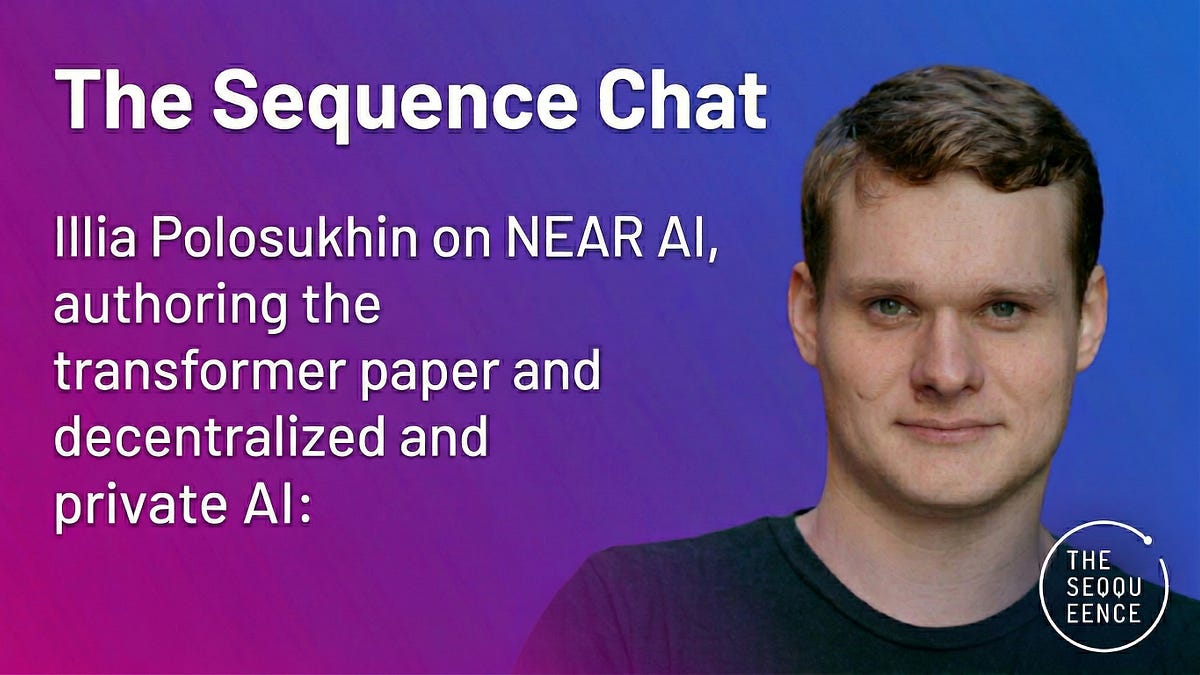
Illia Polosukhin leans into the webcam from some sunlit office—probably in Zug or wherever NEAR’s nomads roam—recounting the exact moment in 2017 when ‘Attention Is All You Need’ flipped AI on its head.
Decentralized AI. That’s the phrase buzzing through this chat, and Polosukhin’s not just talking theory. The guy who co-wrote the Transformer blueprint at Google Brain has pivoted hard to NEAR AI, launching tools like NEAR AI Cloud and IronClaw to wrestle control back from centralized giants.
Look, blockchain folks love their manifestos, but Polosukhin’s story grounds it in cold, hard engineering. Grew up coding competitions in Ukraine, freelanced through uni, landed at Google on TensorFlow and NLP. Then—bam—co-authors the paper that birthed every LLM worth knowing. Left for a startup with Alex Skidanov, hit crypto’s fee walls paying global researchers, built NEAR Protocol instead. Mainnet live October 2020. Zero downtime since. That’s not hype; that’s uptime porn for devs.
The Unexpected Scale Monster
Back in 2017, Transformers crushed RNNs for translation—no sequential chokepoints, pure parallel bliss. Polosukhin admits he was laser-focused on text, knowledge capture, QA benchmarks. Modalities like vision or robotics? Not on the radar.
But here’s the shocker he didn’t see coming: scale. Data and compute, cranked endlessly, keep juicing intelligence. We’re all hunting data efficiency tricks—test-time compute, synthetic data tweaks—but nah, brute force wins for now.
“It is still surprising to me that the scale of data and compute is the main ingredient we need to continue increasing intelligence. I and a lot of other researchers are still looking for something that is more about how the learning process itself is happening and ways to massively improve the data efficiency of this process.”
That’s Polosukhin straight up. And it’s why centralized labs lap the field—xAI, OpenAI, Anthropic stacking clusters like Jenga towers.
## Why Did the Blockchain Detour Happen?
Picture 2018 San Francisco. Everyone’s shilling ICOs, Polosukhin’s startup needs to pay Ukrainian students—no banks, crypto it is. Fees? Killer. Scaling? Joke. AI tooling? Primitive.
So they hack a chain that scales. Thought: six months, back to AI. Reality: years. NEAR launches, flawless. Fast-forward to 2024—NEAR AI revives the dream. Confidential compute, user-owned data. Products shipping: IronClaw for secure enclaves, AI Cloud for inference.
NEAR’s sharding tech hums at 100k TPS peaks, sub-second finals. Compare Ethereum’s gas wars or Solana outages—NEAR’s bored engineers are iterating AI stacks.
But here’s my sharp take: this mirrors Netscape’s browser wars. Early web centralized on portals (AOL, Yahoo). Open protocols won. AI’s at that fork—closed APIs vs. open, private swarms. Polosukhin’s betting protocols triumph again. Bold? Yeah. Data-backed? NEAR’s TVL north of $300M says check the charts.
Data aggregation works. Inference pooling—Bittensor style—delivers. Verifiable benchmarks, RLHF incentives? Gold.
Broken bits: distributed training. Prime Intellect, Nous, Pluralis grind clusters, but who cares? Users crave top-dog models, not ‘decentralized’ badges. Open-source purity loses to raw FLOPs. Even labs struggle centralized.
## Is Decentralized AI Hitting a Compute Wall?
Monoliths rule headlines—GPT-4o, Claude 3.5—but small models swarm underneath. Phi-3 minis, Llama 3.1 8B variants crush inference speed, run local.
Polosukhin nods to MoEs—Mixtral, DeepSeek—smarter than dense giants, faster too. Future? Agent swarms, 8B-class brains with tools, P2P coordination. Specialization via data/tools, not parameter bloat.
Market dynamics scream yes. Edge devices—phones, cars—demand low-latency. Centralized oracles? Latency tax, privacy leaks. NEAR’s confidential compute (IronClaw uses SGX-like enclaves) encrypts inputs/outputs. No OpenAI peeking at your docs.
Critique time: NEAR’s PR spins ‘user sovereignty’ hard, but adoption lags. Bittensor’sTAO moons on hype, yet real apps? Crickets. Polosukhin’s right—privacy’s the bottleneck—but monetizing decentralized inference ain’t trivial. Fees, slashing, collusion risks.
Privacy: AI’s Silent Killer App
Apps die without it. Train on your data? Fine, if locked. RAG over private docs? Must be confidential.
NEAR bets on chain-agnostic infra—verifiable AI, zero-knowledge proofs for gradients. Early wins: auto-research loops emerging, per Polosukhin.
My prediction—and this ain’t in the transcript—watch 2025. Regs like EU AI Act force privacy tech. Centralized labs pivot or perish; decentralized stacks like NEAR capture 20% inference market by ‘27. Historical parallel? GDPR birthed consent managers. This births private AI.
Small models enable it—quantized, on-device. Coordinate via chains for ‘swarm intelligence.’ No single point failure. No Musk-tweet dependency.
The Road Ahead: Swarms Over Oracles
Polosukhin’s mental model: chaotic latent space now, signal amid noise. Working: aggregation, incentives. Scaling: MoEs, agents.
NEAR AI Cloud? Plug-in inference marketplace. Developers rent GPUs peer-to-peer, pay in $NEAR. IronClaw? Verifiable execution, no trust.
Skeptical? Fair. Compute’s king—NVIDIA’s gross margins prove it. But latency/privacy flip the script for agents. Your robot vac? Local model. Enterprise RAG? Private chain.
And downtime? NEAR’s perfect record mocks AWS blips.
This isn’t utopian. It’s market logic—decentralized AI wins where central fails: control, cost, uptime.
**
🧬 Related Insights
- Read more: Anthropic’s Mythos: Cybersecurity Savior or Self-Sabotaging Leak Fest?
- Read more: PlugMem: AI Agents’ New Brain That Ditches the Digital Hoarding Habit
Frequently Asked Questions**
What is NEAR AI?
NEAR AI builds private, decentralized AI tools like Cloud for inference and IronClaw for confidential compute, letting users own their data on the NEAR blockchain.
How does decentralized AI differ from ChatGPT?
It runs on distributed networks—your data stays private, models aggregate compute peer-to-peer, no single company hoards everything.
Will decentralized AI replace big models like GPT?
Not fully—scale still rules frontiers—but swarms of small, specialized models will dominate local/edge use, coordinating for agentic wins.