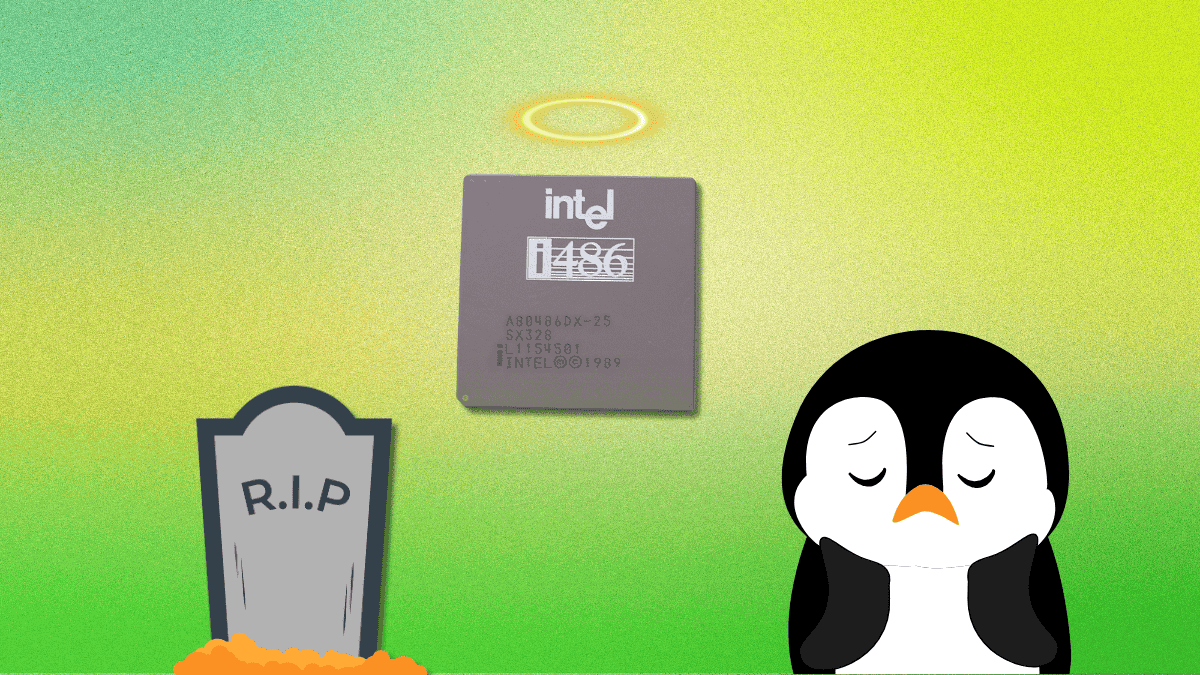
Ingo Molnár’s fingers hover over ‘send’ on the Linux Kernel Mailing List, April 2025. That RFC patch series? A guillotine for the i486, Intel’s once-mighty 1989 chip that’s clung to kernel life like a relic in a museum.
Linux kernel dropping i486 support isn’t some casual cleanup—it’s a seismic architectural purge, slicing out 14,000 lines of code across 80 files. We’re talking the death of CONFIG_M486, the math-emu floating-point library, everything that kept those ancient 32-bit x86 machines wheezing.
And here’s Linus Torvalds, crystal clear:
I really get the feeling that it’s time to leave i486 support behind. There’s zero real reason for anybody to waste one second of development effort on this kind of issue.
Boom. No mincing words.
But rewind. The i486 exploded in the early ’90s—faster clocks, integrated FPU, the works. AMD cloned it, Cyrix hustled knockoffs, even IBM piled on. Personal computing’s golden child, powering first desktops in living rooms everywhere. Intel milked it till 2007 with embedded variants. Yet platforms bailed: Windows 98, NT 4.0—poof, gone.
Linux? Stubbornly loyal. Or masochistic, depending on your view.
Why Now? The TSC and CX8 Tipping Point
Molnár’s patches demand TSC (Time Stamp Counter) and CMPXCHG8B instructions. No more for i486 or early Pentiums. It’s not arbitrary— these are bedrock for modern scheduling, timing, atomic ops that x86-32 leans on hard. Without ‘em, you’re emulating in software, a drag on everyone else.
Think about it. Kernel devs wrestle daily with RISC-V ports, arm64 optimizations, confidential computing. Why babysit a chip whose last real user probably runs DOOM on a floppy? Ingo’s commit notes no distro ships M486 kernels anymore. Impact? Near zero for the living world.
This mirrors the m68k dropout in 2018—another ’80s survivor axed after decades. But i486? Deeper cut. It forces a reckoning: Linux’s x86 base is hardening around post-1993 silicon, aligning kernel assumptions with hardware that’s actually deployed. My unique take? This isn’t just housekeeping; it’s prepping for a post-Moore era where maintenance costs skyrocket, and ancient compat layers become luxury we can’t afford. Bold prediction: by 2030, kernel minimal CPU will leapfrog to Nehalem-era, shedding Pentium cruft entirely.
Your dusty 486 tower gathers cobwebs in the attic.
First patch landed for 7.1. No more building kernels for it. But hey—unsupported doesn’t mean dead.
Grab a 5.15 LTS or older. It’ll boot fine, run local binaries, play those ancient games. Just don’t plug it online—no patches means vuln city. Perfect for retro hacking, teaching OS basics to kids, or proving Moore’s Law wasn’t a myth.
Kernel’s not bricking your heirloom. It’s just growing up.
What Does Dropping i486 Mean for x86 Evolution?
Peel back the layers—this shift exposes how Linux’s x86 port evolved from inclusive blob to lean machine. Early kernels? Emulated everything, math coprocessors to MMU quirks. i486-specific paths handled SX variants sans FPU, MELAN for oddballs.
Now? Uniform baseline. TSC for high-res timers—crucial since PREEMPT_RT demands microsecond precision. CX8 for 64-bit atomics in 32-bit land, feeding lockless data structures everywhere. Lose that, and you’re patching perf regressions forever.
Critique time: Intel’s PR would spin this as ‘progress’—but let’s call the bluff. They kept i486 in embedded till ‘07 for industrial dinosaurs. Linux carrying it longer? Noble, sure, but it masked how x86-32’s becoming niche—IoT, routers, not desktops. Dropping it accelerates 64-bit purity, maybe even nudges distros to sunset i386 images entirely.
Historical parallel: Unix on PDP-11. Bell Labs ditched it in the ’90s despite pleas. Linux learned that lesson late.
Developers win big. Fewer ifdefs, cleaner code. One less config matrix in Kconfig hell.
Users? If you’re on real hardware—Pentium and up—you notice zilch.
Why Does Linux Kernel i486 Removal Matter for Embedded Devs?
Embedded folks, listen up. i486 lingered in industrial controllers, point-of-sale relics. But 2025? ARM dominates, RISC-V surges. x86-32’s for legacy firewalls, maybe.
This forces migration. No more ‘just in case’ kernels bloating your Yocto images. Audit your fleet—anything pre-Pentium? Time to upgrade or isolate.
And the why: resource fungibility. Those 14k lines? Dev hours not spent on Rust-for-kernel, eBPF extensibility, or arm64 LPA2. Architectural shift to sustainability—kernel as living codebase, not archaeology dig.
Skeptical? Fair. Some corner-case server in a Siberian bunker might cry. But Ingo’s right—zero mainstream pain.
We’ve seen this before with Alpha, SPARC fades. x86-32 joins the pantheon.
The kernel slims down, eyes the future.
One door closes—endless perf gains open.
🧬 Related Insights
- Read more: FOSS Force’s March 2026 Blockbusters: Kernel Extensions, Distro Rebellions, and a Browser That Doesn’t Spy
- Read more: Stop Manually Writing Alt Text: This API Handles WCAG Compliance in One Call
Frequently Asked Questions
Does Linux 7.1 still run on i486 hardware?
No, you can’t build new kernels for it, but older LTS versions (like 5.15) will boot and run fine offline.
Why is the Linux kernel dropping i486 support now?
To require modern instructions like TSC and CX8, cutting 14k lines of legacy code no distro uses anymore.
What CPUs are still supported in Linux x86-32?
Pentium and newer—anything with TSC and CMPXCHG8B, which covers all mainstream 32-bit hardware since the mid-’90s.