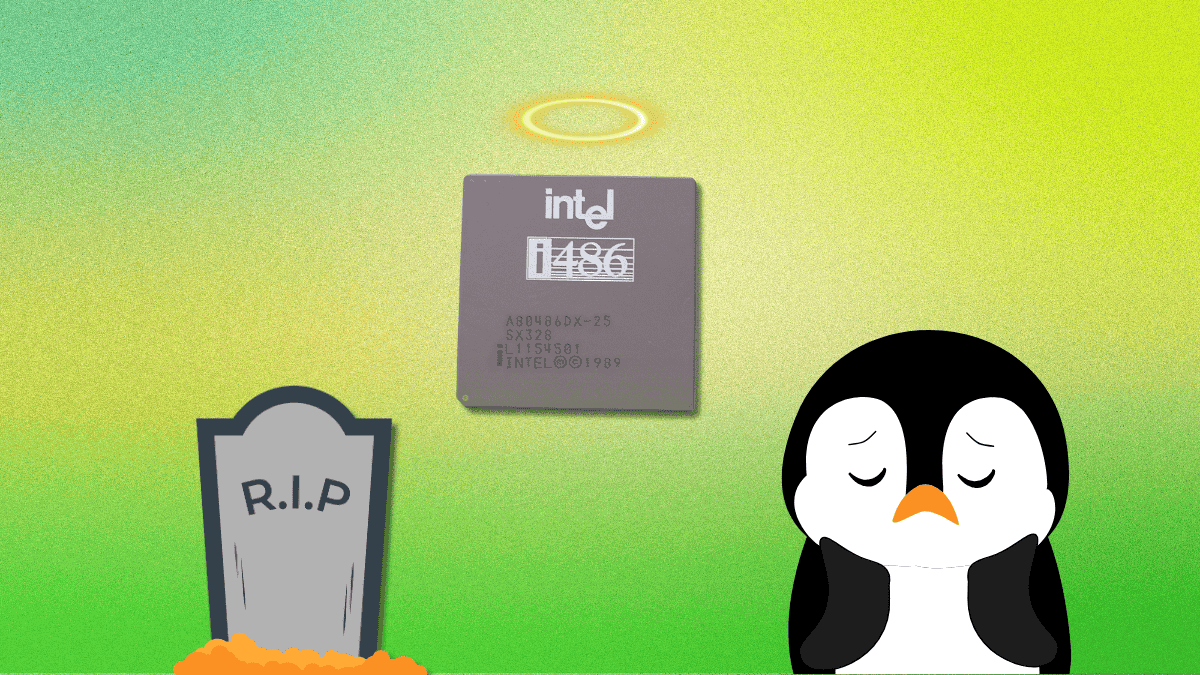
Dust settles on a forgotten 486 motherboard in some hacker’s basement, its fans long silent, capacitors bulging like overripe fruit.
Linux 7.1 is barreling toward us, and it’s packing heat: the first steps to evict i486 CPU support from the kernel’s ancient codebase. Linus Torvalds himself lit the fuse, muttering there’s “zero real reason” to cling to this 30-year-old tech — it’s dragging down the whole upstream effort, he says.
And here’s Ingo Molnar, kernel wizard, swinging the axe with a patch that nukes the CONFIG_M486SX, CONFIG_M486, and CONFIG_MELAN Kconfig options. No more building i486 kernels after this lands. Boom. Users on those stone-age chips? They’ll need to look elsewhere — or upgrade.
Why Ditch the i486 Now?
Think of the Linux kernel as a massive ocean liner, weighed down by barnacles from the ’90s. Maintaining i486 means juggling “various complicated hardware emulation facilities on x86-32,” as Molnar puts it — code that trips up maintainers every merge window. It’s not just nostalgia; it’s a maintenance nightmare, siphoning time from real innovations like Rust drivers or AI-optimized schedulers.
“zero real reason” to keep it around and waste upstream Linux kernel development efforts.
Torvalds nailed it right there. That quote from his mailing list rant? Pure fire. No fluff, just the blunt truth from the bearded overlord who’s steered this ship since day one.
Short version: i486 is deader than a doornail. We’re talking AMD/Cyrix/IBM/Intel SL-series without FPUs (that’s M486SX), the DX flavors with FPUs (M486), and even the quirky AMD Elan (MELAN). These relics powered early Linux boots, sure — but now? They’re museum pieces.
The patch hit tip/tip.git’s x86/platform branch this week. Linux 7.1 merge window? Later this month. Barring a miracle uprising from retro enthusiasts, it’s gone.
But wait — gutting the actual code comes next cycle. First, kill the config knobs. Listen for complaints. Crickets? Scalpels out.
What Does This Mean for Old Hardware Diehards?
You’ll feel it if you’re that guy (or gal) compiling kernels for a 486DX4 to run Slackware in a VM — or worse, bare metal. Modern upstream Linux? Off-limits post-7.1. Distros might patch it back for a cycle or two (looking at you, Debian oldstable fans), but upstream’s moving on.
Here’s the thing. This isn’t cruelty; it’s evolution. Remember when the kernel waved goodbye to i386 in 5.5? Or Alpha architecture? Same vibe. Linux sheds skin like a snake hitting hypergrowth — leaner, meaner, ready for ARM, RISC-V, and whatever quantum weirdness tomorrow brings.
My bold call, one you won’t find in Phoronix: this i486 purge accelerates the kernel’s pivot to edge computing. Imagine slimmer codebases deploying to billions of IoT devices, not lugging 486 baggage. It’s like trimming fat from a racehorse mid-Golden Gate sprint — sudden burst of speed for the AI era, where kernels need to hum on everything from Pis to supercomputers.
Energy surges through the kernel trees. Wonder at it: Torvalds, Molnar — these guys aren’t just coders; they’re time travelers, yanking us from 1994 into 2025 overnight.
Critique time. Sure, Red Hat or Canonical might spin this as ‘progress’ in their blogs, but let’s call the hype: it’s not about ‘modernizing’ for buzzwords. It’s raw pragmatism. No one’s running production workloads on i486 anymore — if you are, fix your life.
The Bigger Picture: Kernel as Living Fossil?
Pause. A single, electrifying fact: i486 debuted in 1989. Linux kernel? 1991. They’ve grown up together — kernel booting on chips that outsold the competition by millions. Now, divorce papers signed.
Sprawling thought: this mirrors the web’s cull of IE6 support. Devs rejoiced, innovation exploded. Linux maintainers? Same high. Fewer bugs from obscure write barriers, less yak-shaving on segment limits. Result? Faster cycles, bolder experiments — think eBPF on steroids or real-time subsets without legacy drag.
And yeah, retro computing? Fire up QEMU. Or Arch Linux ARM on a Pi Zero. Nostalgia’s safe; progress isn’t.
Look, if you’re a collector, snap pics now. That humming 486 tower? Last dance with upstream Linux.
We’ve danced this tango before — PowerPC axed in 6. something, MIPS teetering. i486? Final boss of the 32-bit era.
Will Linux Keep Slimming Down?
Bet on it. Next? Pentium-level cruft, maybe. Or full x86-32 sunset by 2030. Why? Upstream’s a volunteer army — they fight for relevance, not relics. Bold prediction: Linux 10.0 runs circles around Windows NT’s fossil fuel, powering the metaverse (or whatever we’re calling it).
Vivid analogy: kernel as a redwood, pruning dead branches to rocket toward the sun. Wonder hits — this is open source magic, self-pruning for infinity.
So, enthusiasts, mourn briefly. Then rejoice. Linux 7.1 isn’t ending history; it’s turbocharging the future.
🧬 Related Insights
- Read more: Why This Freelancer Built an Invoicing App That Refuses to Touch the Cloud
- Read more: GitLab’s Container Scanning Arsenal: Five Tools to Lock Down Your Images Before Disaster Strikes
Frequently Asked Questions
Will Linux 7.1 still run on my old 486 PC?
Nope — kernel builds for i486 configs are toast. Distros might lag, but upstream says adios.
What CPUs does Linux 7.1 drop support for exactly?
i486-class: M486SX (no FPU), M486 (DX series), MELAN (AMD Elan). Pentium and up? You’re golden.
Can I still use i486 hardware with Linux?
Sure, via older kernels, VMs, or distro patches. But modern features? Dream on.