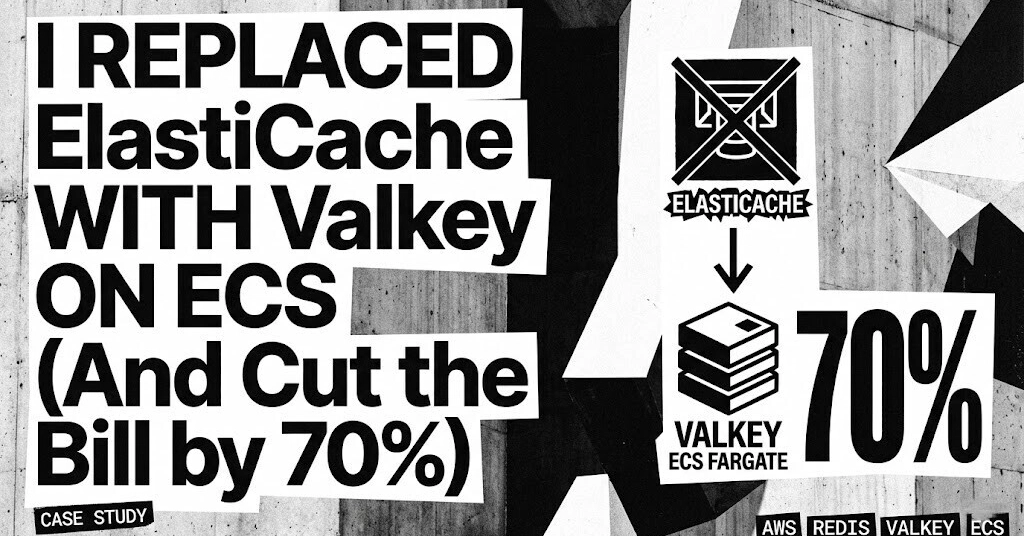
Midnight glow from my laptop screen — AWS bill open, that $175 ElastiCache line mocking my side project’s razor-thin margins.
ElastiCache shines. Managed failover. Automated backups. CloudWatch baked in. But here’s the kicker: prices don’t budge for small setups. A cache.t4g.small? $25/month in eu-west-1. Scale to cache.r7g.large? $175. Multi-AZ? Double it. For bootstrapped teams, that’s brutal — especially when it’s just sessions and queues.
Enter Valkey on ECS. This Redis-compatible fork, born from Redis 7.2.4 under Linux Foundation wings (AWS, Google cheering from sidelines), drops in smoothly. Every client — ioredis, node-redis, BullMQ, Sidekiq, Celery — just works. No rewrites. And the cost? I slashed 70%.
ElastiCache is a genuinely good service. Managed failover, automated backups, CloudWatch integration out of the box. For teams that need Redis and don’t want to operate it, it makes sense.
But sense doesn’t pay bills. Valkey does.
Why Replace ElastiCache with Valkey?
Look, AWS owns Redis compatibility — they could’ve backed the original. Instead, licensing drama forked it into Valkey. Opportunity? Massive. It’s open source fury meets enterprise needs, like MySQL’s MariaDB moment in the early 2010s, pressuring Oracle to rethink pricing.
My unique bet: Valkey forces ElastiCache’s hand. Within a year, AWS drops rates or adds a “Valkey-compatible” tier. Open source commoditizes caching — the platform shift from managed monopoly to self-serve fleets.
Startups win first. Side projects too. Production? Absolutely, with right setup.
Valkey lives in private subnets on ECS Fargate. App services hit it via VPC. No public exposure. EFS for persistence — Fargate tasks die and respawn, but data sticks.
VPC
├── Public Subnet
│   └── Application Load Balancer
├── Private Subnet A
│   ├── ECS Service: App (Fargate)
│   └── ECS Service: Valkey (Fargate)
└── Private Subnet B
    └── ECS Service: App (Fargate) - replica
Simple. Secure.
How Do You Set Up Valkey on ECS Fargate?
Terraform first — EFS filesystem, mount targets, access point. Crucial: Access Points. Skip rootDirectory or Fargate chokes on non-existent paths.
resource "aws_efs_access_point" "valkey" {
  file_system_id = aws_efs_file_system.valkey.id
  posix_user {
    uid = 1000
    gid = 1000
  }
  root_directory {
    path = "/valkey"
    creation_info {
      owner_uid   = 1000
      owner_gid   = 1000
      permissions = "0755"
    }
  }
}
Task definition next. 512 CPU, 1GB RAM. Valkey 8.0-alpine image. Mount EFS at /data. Config flags for persistence magic.
–save 60 1000 for RDB snapshots. –appendonly yes, –appendfsync everysec for AOF durability. –maxmemory 800mb, allkeys-lru eviction (swap to noeviction for queues).
Password? Secrets Manager. Healthcheck pings PONG.
Service discovery via AWS Cloud Map — stable hostname for apps.
{
  "family": "valkey",
  "networkMode": "awsvpc",
  "requiresCompatibilities": ["FARGATE"],
  "cpu": "512",
  "memory": "1024",
  // ... volumes, containerDefinitions
}
Deploy. Scale. Done.
But wait — costs?
What’s the Real Cost of Valkey on ECS?
Fargate: 512 vCPU, 1GB RAM — ~$25/month single AZ. EFS? Pennies for light use (under 10GB, low IOPS). Total: ~$30/month. ElastiCache equivalent? $175. Boom — 70-80% off.
Multi-AZ? Duplicate Valkey task in Subnet B — doubles to $60. Still crushes $350 ElastiCache.
No managed overhead tax. You’re the boss — tune maxmemory, eviction, persistence to your workload. Queues? Alert on memory, noeviction. Cache? LRU away.
Caveat: Monitor EFS throughput. Bursty writes? Provisioned mode. But for sessions/queues, standard suffices.
And restarts? RDB speeds ‘em up — AOF for durability.
Can Valkey Handle Production Loads?
Yes. Protocol match perfect. Backed by giants. My setup: BullMQ queues humming, sessions snappy. No hiccups.
Tradeoffs? You manage scaling, backups (EFS snapshots via Lambda?), monitoring (CloudWatch agent?). Worth it for savings.
Future-proof too. Redis licensing woes? Valkey laughs. Community explodes — forks breed innovation, like Linux kernels powering clouds.
Imagine: Caching as utility, not luxury. Valkey on ECS turns AWS into your playground, not prison.
Thrilling, right? Bootstrappers, rejoice.
🧬 Related Insights
- Read more: The Frontend’s Quiet Revolution: From Buttons to Brainy Assistants
- Read more: Python Async Scraping: 10x Faster, Until Sites Fight Back
Frequently Asked Questions
What is Valkey and why fork Redis?
Valkey is an open-source Redis-compatible fork from 7.2.4, under Linux Foundation. Forked over BSD-3 license changes; full compatibility, backed by AWS/Google.
How much does Valkey on ECS Fargate cost vs ElastiCache?
~$30/month single AZ (512 CPU/1GB), vs $175 ElastiCache large. 70%+ savings; scales linearly.
Does Valkey work with my Redis clients on ECS?
Yes — ioredis, node-redis, BullMQ, Sidekiq, Celery. Zero code changes; same protocol.