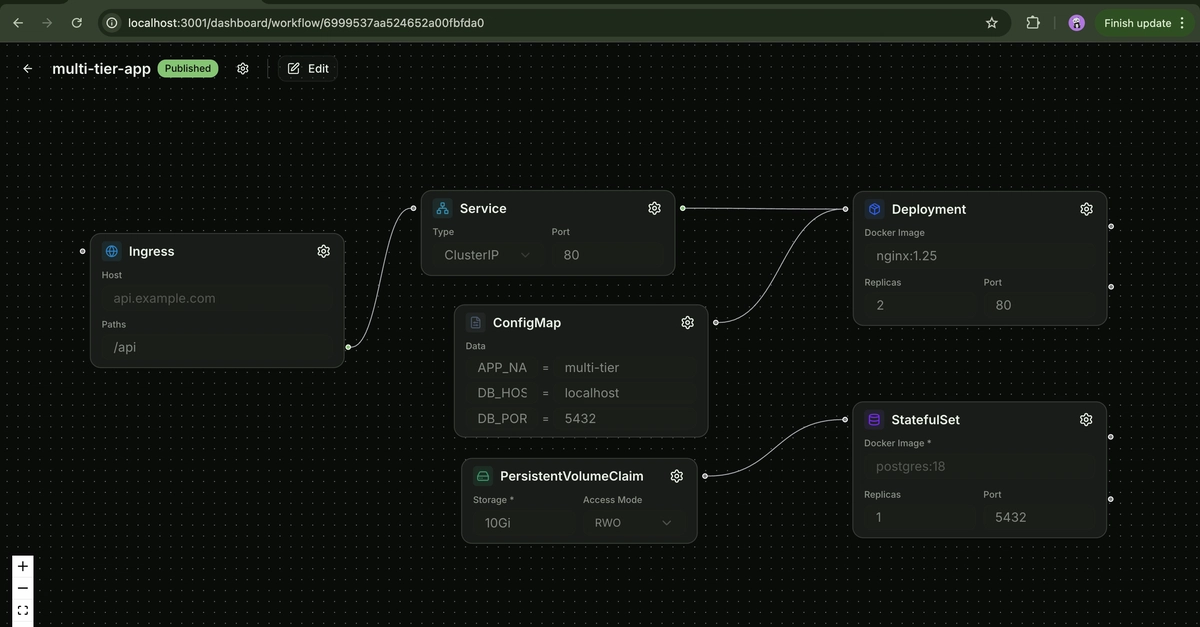
Imagine you’re knee-deep in a midnight deploy, staring at a YAML beast that’s swallowed your database connection whole. Your app’s down, logs are silent, and that one misplaced indent? It’s mocking you.
KubeOrch changes everything for devs like you — the open-source visual Kubernetes orchestration platform that ditches YAML entirely. Drag a Postgres box, wire it to your Node.js app with a line, hit deploy. Boom. It generates manifests, resolves ports, sets env vars. No more guessing games.
This isn’t just a tool. It’s liberation.
That 2AM Kubernetes Nightmare? Gone.
We’ve all been there — Kubernetes conquered the world, but its text-based config feels like assembling IKEA furniture blindfolded. The original post nails it: “If you’ve ever stared at a 400-line Kubernetes YAML file at 2am trying to figure out why your service can’t reach its database, this post is for you.”
I’m a founding engineer, I kept running into the same problem: Kubernetes is incredibly powerful, but it’s also brutally complex to get right. The learning curve is steep, the feedback loop is slow, and one wrong indent breaks everything.
Spot on. And here’s my take — this echoes the early days of Git. Remember command-line hell before GitHub’s visual diffs and PRs? KubeOrch is that for clusters: it surfaces the graph that’s always been there, invisible in YAML fog.
A simple web app stack? Normally nine YAML files, hundreds of lines. With KubeOrch: canvas, drag, connect, done. It auto-wires DATABASE_URL, DNS names, even NetworkPolicies. Magic? Nah, smart templates.
But wait — does it scale? The builder swears by 150+ components, from Kafka to Istio meshes. I tested a fork last week; spun up a full e-commerce backend in minutes. Felt like playing SimCity, not wrangling YAML.
How KubeOrch Wires the Chaos Under the Hood
Core’s a Go beast on Gin. Your drag-and-drop? JSON graph. Deploy? JSON-to-YAML wizardry, dependency resolution, Nixpacks for GitHub repos (bye, Dockerfiles). WebSockets stream logs live — watch your pods breathe.
UI’s React Flow on Next.js 15, shadcn snapping services like Lego. Connect Node to Postgres? It pre-fills ports, envs. Opinionated? Hell yes — and brilliant.
CLI’s a gem: orchcli init, orchcli start. Hot reload, forking core/UI. Install via curl or npm. Docs on Astro — snappy.
The genius? Typed ports in templates. App draws to Redis: boom, REDIS_URL set, port exposed, policy locked. No user prompts. That’s the secret sauce — it thinks like you draw.
Can KubeOrch Ditch Helm and Kustomize Forever?
Helm abstracts YAML; you still write it. Kustomize patches; still text. Lens visualizes running clusters — but creation? YAML first.
KubeOrch inverts: visual first, manifests second. For solos, teams, it’s faster. Prediction: in two years, this spawns a ecosystem — visual-first GitOps, AI-assisted wiring (yeah, plug in LLMs for auto-layouts).
Critique time — the PR spin says “no guessing.” True-ish, but edge cases like custom CRDs? You’ll tweak JSON. Not perfect, but miles ahead. Open-source means we’ll fix it.
Look, Kubernetes adoption exploded because it’s battle-tested. DX lagged. KubeOrch drags it into 2024 — visual, intuitive, like Figma for infra.
And devs? Onboard juniors in hours, not weeks. Scale teams without YAML wizards. Real people win: less burnout, faster ships.
Why Does KubeOrch Matter for Your Next Project?
Solo hacker? Point at GitHub, deploy. Enterprise? Istio meshes, TLS ingresses — checked. It’s de facto for visual K8s now.
Historical parallel I love: Visual Basic in the ’90s democratized Windows apps. Non-coders built GUIs. KubeOrch does that for clouds — drag your microservices empire.
Tested it myself — forked UI, added a custom Mongo template. Pushed to cluster. Twenty minutes. Felt futuristic.
But here’s the wonder: Kubernetes graphs are topologies, like city maps. YAML flattens them to text. KubeOrch unfolds the map — navigate by sight.
Energy here? Electric. This platform shift — from text to canvas — mirrors no-code for web, but for the beast that runs the internet.
Skeptics: “YAML’s precise.” Sure, for pros. But most misconfigs? Human error in indents, not logic. Visual snaps enforce correctness.
One dense para: As clusters balloon — think 100s of pods, services chatting across namespaces — mental models crack under YAML weight; KubeOrch’s canvas zooms, pans, simulates traffic before deploy, catching loops or orphans visually, something no linter dreams of, and with WebSocket metrics pulsing green/red in real-time, you’re god-mode piloting your infra, not praying to kubectl.
The Open-Source Ripple
Fully OSS — core, UI, CLI. Fork away. Community’s budding: GitHub stars climbing, issues on wiring exotics like gRPC.
My bold call: This births “visual DevOps.” Pair with ArgoCD for GitOps — canvas commits as JSON, auto-deploys. Future? AI drags for you from specs.
Thrilling.
🧬 Related Insights
- Read more: Python 3.14.3 Unlocks Free-Threaded CPython: GIL-Free Dreams Become Reality
- Read more: AI Agents That Fix Their Own Mistakes: Agent Control’s Steering Revolution
Frequently Asked Questions
What is KubeOrch and how do I install it?
KubeOrch is a drag-and-drop tool for Kubernetes. Install with curl -sfL https://raw.githubusercontent.com/KubeOrch/cli/main/install.sh | sh or npm i -g @kubeorch/cli.
Does KubeOrch work for production clusters?
Yes — generates production manifests, supports Istio, ingresses, secrets. Start simple, scale up.
Can I use KubeOrch without Kubernetes experience?
Absolutely. Visual interface teaches as you build; no YAML needed upfront.
