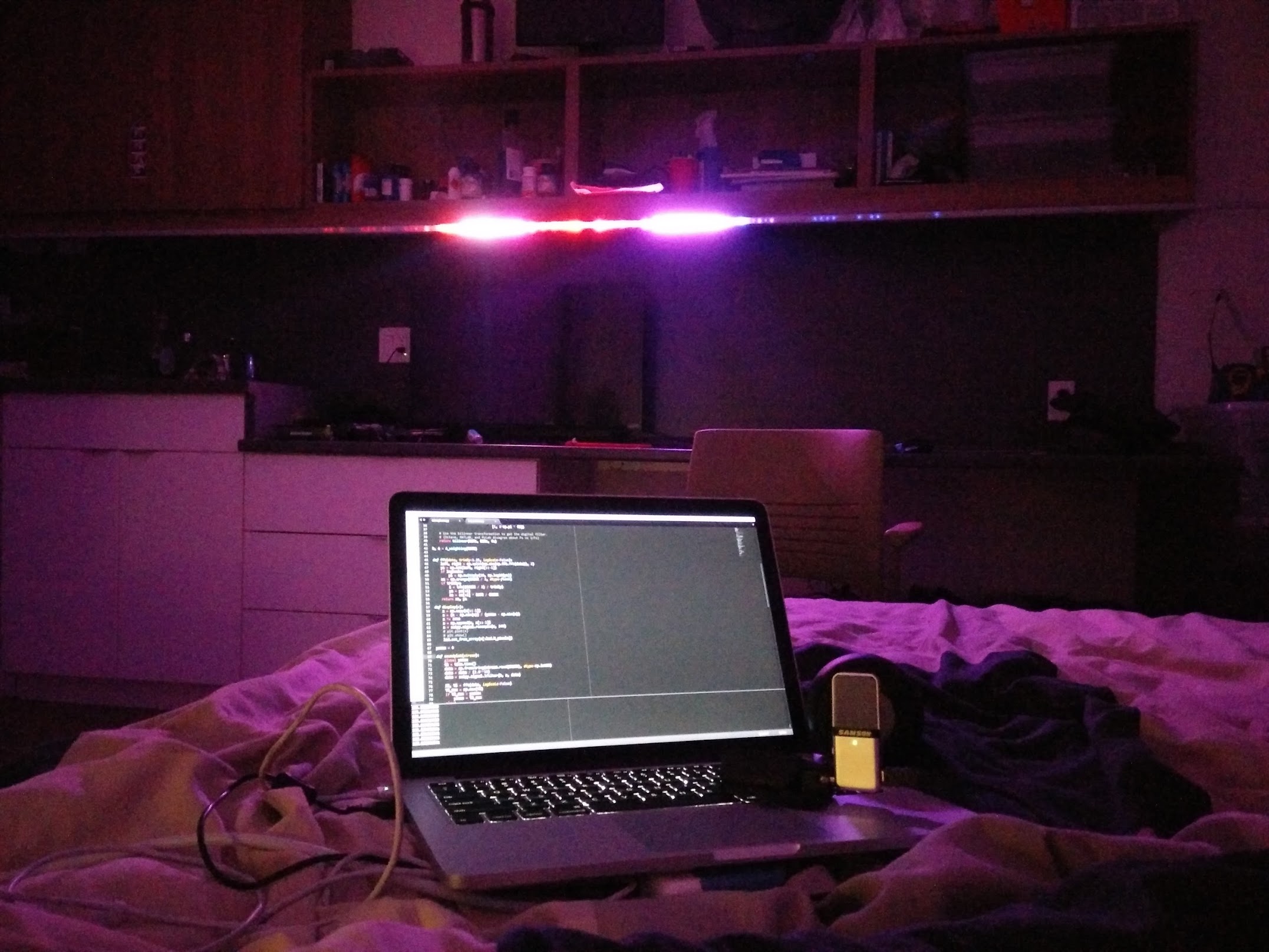
Your living room pulses with bass. Friends ooh and ahh as the LED strip behind your TV throbs exactly like the kick drum — not some generic flash, but a real-time mirror to the music. That’s the dream for every maker, DJ, or home theater nut. But here’s the gut punch: building audio-reactive LED strips isn’t a weekend hack. It’s a decade-deep warren of signal processing pitfalls that chews up hobbyists and spits out half-baked GitHub repos.
2.8k stars don’t lie.
One dev dove in back in 2016, thinking it’d take weeks. Ten years on, his project’s a Hackaday darling, nightclub staple, even an Alexa sidekick. Still — he’s not happy. Why? Because audio-reactive LED strips expose a raw truth: with just hundreds of pixels, you’re not visualizing music. You’re compressing human hearing into a brutal bottleneck.
Look, screens spoil us. Throw a spectrogram up on your monitor — millions of pixels mean you can dump raw FFT data and call it art. But snake a meter of WS2812s behind your couch? 144 LEDs. That’s your canvas. Miss the mark, and it’s dead space staring back.
Volume Control: The Lazy Afternoon Win That Dies Quick
Start simple, right? Grab audio chunks — 10-50ms bites — low-pass filter ‘em, crank brightness on volume spikes. Assign time constants per color channel: red snaps fast to beats, green lags slow like a reverb tail, blue chills in the middle. Boom. Afternoon project. It’ll dazzle on EDM drops.
But switch tracks. Jazz? Acoustic strums? Crickets. Volume blinds you to timbre, melody, the stuff that hooks your ear. No clue if it’s a snare or a symphony — just ‘loud.’ And rooms wreck it. Quiet chat? Barely flickers. Rager next door? Washed-out white.
Adaptive gain saves the day — exponential smoothing, dead simple, constantly tweaks thresholds. Still, three channels choke the story. Time to level up: addressable LEDs. Pixels galore. Or so you think.
“Pixel Poverty, Feature Famine, Compression Curse, whatever you want to call it, is the central lesson I learned and the reason LED strip visualization is so difficult.”
That quote nails it. Screens hoard pixels like dragons. LED strips? Starved.
The Naive FFT: Promise, Then Pixel Wasteland
Fourier transform time. Scoop audio, FFT it, bin frequencies, map to LEDs — one bin per pixel on your 144-strip meter. Spectrum analyzer, LED edition.
Kinda works. More energy captured than volume hacks, sure. But — disaster. Power clumps in low bins; bass owns the first 20 LEDs, the rest sulk dark. Crop the range? Helps a tad. Still lopsided. Underused pixels mock you.
Most makers stall here. GitHub’s littered with ‘em. Fine for screens, where detail sprawls. On strips? No mercy. Every LED must scream musical relevance, or it’s failure.
Here’s my unique spin — and it’s not in the original: this mirrors the Commodore 64 demo scene wars of the ’80s. Back then, 320x200 pixels forced coders to perceptual wizardry, not raw dumps. Same curse now. LED strips aren’t dumber projects; they’re elite tests of human-audio modeling. Predict this: consumer smart lights (Philips Hue, Nanoleaf) will crib these tricks soon, birthing perceptual APIs that mask the poverty.
But first, the why.
Why Are Audio-Reactive LED Strips Diabolically Hard?
Pixel poverty. One meter, 144 lights — that’s 144 chances to nail perception. Flub one feature, the strip looks sparse. Screens forgive; strips punish.
You can’t blast every audio stat. Raw FFT? Lopsided. Volume? Blind. Solution? Mimic ears. Humans don’t hear linear frequencies — we cluster ‘em logarithmically, via the mel scale from speech rec papers.
Dig in: speech folks nailed feature extraction decades ago. Linear freqs? Useless. Mel scale warps ‘em — lows spread wide (bass dominates feel), highs compress (treble details). Bin your FFT into mel bands, not equal slices. Suddenly, energy spreads. Kick gets low-end glory; hi-hats sparkle across the top.
But wait — that’s table stakes. Now perceptual tweaks: bark scale for critical bands, where our ears slice sound. Add tempo detection? Phase vocoder hell, but sync trails to beats. Mirror imaging — left LEDs for left channel, spatialize the strip like headphones.
Still, famine looms. Pick wrong features, strip starves. Right ones? Magic. The dev iterated: smoothing (don’t twitch per sample), peak holds (linger on hits), even genre hints via spectral flux.
And hardware bites back. WS2812s chain serially — one glitch kills the tail. Mic noise? RF interference? Embed AGC everywhere. Microcontroller muscle — ESP32 or Teensy for FFT muscle.
Ten years. Nightclubs run it. Kids’ first solder. Yet perfection slips — why? Because music’s subjective. Your ‘cool’ is my ‘meh.’ Perceptual models approximate; true sync needs AI ears we ain’t built yet.
How Do You Actually Build One That Doesn’t Suck?
Don’t naive-FFT. Mel scale first — libraries like libROSA (port to C++) handle warping. ESP32’s FFT accel shines here.
Pipeline: mic -> ADC -> chunk -> window (Hann) -> FFT -> mel bins -> log magnitude -> smoothing -> map to HSV (hue sweeps freq, value on energy, sat on novelty).
Perks: bass-weighted bottoms, treble fireworks tops. Add mirrors, trails. Test on diverse tracks — metal, classical, podcasts (ha, fails gracefully?).
Unique insight redux: this poverty forged a maker superpower. Unlike bloated screen viz, strips demand elegant compression — skills transferable to AR glasses, wearables, where pixels stay scarce. Corporate Hue spins ‘easy apps’; truth? Core math’s unchanged, just repackaged.
Skeptical? Fork the repo. Tweak. Feel the curse.
🧬 Related Insights
- Read more: Why $300/Month Influencer Platforms Are Just Fancy Postgres Tables — And How to Build Yours
- Read more: Four Sneaky Bugs That Could Wreck Any Matching Engine in Production
Frequently Asked Questions
Why are audio reactive LED strips so hard to make?
Pixel limits force perfect feature picks — hundreds of LEDs can’t waste space like screens, so you model human hearing precisely.
What is pixel poverty in LED visualizers?
With only 144-ish pixels per meter, every LED must convey musically vital info; raw data flops, perceptual hacks win.
How to start an audio reactive LED strip project?
Grab WS2812s, ESP32, mic. Skip volume/naive FFT; jump to mel-scale FFT bins with smoothing for quick wins.
