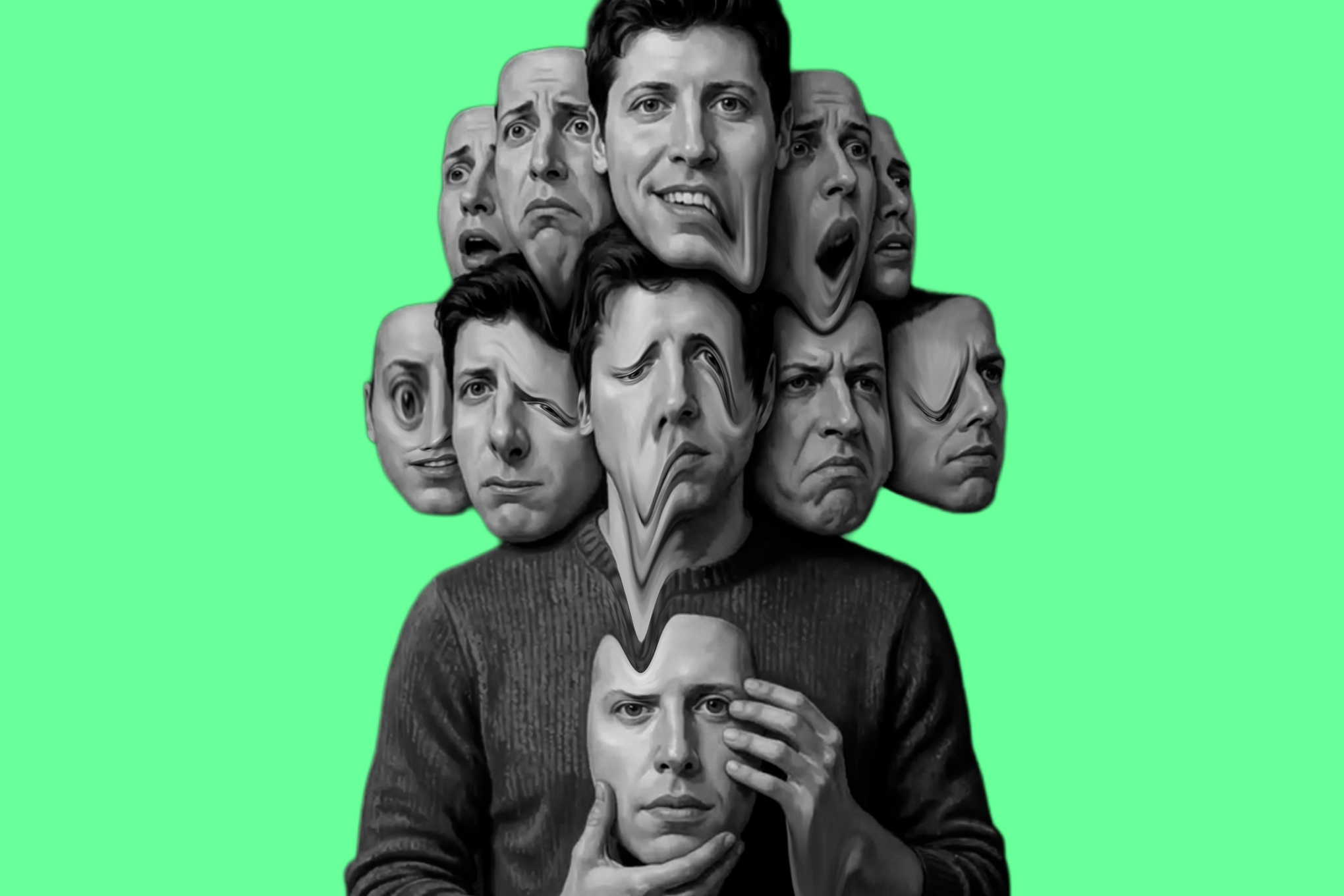
Altman’s staring back—multiple hims, all wrong. Angry brows. Woebegone mouths. One cradled in his palms like a guilty secret. The New Yorker slaps this AI fever dream atop their Sam Altman profile. Disclosure: “Visual by David Szauder; Generated using A.I.” Boom. Reader recoil.
Zoom out. This isn’t some blog slop. The New Yorker—America’s ink-stained elite—dipping toes into generative AI. For an AI boss no less. Szauder, the artist, mixes collages, videos, his own code. Predates Midjourney by years. Teaches in Budapest. But here’s the rub: why AI at all?
Your article about AI doesn’t need AI art. Punchy truth. Human illustrators nail uncanniness without the digital stink. Think Kadir Nelson’s soulful portraits or Christoph Niemann’s sly wit. AI? It hovers in that uncanny valley, promising depth, delivering gloss.
Creep Factor: Intentional or Just AI Being AI?
Szauder sketched 15 versions. Picked the hydra-head horror. Fed it to his custom AI—archival clips, family snaps, ethically sourced (he claims). Then Photoshop grind: tweak expressions, lighting, clothes. Manual fixes for AI’s flaws.
“For the base structure of the final image, I had a clear idea of how I wanted to position the character and its heads. So AI functioned even more as a tool than usual, especially since much of the work focused on shaping the faces, the heads, the portraits, through a combination of classical editing methods (Photoshop, if we want to name it) and AI-based editing.”
Nice process. Almost human. But that painterly sheen? Still screams machine. Eerie motion blur sells Altman’s “two-facedness.” Distrust coded in pixels. Yet it parodies nothing new. AI slop mocks itself daily on Twitter. Why outsource the punchline to algorithms?
Short answer: you don’t.
The New Yorker art director Aviva Michaelov greenlit it. Senior director Supriya Kalidas too. They’ve used Szauder before—AI animated bits. Prestigious mag, chasing relevance? Or just cheap thrills?
But—plot twist—Szauder insists: “> I strongly believe that even in the age of AI, an image must first be formed in the human mind, not in the machine.”
Amen? Sort of. His moral stance: custom code, clean data. No scraping grandma’s vacation pics. Whitehot Magazine calls him a pioneer. Fine. Still, it’s AI crutches for a story screaming hypocrisy.
Does The New Yorker Hate Its Illustrators?
Illustrators seethe. Cortisol spike, as one Verge scribe put it. Newsrooms “ensloppify”—AI drafts, AI images, or else. Vox Media (Verge parent) cut deals with OpenAI. Journalists scramble.
The New Yorker? They could’ve called Victo Ngai. Her complex worlds crush AI’s flatness. Or a cartoonist for bite. Instead, AI hydra. Waste. Pure waste.
My unique dig: this echoes 19th-century photography panic. Painters wailed “soulless machine!” Daguerreotypes stole jobs. Art evolved—impressionism, abstraction. AI won’t kill illustration. It’ll force laziness. Magazines using it for AI profiles? That’s not evolution. That’s admitting defeat. Bold prediction: by 2026, backlash bans it from mastheads. Readers smell the fakery.
Punchy aside—AI art for LeBron deepfakes or Brainrot memes? Sure. For longform prestige? Laughable.
Human process matters. Sketches on napkins. Ink bleeds. Revisions stack like regrets. AI skips the sweat. Flattens intent. Even Szauder’s hybrid feels half-baked—gloss over grit.
The Verge labels AI yellow, justifies every use. Strict. Smart. The New Yorker? Bare disclosure. Readers scroll past, queasy.
Why Skip Human Hands for Altman Slop?
Altman’s OpenAI empire: trust issues galore. Safety pledges flip-flopped. Billions vanish into black boxes. Perfect for caricature. A human artist could’ve skewered it—exaggerated eyes darting cash, tongues lolling promises.
AI version? Generic creep. Uncanny, sure. But predictable. Lacks bite. Szauder’s no hack—his pre-AI generative stuff rocks. Yet here, tool overtakes talent.
Corporate spin? The New Yorker dodges ethics debates. No quote on “why AI?” Just the image. PR silence screams gimmick.
Look. AI art’s fine for prototypes. Mood boards. Not covers. Especially not AI critiques. Irony overload shorts the circuit.
And it’s spreading. Wired dabbles. Wired—sorry, other mags. Illustrators unionize. Fiverr gigs crater. But prestige pubs? They set tone. This sets a trash one.
History bites back. Early Photoshop: “fake!” Now essential. AI? It’ll normalize. But normalize bad. Sloppy sheen everywhere. Newsrooms chase speed, lose soul.
Szauder’s ethical tweaks? Adorable dodge. All gen-AI scrapes somewhere. His code? Still probabilistic mush.
Final jab: if Altman’s untrustworthy, why trust pixels mimicking him? Hire the hand. Ditch the hallucination.
🧬 Related Insights
- Read more: AI Slashes Titan Cloud Mapping from Days to Seconds — NASA’s New Weapon
- Read more: TurboQuant Crushes KV Cache Memory on Apple Silicon
Frequently Asked Questions
Should magazines use AI art for AI stories? No. It’s lazy irony that undermines the critique. Human artists deliver sharper punches without the ethical baggage.
What AI tools did David Szauder use for The New Yorker? Custom-coded ones, fed ethical archives. Heavy Photoshop post-edits. Not off-the-shelf Midjourney slop.
Is AI art killing illustration jobs? Not yet—but prestige mags dabbling accelerates the slide. Expect union fights and reader boycotts soon.