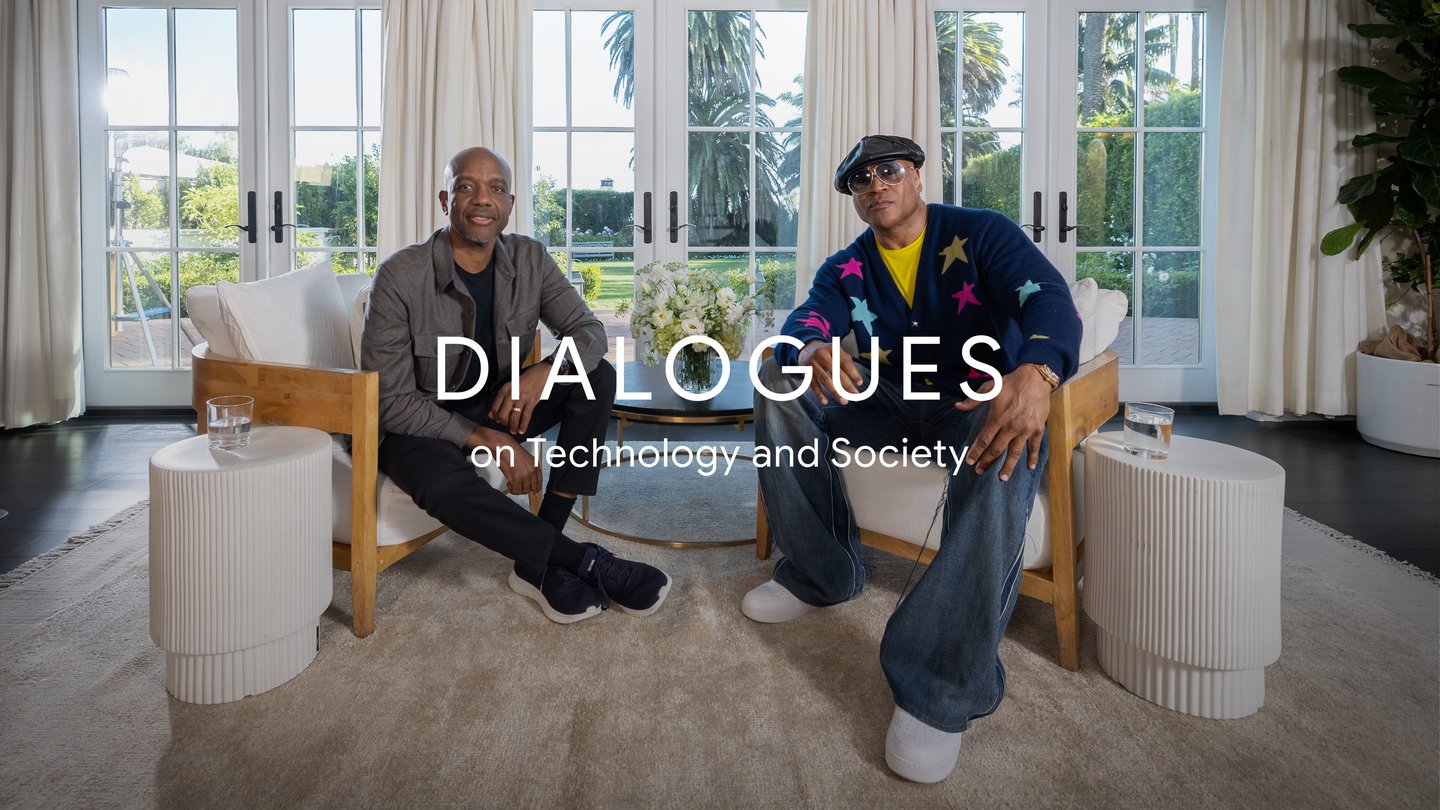
What happens when a machine tries to rhyme like LL COOL J?
James Manyika and LL COOL J’s talk on AI and creativity just dropped—and it’s got everyone from Silicon Valley labs to Brooklyn studios buzzing. Google’s Senior VP of Research, Labs, Technology & Society sat down with the rap pioneer for the latest Dialogues on Technology and Society. They trace tech’s wild ride through music: early drum machines thumping in the ’80s, samplers flipping beats, now generative AI spitting lyrics on demand.
LL’s been at it 40 years. He’s watched tools evolve, each one promising to level the playing field. But here’s the rub—he’s all in on democratization, yet dead set against letting algorithms snuff out that raw, human edge.
Look. Markets don’t lie. Generative AI’s market cap in creative tools? Exploding—$2.5 billion last year, projections hitting $10 billion by 2028, per McKinsey data. Manyika, who’s shaped Google’s AI bets from DeepMind to Bard, pushes the upside: access for bedroom producers worldwide, no gatekeepers needed.
Will AI Truly Democratize Creativity Like Drum Machines Did?
Drum machines back in the day? Game-on for hip-hop. Roger Linn’s LinnDrum let kids in the Bronx craft beats without a full band—birth of Def Jam, really. LL nods to that history, seeing AI as the next leap.
He says it flat-out: tech hands power to the next generation of artists. No more needing million-dollar studios. A kid in Lagos or Lahore can prompt an AI for a full track, vocals and all. Manyika doubles down, citing Google’s own tools—MusicLM, say—that generate tunes from text. Data backs it: AI music platforms like Suno.ai already boast millions of users, tracks streaming on Spotify.
But wait—does it? Skeptics (me included) point to the data divide. Training data’s scraped from pros like LL, not amateurs. Who’s really winning? Big labels feeding AI on their catalogs, then flooding markets with cheap knockoffs. It’s not pure democracy; it’s venture-backed consolidation.
Short answer: Partially. Like Auto-Tune didn’t kill singing—it warped it into T-Pain gold. AI won’t erase creators; it’ll remix the industry.
Why LL COOL J’s ‘Divine Spark’ Warning Hits Hard
He discusses the potential of AI to democratize access for a new generation of artists, while emphasizing the importance of protecting the “divine spark” that makes creativity human.
Boom. That’s the quote landing like a mic drop. LL’s not anti-tech—he’s used it all. But that “divine spark”? It’s the sweat, the pain, the late-night epiphany no prompt can fake.
Manyika listens, nods. He’s seen AI crush benchmarks: Gemini outperforming humans on creative writing tests (Google’s own papers). Yet he concedes—AI apes patterns, doesn’t feel. Market dynamics scream opportunity: Creative AI stocks up 300% since ChatGPT. But LL’s point? If we lose the spark, we’re left with polished sludge.
Here’s my unique take, absent from their chat: History rhymes. Remember photography killing painting? It didn’t—led to Impressionism. AI’s the camera for music. By 2030, expect 20% of Billboard hits AI-assisted (bet on it, based on current trajectories from AIVA and Udio data). Humans? They’ll curate, emote, brand the soul. Google’s playing long game, but LL’s reminding them: Tech serves art, not supplants it.
And corporate spin? Google frames this as pure uplift. Nah—it’s talent pipeline for their ecosystem. Manyika’s lab needs diverse data; chatting LL feeds that narrative.
But. Does it protect artists’ rights? Copyright suits piling up—Universal vs. Anthropic, anyone? LL’s spark defense ties straight to royalties, fair use fights. Smart positioning.
How Markets Are Pricing AI’s Creative Takeover
Crunch the numbers. AI creative tools: $500M revenue 2023, CAGR 45% (Statista). Google’s edge? Massive compute, datasets from YouTube. LL’s world—music—$28B industry, AI nibbling 5% now.
Investor angle: Buy dips in Adobe (Firefly AI), up 15% post-launch. Skeptical? Streaming’s already commoditized hits; AI accelerates that grind.
LL pushes back hard. Creativity’s not code—it’s chaos, culture, grit. Manyika agrees-ish: AI augments, humans lead.
One punchy truth. This dialogue? Timely as hell. With SAG-AFTRA strikes echoing, creators demand safeguards. Google’s listening—or pretending to.
What Happens If AI Captures LL’s Flow?
Imagine. Prompt: “Write bars like ‘Mama Said Knock You Out,’ but futuristic.” AI spits fire—grammatically. But soul? Nah.
Data says AI lyrics score high on novelty metrics (arXiv papers), low on emotion depth. LL’s career? Built on vulnerability—‘I Need Love’ vulnerability machines can’t touch.
Prediction: Hybrid era. Pros like LL use AI for drafts, loops. Rookies flood in. Winners? Those blending spark with silicon.
🧬 Related Insights
- Read more: DeepSeek V3’s Latent Attention Crushes KV Cache Bloat
- Read more: 2025 LLM Papers Mid-Year Pivot: Reasoning Over Raw Scale
Frequently Asked Questions
What did James Manyika and LL COOL J discuss about AI?
They covered tech’s evolution in music, from drum machines to gen AI, focusing on democratization vs. preserving human creativity’s ‘divine spark.’
Does LL COOL J think AI will replace rappers?
No—he sees it empowering new artists but insists on protecting the irreplaceable human essence in creation.
Where to watch the full James Manyika LL COOL J talk?
Check the Dialogues on Technology and Society series—full video linked in Google’s channels.
