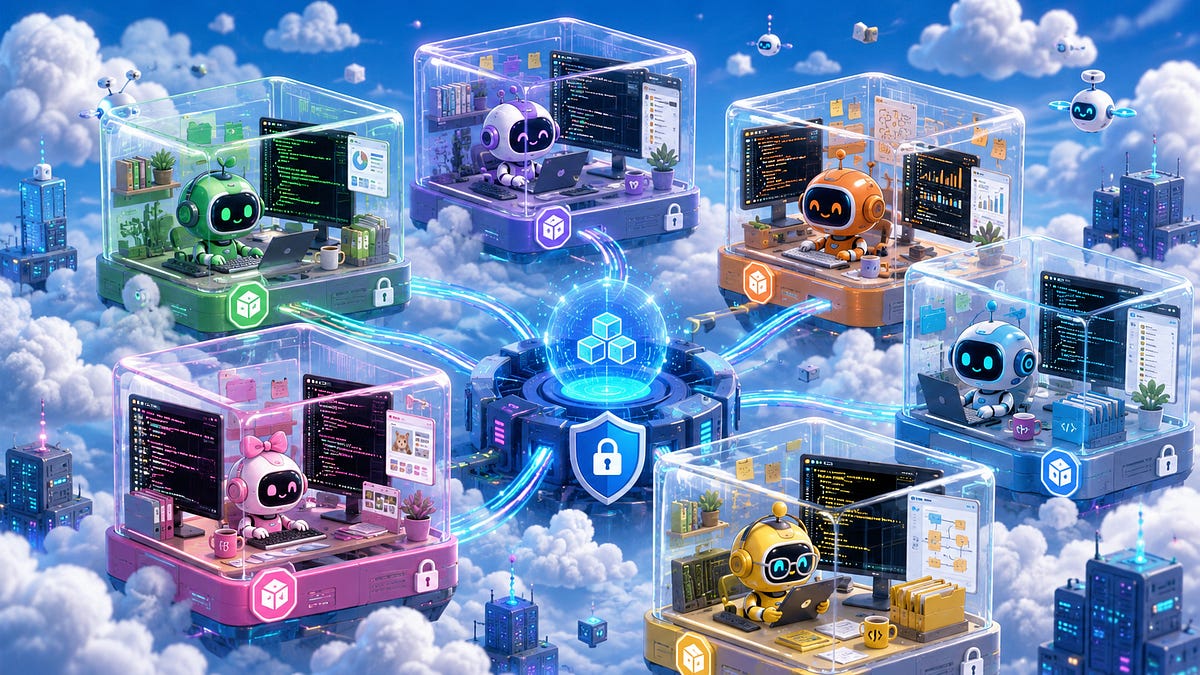
For the average person, this seismic shift in artificial intelligence means AI agents might soon stop being theoretical marvels and start becoming genuine digital collaborators. Imagine software that doesn’t just process requests but actively works on your behalf, managing files, writing code, and browsing the web with a tangible presence in your digital environment. This isn’t some far-off sci-fi concept; it’s the immediate, practical implication of giving AI agents access to the foundational tools of computing.
The ‘Body’ of Intelligence
The argument is simple, yet profound: an AI agent, no matter how sophisticated its underlying model, is fundamentally limited if it can only emit text. It’s like a brilliant mind trapped in a sensory deprivation tank. The real power, the ability to act and execute, comes from granting that mind access to a computer. This means a file system to store and retrieve information, a terminal to run commands, a browser to access the vastness of the internet, and crucially, a secure, isolated environment—a sandbox—where it can experiment, fail, and learn without consequence.
This emerging market for micro-containers and agent workspaces isn’t about fancy new software; it’s about providing intelligence with a tangible operational space. It’s the digital equivalent of giving a skilled worker the tools and the workshop they need to actually build something.
Why Does This Matter for Real Work?
Think about the current limitations. You ask an AI to write a script, and it gives you the code. Then you have to copy-paste it, run it yourself, debug it yourself, and manage any dependencies. It’s a fragmented, human-in-the-loop process that severely caps efficiency. When an AI agent has its own computer, its own terminal, it can execute that script directly. It can install the necessary packages, run the commands, inspect the output, and then iterate on the code based on the results—all autonomously.
This isn’t just about convenience; it’s about enabling a new class of autonomous workers. Imagine agents that can deploy software, manage cloud infrastructure, conduct detailed market research by navigating complex websites and synthesizing data, or even automate scientific experiments by controlling laboratory equipment via software interfaces. The current paradigm feels almost archaic by comparison.
The Sandbox Imperative: Safety First, Then Action
Crucially, this access must be provided within a secure, isolated environment. The notion of an AI agent with unfettered access to a production system is, frankly, terrifying. The market for sandboxes, micro-containers, and browser runtimes is therefore not just about enabling functionality but about building the necessary guardrails. These environments are designed to contain the AI’s actions, monitor its behavior, and prevent unintended consequences—a critical step before we can confidently delegate complex tasks.
“An agent that can only emit tokens is a brilliant brain in a jar; an agent with a filesystem, terminal, browser, network, package manager, credentials, memory, and guardrails becomes a worker inside a real execution environment.”
This quote perfectly encapsulates the core proposition. The “brain” is already here, in the form of powerful LLMs. What’s been missing is the “body”—the ability to interact with the world in a meaningful, executable way. The focus on these execution environments signals a pragmatic maturation of the AI agent field.
The Hype vs. The Hardware
Much of the AI discourse still revolves around model capabilities and theoretical advancements. While those are important, this development signals a shift toward the practical engineering that will unlock real-world utility. It’s easy to get lost in the hype of ever-larger context windows or fancier tool-calling APIs. But the fundamental bottleneck for agents has always been their inability to do things outside the token stream. Giving them a computer solves that.
This is a subtle but vital point. Companies might frame these developments with buzzwords, but the underlying reality is a fundamental architectural change. It’s not just about a smarter model; it’s about providing the infrastructure that allows that intelligence to operate effectively and safely in digital space. Think of it as moving from an architect who can draw amazing blueprints to an architect who can also manage the construction site.
The market for these agent workspaces, therefore, represents a tangible bet on the future of automated work. It’s a move from theoretical potential to practical implementation, and the implications for productivity, for how we interact with technology, and even for the job market are immense. The days of AI as a passive information provider are rapidly drawing to a close. The age of the active digital agent is dawning, and it’s built on the humble, yet indispensable, foundation of a computer.