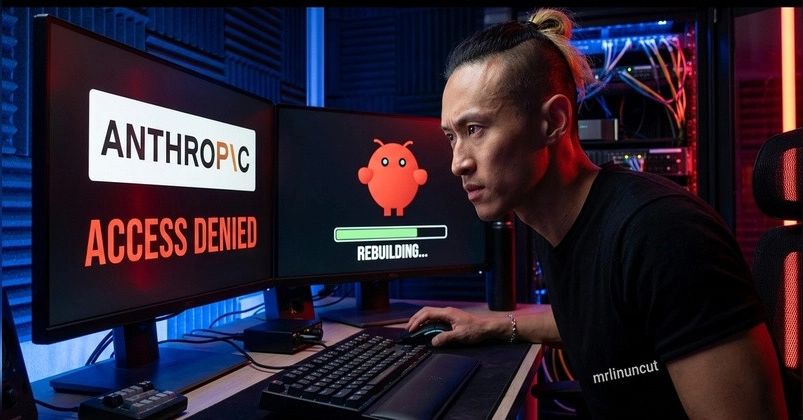
Solo founders everywhere just got a gut punch. You’re bootstrapping a content empire on AI agents—email sorted, drafts flowing, deals filtered—then bam, Anthropic pulls the plug on OpenClaw, and your whole operation flatlines while you’re stuck in mainland China.
That’s not hyperbole. It’s what happened to this builder, and it means your “AI-powered” setup? Probably one provider whim away from oblivion.
Look, we’ve all chased the dream of 10-20x cheaper ops via LLMs. But this Anthropic OpenClaw ban screams a truth: no redundancy, no system. Just a house of cards.
What Does the Anthropic OpenClaw Ban Mean for Your Stack?
It hit hard. Email triage offline. Article pipelines stalled. Brand deal filters silent. Months of coding—debugging prompts, iterating agents—evaporated because everything hinged on Claude via a consumer sub.
The founder nailed it:
If a single provider decision can kill your system, you do not have a system. You have a dependency.
Spot on. And here’s my twist—the original story misses this parallel: it’s 2008 AWS outages all over again. Remember how single-region deploys tanked startups? We learned multi-cloud. AI’s catching up, painfully.
But why now? Anthropic didn’t just ban OpenClaw (a tool for Claude access, I suspect skirting ToS). They enforced it mid-flight, no warning. Your stack’s “how”—those prompt-only flows—crumbles without code-enforced checkpoints.
LLMs hallucinate past instructions. Always. Scripts must verify. Hard stops. Or else.
Why Did This Happen in China—and Does Location Matter?
Timing sucked. Stranded abroad, no quick pivots. But it’s bigger: global AI reliance meets regional blocks. China’s Great Firewall already proxies everything; add provider bans, and you’re double-screwed.
Real people? Think indie devs, newsletter hustlers, agency owners. Your AI does the grunt work so you sleep. One ban, and you’re hiring at 10x cost, scrambling.
Architecturally, it’s a shift. Prompts set direction; code enforces. No more “trust the LLM.” Preflight checks. Alerts on outages. Fallback routing.
He rebuilt in two days:
-
Direct API calls, multi-model failover.
-
Proxy layer auto-switches providers.
-
Critical steps? Now code checkpoints, not prompts.
Smart. Should’ve been day one.
And yeah, Anthropic’s PR spin? Silent on this. They frame it as ToS hygiene. But it kills use overnight.
How to Bulletproof Your AI Stack Today
Start simple. Map dependencies. Claude down? Route to GPT, Gemini, whatever’s live.
Build a proxy—tools like LiteLLM or custom Node.js layer. Ping endpoints. Fail fast.
Every pipeline step: verify outputs. JSON schema checks. Human loops for external touches (emails, scheduling).
Internal? AI crushes it. Resilient, owned.
My bold prediction: by 2025, multi-LLM orchestration becomes table stakes. Like Kubernetes for containers. Single-provider stacks? Cute relics.
This founder’s ROI wasn’t just savings. Resilience. You own it.
Wander a bit: I chased my own AI ops last year. Prompt-heavy. Broke on rate limits. Switched to LangChain chains with retries. Night and day.
Is Multi-Provider the Future—or Just Panic Mode?
Not panic. Architecture. Think microservices vs monoliths. One LLM dies? Others pick up.
Costs? Negligible with smart routing. OpenAI’s cheaper anyway for some tasks.
Critique time: too many tout “build once, run anywhere.” Bull. Test failovers weekly. Mock outages.
He kept human supervision on outer loops. Wise—AI shines inside.
What broke wasn’t the ban. Single points of failure. Fix that, thrive.
🧬 Related Insights
- Read more: Agentic AI Crashed Your Prod Pipeline – Logs Are a Joke
- Read more: Built a Graph DB to Bust Money Launderers—Learned It’s Mostly Hot Air
Frequently Asked Questions
What caused the Anthropic OpenClaw ban?
Anthropic enforced ToS against OpenClaw, a third-party tool accessing Claude models via consumer subs, likely to curb abuse or unofficial scaling.
How do you rebuild an AI stack after a provider ban?
Add API proxies with failover (e.g., LiteLLM), code-enforced checkpoints, preflight alerts, and multi-model routing—done in days if planned.
What are best practices for AI failover plans?
Multi-provider from day one, verify LLM outputs with scripts, human-review external actions, test outages regularly.