The flickering cursor on the blank IDE screen. A familiar scene for any engineer. But for AI, the real struggle isn’t writing code. It’s the brutal, unwritten rules of production. The stuff they absolutely never teach you in school.
Forget elegant algorithms for a second. We’re talking about the dirty details. When does a slick API call become a budget black hole? How much does that 2% accuracy gain really cost in debugging hell? These aren’t academic exercises; they’re the daily grind.
This isn’t about theoretical models or the next flashy research paper. This is about what happens when the rubber meets the road, and your shiny AI product needs to actually work. And keep working. And not bankrupt the company.
The Unspoken Rules of AI Production
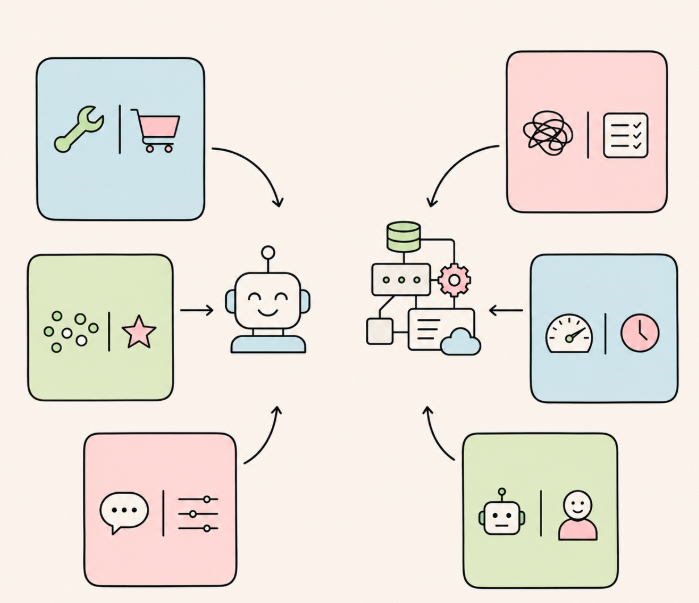
Anyone can learn how to build a model. Few can teach you how to navigate the minefield of production. The original article — bless its data-driven heart — tries to tackle six core dilemmas. Let’s break them down, with a healthy dose of skepticism, of course.
1. Build vs. Buy: The API Tightrope
The old question was: train it yourself or use a pre-trained beast? Now, it’s more nuanced. We’re talking API calls versus fine-tuning an open-source model versus, God forbid, building your own stack from scratch. This feels like a decision with clear cost-benefit, right? Wrong.
Sure, calling an API like GPT-4o Mini is cheap and fast at first. Below 100k requests daily? Probably your best bet. But ramp it up to a million requests? Those per-token costs start to sing a siren song of impending doom. And here’s the kicker they always forget: the engineers. Hardware is a fraction of the cost. Your staff’s salaries? That’s where the real money goes. Teams blow their LLM budgets by 340% on average, not because the token rate is too high, but because they can’t track who or what is burning cash.
And then there’s the framework lock-in. Hugging Face’s TGI moving to maintenance mode? Teams built on it scrambled. API users? Didn’t bat an eye. The practical advice: start with the API, instrument everything (cost, latency, attribution), and switch only when the math screams at you.
2. Complexity vs. Maintainability: The 6-Month Curse
Google’s “Changing Anything Changes Everything” (CACE) principle. It’s cute. In ML, it’s a nightmare. A tiny change here can break everything there. Especially with ensembles and neural nets. Forget code dependencies; data dependencies are the real monster. Data is harder to track, harder to version, and impossible to explain to the poor sap who inherits your mess in six months.
The actual model code? A sliver. The rest? Feature stores, pipelines, monitoring, retraining triggers — the whole spaghetti junction. Teams chase a 2% accuracy bump with a complex model, then spend 18 months debugging, retraining, and groaning, “Why did we do this?” If the honest answer to “Who owns this in a year?” is “I don’t know,” you’ve found your decision point.
3. Data Quantity vs. Data Quality: The Mirage of More
For those gargantuan foundation models trained on the entire internet? Yeah, more data helps. For applied ML? Not so fast. Push past a certain noise threshold, and adding more data actively hurts performance. The relationship between samples and accuracy isn’t infinite. It breaks. Hard.
The article touches on this with its “data swamp” analogy. It’s a good one. Trying to build a pristine ML system on a foundation of junk data is like building a skyscraper on quicksand. You need quality over sheer volume, especially when you’re not Google.
4. Throughput vs. Latency: The Real-Time Reckoning
Batch processing for those scheduled, non-urgent tasks? Cheap and cheerful. Real-time inference for that immediate user response? It costs. And it costs in more ways than just GPU hours. Think infrastructure, complexity, and potential failure points.
When does that slight delay in batch processing become unacceptable? When does the cost of maintaining a low-latency, always-on system outweigh the benefits? This is a classic engineering trade-off, but in AI, the stakes are higher. A slow chatbot is an abandoned chatbot. A batch job that’s too slow might just mean a lost opportunity. The research here highlights that while batch can be cheaper, it’s the predictability and reliability of real-time that often wins in user-facing applications, even if it’s more expensive upfront.
5. Prompt Engineering vs. Fine-Tuning: The Investment Curve
Prompting is easy. Get a good prompt, and the model spits out decent results. It’s fast. It’s iterative. But it has limits. Fine-tuning a model? That’s a commitment. It takes data, time, and serious compute. You’re baking in specific behaviors, not just guiding them with words.
The most common pitfall is starting fine-tuning too early. Prompting is cheaper and faster. You can iterate much faster with prompts than with fine-tuning. Fine-tuning is a bigger investment and should be reserved for when prompts stop being sufficient. [Source: Original Article]
The question isn’t if you should fine-tune, but when. And why. Is the prompt engineering truly exhausted, or are you just looking for a more complex solution to a simple problem? The cost curves are stark. Prompting is a low-cost, low-commitment entry, while fine-tuning is a significant investment with higher potential returns—if you get it right.
6. Automation vs. Human Oversight: The Trust Equation
This is the big one. How much do you let the AI do on its own? When do you absolutely need a human to sign off? This isn’t just about safety; it’s about cost, speed, and the inherent limitations of even the most advanced AI.
We saw this with early autonomous driving systems. Amazing tech, but blind spots. Humans are messy, slow, and prone to error, but they also possess intuition, common sense, and the ability to handle novel situations. AI is brilliant at pattern recognition and executing defined tasks. It falters when faced with true ambiguity or ethical quandaries.
The research indicates a continuous spectrum. For high-stakes decisions or areas with significant ethical implications, human oversight remains non-negotiable. For routine tasks where the cost of a rare AI error is low, full automation might be feasible. The key is understanding the risk tolerance of your application and the current capabilities of your AI system. It’s a constant balancing act, and the line shifts as AI evolves. But don’t kid yourself: a human in the loop is often the cheapest form of error correction.
The Unavoidable Reality
These six trade-offs aren’t abstract concepts. They are the daily bread of anyone trying to ship and maintain AI in the real world. The original article provides a good framework, but the true learning comes from wrestling with these decisions yourself. And often, you’ll learn best from the mistakes. We all do.
🧬 Related Insights
- Read more: semver-checks: The CLI That Finally Ends TypeScript’s SemVer Guessing Game
- Read more: The Hidden Memory Traps Killing Your Manticore Search — And the Dashboard That Exposes Them
Frequently Asked Questions
What does it mean to build vs. buy in AI? It’s the decision of whether to use third-party AI APIs, fine-tune existing open-source models, or develop and host your own AI infrastructure from scratch, balancing customization, cost, and speed.
When should I consider fine-tuning an AI model instead of just using prompts? Fine-tuning is a larger investment best reserved for when prompt engineering alone is insufficient to achieve the desired model behavior, accuracy, or specialization, typically after exhausting simpler prompting techniques.
Is more data always better for AI models? No, for applied machine learning, adding low-quality data beyond a certain noise threshold can actually degrade model performance; data quality often trumps quantity.