Picture this: you’re hunched over your MacBook in a dimly lit coffee shop, coffee steaming, as gigabytes of medical imaging data stream from Google Cloud—straight into a fine-tuning session for Gemma 4, no NVIDIA hardware in sight.
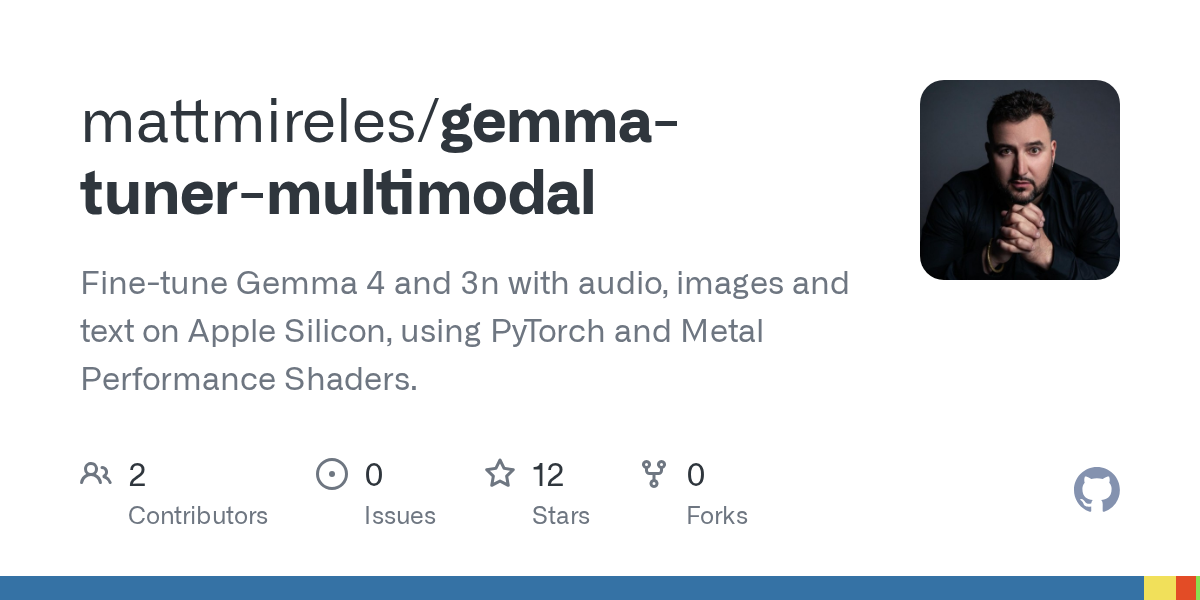
Gemma 4 Multimodal Fine-Tuner for Apple Silicon. That’s the beast Matt Mireles just unleashed on GitHub, and it’s a game-changer for anyone tired of begging for H100 time or drowning their laptop in terabytes of training data.
This tool—gemma-tuner-multimodal—handles text, images, and audio. On your Mac. Locally. Or streamed from GCS or BigQuery. No copying petabytes locally; it shards on demand, like Netflix buffering your next episode without hogging your drive.
And here’s the kicker—it’s MPS-native. Apple’s Metal Performance Shaders hum along, turning your Silicon chip into a fine-tuning powerhouse. Forget Unsloth or Axolotl fumbling on Apple hardware; this is the only one nailing audio + text LoRAs natively.
Why Your Mac Just Became an AI Fine-Tuning Supercomputer
Look, we’ve been slaves to NVIDIA’s empire for too long—renting clusters, praying for availability, watching bills skyrocket. But Apple Silicon? It’s flipping the script, much like how the Macintosh crushed mainframes back in ‘84, shoving creative power into every desk.
This tuner loads Hugging Face’s Gemma checkpoints—2B or 4B instruct models like gemma-4-e2b-it—and slaps PEFT LoRA on top. Supervised fine-tuning via a clean Python script, then export to merged HF or SafeTensors. Want Core ML for on-device inference? Guides are there.
If you want to fine-tune Gemma on text, images, or audio without renting an H100 or copying a terabyte of data to your laptop, this is the only toolkit that does all three modalities on Apple Silicon.
That’s straight from the repo. Bold claim? Check the table: it green-lights everything MLX-LM dreams of, plus audio and cloud streaming where others blank out.
Short para punch: It’s open-source. Public GitHub. Fork it yesterday.
But dig deeper—this isn’t just convenience. It’s a prediction: on-device multimodal fine-tuning will birth a explosion of edge AI apps. Think domain-specific beasts: medical dictation that nails jargon Whisper botches, receipt captioning for fin-tech agents, accent-adapted voice models for low-resource languages. Your Mac becomes the lab; data stays private, never pinging APIs.
Can You Fine-Tune Gemma 4 Multimodal on a Single MacBook?
Hell yes. And it’s wizard-guided—Questionary + Rich UI walks you through. CLI’s gemma-macos-tuner bootstraps MPS early, dodging Torch pitfalls.
Text-only? CSV splits under data/datasets, modality=text. Boom, instruction tuning.
Images? Modality=image, toss in captioning or VQA pairs from local CSV. Token budget your call.
Audio—that holy grail. Pair waveforms with text transcripts. Only this tool does it on Apple Silicon, routing through gemma_tuner/models/gemma/finetune.py.
Memory? Wizard spits hints from ModelSpecs. E2B fits comfy; E4B pushes but doable on M3 Max. No drama.
Skeptical? It’s Gemma-only by design—3n and 4 E2B/E4B checkpoints prepped in config.ini. Add your own [model:foo] with a compatible base_model. Larger 26B/31B? Not yet—their Transformers arch mismatches the audio path. Fair.
One caveat: v1 images/text are local CSV only. Streaming’s text/audio tease for now. But terabyte GCS/BigQuery? Handled.
The Killer Use Cases That’ll Hook You
Domain-specific ASR. Train on legal depositions—Gemma learns “habeas corpus” cold, unlike generic Whisper.
Vision for niches: manufacturing defects in photos, chart QA from screenshots. Hallucinations? Vanquished.
UI agents: screenshot to structured JSON. Multimodal assistants grounding text reasoning in pixels or sound waves.
And private pipelines—train, export, run on-device. Data locked down.
This echoes the PC revolution: power to the people, minus the beige boxes. Back then, desktops democratized computing; now, your Mac democratizes custom AI. Bold take? Nvidia’s cloud moat crumbles as Silicon chips close the perf gap—Apple’s secret sauce for indie devs building the next wave.
Under the hood: utils/device.py picks MPS>CUDA>CPU, syncs tensors. dataset_utils.py patches CSVs, blacklists junk. ops.py dispatches prepare/finetune/eval/export.
Install? pip install -e . (pin to gemma-3n-e2b-it default). Gemma 4 needs extra reqs.
Deeper? README/guides and specs/Gemma3n.md.
Why Does This Matter for Indie AI Builders?
Energy surge. No more gatekept by GPU lords. Prototype fast—fine-tune on your commute, iterate by dinner.
It’s the platform shift: AI as software, fine-tunable like code. Vivid analogy—remember Photoshop plugins? This is LoRA for multimodality, but on hardware you own.
Critique the hype? None here; it’s raw GitHub truth, no VC gloss. Mireles delivers where corps dawdle.
Prediction: within a year, Gemma-tuned edge models power a thousand apps—from personal tutors to factory QA bots. Your Mac? Ground zero.
Fragment: Exciting times.
Long weave: We’ve waited for this convergence—powerful local chips meeting open multimodal bases like Gemma, dataloaders smart enough to stream the world’s data without local bloat, all wrapped in a CLI that feels like magic but runs like clockwork, positioning solo devs to outpace teams shackled to clouds, because speed wins in AI’s wild frontier where ideas lap infrastructure every day.
Medium: Get building.
🧬 Related Insights
- Read more: Peering Inside the LLM Engine: Tokens, Transformers, and the Magic of Prediction
- Read more: Kubernetes Spins Up AI Gateway Working Group as AI Workloads Flood Clusters
Frequently Asked Questions
What is Gemma 4 Multimodal Fine-Tuner?
It’s an open-source toolkit for fine-tuning Google’s Gemma models on text, images, and audio using Apple Silicon Macs, with cloud data streaming to avoid local storage woes.
Does Gemma Tuner work on Apple Silicon without NVIDIA?
Yes, fully MPS-native—runs on M1/M2/M3/M4 chips, no GPU rentals needed, outperforming alternatives like Unsloth on non-NVIDIA hardware.
How do I fine-tune Gemma on images and audio with this tool?
Use CSV datasets with modality=image or audio in config.ini, stream from GCS/BigQuery if huge, and launch via gemma-macos-tuner finetune—wizard UI guides you.
