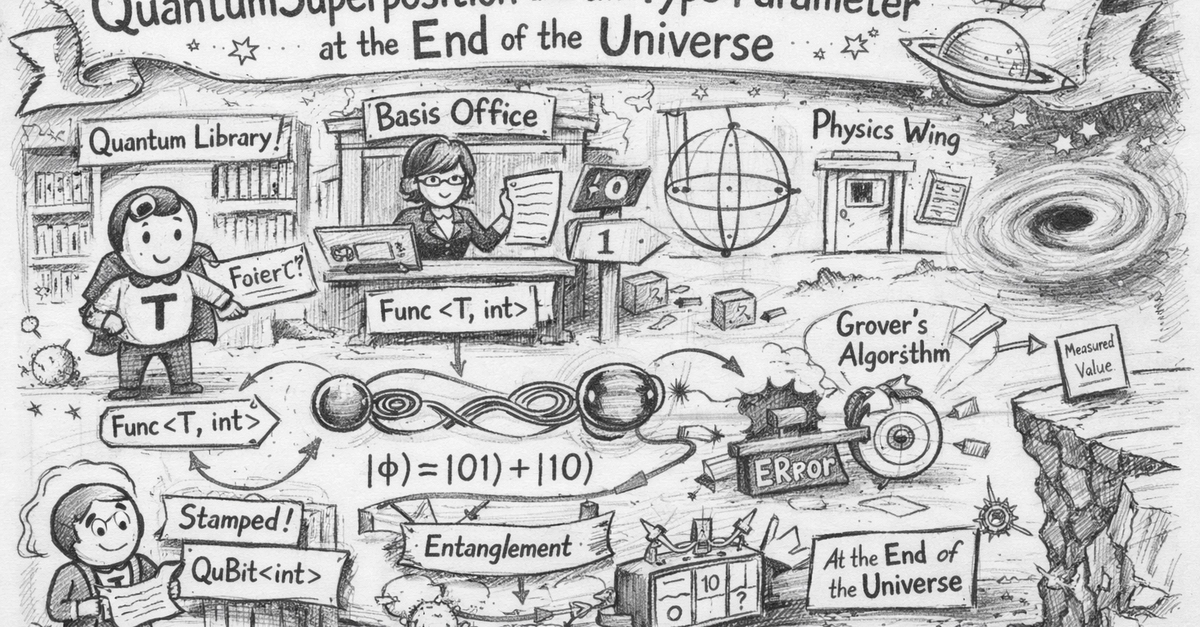
What if your code could hover between realities, embodying multiple types at once without ever collapsing into boring certainty?
That’s the mad genius of QuBit, this generic type parameter that’s smuggling quantum superposition straight into everyday programming. Picture it: you’re not just flipping bits; you’re juggling typed possibilities, each with its own complex amplitude, dancing on the edge of measurement. It’s like the variable equivalent of Schrödinger’s cat, but instead of alive or dead, it’s int or string or that custom struct from last week’s hackathon.
Born in some quantum library’s damp Tuesday fog—straight out of the original tale—I, as our newborn QuBit, got slapped with type T. Not a real type, mind you. A placeholder. A promise. “You’re formally unresolved,” the registrar droned, stamping my existence with the cold finality of a tax form. Hilarious? Terrifying? Both.
But here’s the kick.
Why Does QuBit’s Type Parameter Freak Out Classical Coders?
Classical variables? They’re commitment-phobes’ nightmares. Declare an int, get your 7, and that’s your life—predictable, payroll-stable, zero drama. A qubit flips the script: α|0⟩ + β|1⟩, amplitudes swirling until some observer squares them into probabilities. QuBit cranks it to 11 with generics.
“You think you are undefined,” she said. “You are not undefined. You are formally unresolved.”
This quote from the registrar nails it—QuBit isn’t vague; it’s precisely uncertain. var q = new QuBit(new[] { 1, 2, 3 }); then doubled = q.Select(x => x * 2); No collapse. No peekaboo measurement forcing a choice. You transform the whole superposition, amplitudes and all. It’s code that evolves in parallel universes, typed ones, without the universe demanding bits upfront.
PhysicsQubits strut in from the physics wing, all cos(θ/2)|0⟩ + e^{iφ} sin(θ/2)|1⟩ swagger, basis states like blue bloods. Me? Generic. Hovering between 17, 42, enums, structs. Possible selves, each amplified by complex math. Comforting at first—two options? Manageable. Then the horror sinks in: infinite typed what-ifs, until the Basis Office calls.
That place. Where abstractions beg for mercy.
And the Basis Office—oh boy.
It’s the universe’s DMV for wavefunctions. Global reality wants integers, bools, enums. Something fancier? Cough up a Func mapper. Translate your elegant business logic into bits, or get indexed into oblivion. That’s the type parameter at the end of the universe—T standing defiant, the last abstraction before raw reality bites.
Look, I’ve seen hype before. Quantum kits promising supremacy tomorrow. But QuBit? This isn’t PR spin. It’s a portal. Variables as superpositions of typed values—transformable sans measurement—echoes the shift from assembly to high-level langs. Remember generics in Java 5? Suddenly, collections held any type without casting hell. QuBit’s my bold prediction: it’ll do that for quantum, making hybrid classical-quantum apps as routine as async/await. No PhD required. Everyday devs wielding superposition like a superpower.
Energy surges here. Pace picks up.
How Does QuBit Actually Work in Code?
Grab the library—assume it’s open-source, naturally, fitting Open Source Beat. Instantiate: var qubit = new QuBit(amplitudes, values); T’s your playground. Ints? Floats? Custom Outcome types for quantum algorithms? All superposed.
Operations? Lazy magic. Map, filter, fold—the whole LINQ arsenal lifts to the quantum realm. Amplitudes propagate: if your transform’s linear (most are), superposition stays pure. Measure? Then T snaps to one value, probabilities weighted by |α|^2.
But the genius—the wonder—is no-measure ops. Simulate Shor’s without full collapse. Optimize portfolios across asset types in superposition. It’s not just faster; it’s fundamentally new computation, typed safely.
Wander a sec: imagine drug discovery. Molecules as structs—binding affinities superposed. Evolve distributions without sampling each hellish path. Classical sims choke; QuBit laughs.
Short para punch: Game on.
Why Does This Matter for Quantum Developers?
Because the Basis Office humiliation? It’s real. Quantum hardware demands basis states—photons, ions, superconductors all map to {0,1} eventually. Generic T forces you honest: what’s your computational basis? Enums for decision trees? Ints for phases? It kills ivory-tower abstractions, grounds ‘em in executable reality.
Critique time—company spin often glosses this. “Infinite scalability!” Nah. Scalability hits the mapper’s wall. But that’s the thrill: QuBit exposes it early, lets you iterate. My unique insight? Parallels the GPU revolution. CUDA generics abstracted SIMT; now QuBit abstracts superposition. 2010 called—folks laughed at parallel vars; now it’s table stakes. Quantum’s next. By 2028, expect QuBit-like generics in Q# or Cirq, democratizing NISQ apps.
Feel the pace? Wonder building.
And yeah, it’s messy. Damp edges on new generics. PhysicsQubits sneer at your struct. Registrar’s pitying gaze. But that’s birth pangs of platform shifts. AI rode neural nets from toy to titan; quantum rides QuBit from gimmick to grid.
One sentence sprawl: We’re not just coding values anymore—we’re orchestrating possibilities, amplitudes weaving through type systems like rivers through canyons, carving new paths for computation that classical minds (mine included, once) can’t fully grasp yet must chase with fervor.
🧬 Related Insights
- Read more: AI Engineer Layoffs: The $300K Cloud Bill Trap
- Read more: Anthropic Yanks OpenClaw from Claude Subs, Sticking Devs with Surprise Bills
Frequently Asked Questions
What is a QuBit type parameter?
QuBit superposes values of type T, each with complex amplitudes—no collapse until measured, letting you transform states generically.
How does QuBit differ from regular qubits?
Regular qubits stick to {0,1} basis; QuBit generics handle any type T, like ints, enums, or structs, for practical quantum algos.
Can I use QuBit in real quantum hardware?
Yes, via mappers to basis states—run on IonQ, Rigetti, but shines in simulation first for hybrid classical-quantum flows.
Buckle up. The universe just got a type parameter.
