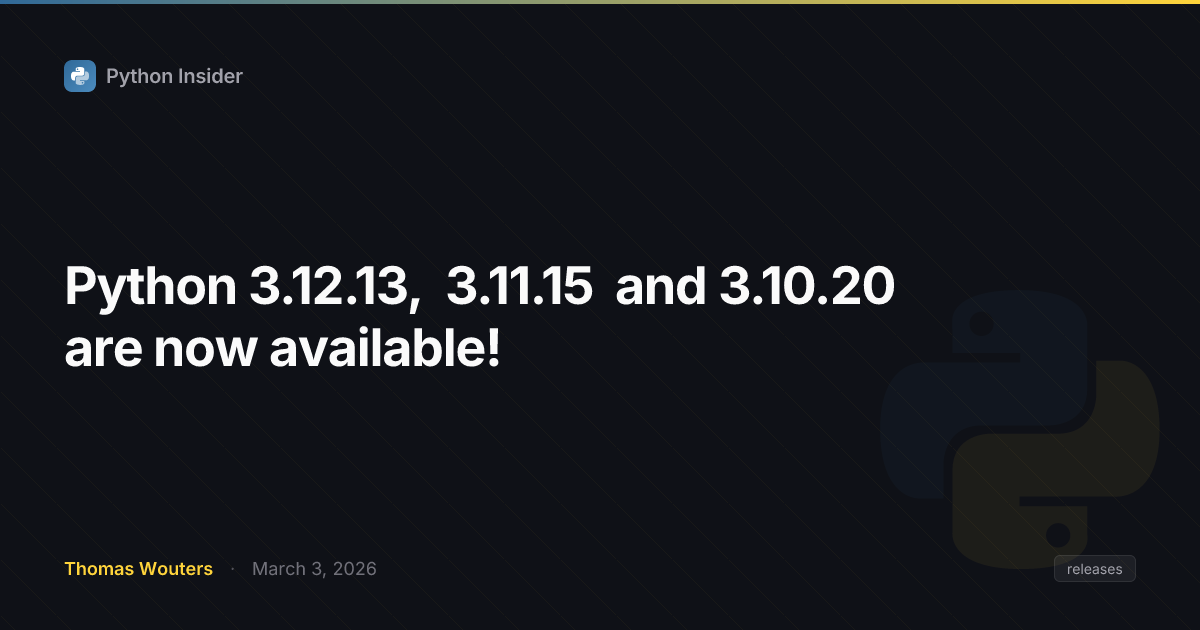
Your next email blast from that Django app? It could be a hacker’s backdoor if you’re still on unpatched Python. Python 3.12.13, 3.11.15, and 3.10.20 just landed with a barrage of security fixes—source-only drops since these branches are in lockdown mode, churning out patches without fanfare or binaries.
Real people—web devs juggling Flask servers, data scientists parsing XML feeds, sysadmins running CGI scripts—wake up vulnerable every day their runtime lags. One overlooked CVE in email handling, and boom: injected headers turn your outbound messages into phishing vectors. We’re talking everyday tools like email.generator.BytesGenerator now flat-out refusing unsafe folds, thanks to CVE-2024-6923.
And here’s the kicker—these aren’t fluffy improvements. They’re battle scars from the front lines of open-source defense.
Email Headers: The Silent Killer Returns
Look, email’s been a mess since forever—remember the great header injection panics of the early 2010s? Python’s modern policies just got a comment-folding fix (gh-143935) to stop long, non-foldable junk from sneaking past. It’s linear complexity now for HTTP params too (gh-136063), because quadratic blowups are attacker’s candy.
“email.generator.BytesGenerator now refuses to serialize headers that are unsafely folded or delimited (see email.policy.Policy.verify_generated_headers); addressing CVE-2024-6923.”
That’s straight from the release notes—dry, but it screams urgency. Your SMTP relay or newsletter tool? Patch it, or risk becoming the next cautionary tale.
But wait—wsgiref.headers.Headers (gh-143916) now boots C0 controls from fields, values, params. http.cookies.Morsel does the same (gh-143919). Even data: URLs reject controls (gh-143925). It’s a full-spectrum sweep against the low-level crap attackers sling.
Why Does XML Parsing Keep Exploding?
XML. That relic we can’t quit. Libexpat bumps to 2.7.4, squashing CVE-2026-24515 and CVE-2026-25210 (gh-144363). Then xml.parsers.expat gets allocation trackers to cap memory bombs from evil inputs—mitigating CVE-2025-59375 (gh-90949). No more quadratic node ID caches in xml.dom.minidom (gh-142145).
Think about it: your API ingesting third-party XML? One fat payload, and your server’s OOM-killed. This hardening isn’t optional; it’s survival for anyone touching syndication feeds or config files.
Here’s my take, one you won’t find in the release blurb: this mirrors the Heartbleed era for OpenSSL—volunteer teams racing to plug lib-after-lib as exploits mature. Python’s security-fix-only phase forces a brutal architecture shift: no new features, just patches, pushing devs toward 3.13 like Linux LTS kernels nudge to mainline. Bold prediction? By 2026, 3.10 stragglers will be museum pieces, bleeding exploits in forgotten corners of the web.
DoS Hardening: No More Free Crashes
plistlib, http.client, http.server (Windows CGI especially)—all patched against memory DoS (gh-119342, 119451, 119452). os.path.expandvars() sheds quadratic baggage (gh-136065). html.parser.HTMLParser toughens up with RAWTEXT/PLAINTEXT tags like , , even optional (gh-137836).
Short version? Hostile markup won’t melt your parser anymore. And SSL’s use-after-free on SSL_new() failure? Fixed (gh-144833). Plus backports: list rich compares and slice assigns dodge use-after-free/out-of-bounds under concurrent hell (gh-120298, 120384)—stuff already in newer 3.12.
“Stay safe and upgrade! As always, upgrading is highly recommended to all users of affected versions.”
The release team’s plea hits hard—volunteers like Thomas Wouters and Pablo Galindo Salgado grinding this out. Impressive, yeah, but it exposes the strain: Python’s volunteer model shines, yet corporate backers (looking at you, big cloud outfits) could fund full-time triage.
So, how’d they pull this off? Deep in the C guts—refusing chars at parse time, capping allocs, linearizing loops. No silver bullet, just incremental walls against fuzzers and red-team pokes.
Is Your Python Stack Actually Safe Now?
Not yet. These are source drops—no wheels, no easy pip. Grab from python.org, compile if needed (Docker helps). Test your deploys—email libs, XML parsers, HTTP handlers. If you’re on 3.9 or older? You’re firewatching a dumpster.
Corporate hype? Nah, this is raw necessity—no spin, just GitHub issues turned fixes. But critique time: Python’s “security-fix-only” tag feels like a polite eviction notice. It works—fewer zero-days slip—but accelerates version churn, punishing conservative ops teams.
Wander a bit: remember Ruby’s 2013 mass-pwn via unpatched Rails? Python dodged that bullet through community vigilance. These patches? Proof the system’s holding, but entropy wins without upgrades.
The Bigger Shift: Open-Source Maturity Test
Python’s entering a phase where security isn’t bolted-on—it’s baked deep. Expat trackers, header validators: architectural bets on defense-in-depth over speed hacks. For devs, it means auditing stdlib deps harder, leaning on tools like pip-audit.
Prediction: this cadence (irregular, fix-driven) will birth a new norm—security SLAs for OSS runtimes. Red Hat’s doing it for Podman; Python could follow.
Upgrade. Now. Your users thank you later.
🧬 Related Insights
- Read more: The Silent Killer in Your Build Pipeline: How Two Tiny Bugs Nearly Broke Production Video Rendering
- Read more: Kubernetes API Governance: The Unsung Heroes Battling API Sprawl
Frequently Asked Questions
What do Python 3.12.13 security fixes cover?
They tackle email header injections (CVE-2024-6923), XML memory amps (CVE-2025-59375), DoS in plistlib/http, and more—full list in release notes.
Should I upgrade from Python 3.11 to 3.12.13?
Yes, immediately if exposed to email/HTTP/XML—backports cover 3.11.15 too, but newer branches get broader support.
Do these Python patches break existing code?
Unlikely—mostly rejections/hardenings, but test header folding and XML parsing if you’re edge-casing.