Everyone figured Duolingo would coast forever on AWS ECS. Smooth sailing, no drama, just crank out those daily lessons for 128 million users. Right?
Wrong. Buckle up — they’ve just vaulted to Kubernetes, and it’s like swapping a trusty bicycle for a rocket-powered hoverboard. This isn’t some idle tweak; it’s a seismic shift for their 500+ backend services, promising the kind of scalability that turns a language app into a global brain-training juggernaut.
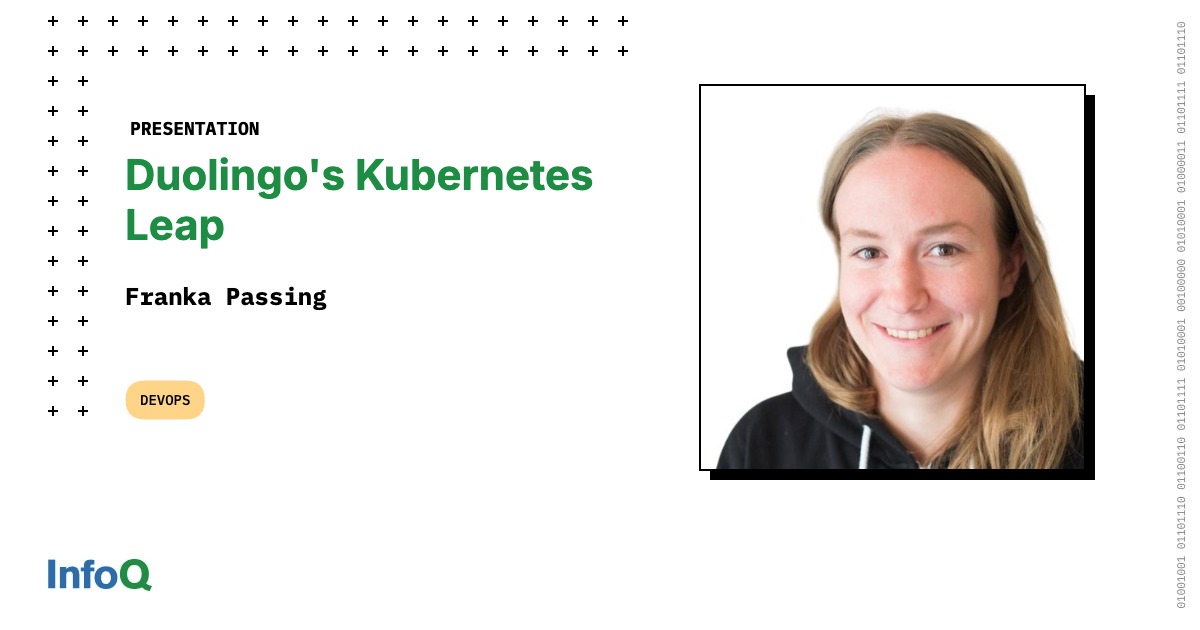
Franka Passing, senior platform engineer, spilled the beans in her InfoQ talk. She’s been knee-deep in this for a year, and her voice crackles with that mid-battle excitement. Picture it: Duolingo, the owl that nags you to konnichiwa, now orchestrating chaos with EKS.
Why Ditch ECS When It Was Working Fine?
Here’s the thing. ECS? Loved it. Simple as pie — deploy, scale, done. But growth hits like a freight train. Suddenly, you’re at 400 engineers, 250 courses from Navajo to Japanese, and ECS starts feeling like a cozy sedan on a Formula 1 track.
Kubernetes roars in as the open-source beast. Multi-cloud dreams? Check. Feature-rich ecosystem? Argo CD for GitOps wizardry, Karpenter for auto-scaling smarts — tools ECS just can’t touch. And it’s EKS, AWS-managed, so no raw K8s nightmares.
“Kubernetes, obviously, has been the industry standard for container orchestration for the past decade. It’s open source. It gives you multi-cloud support… It’s very feature-rich.”
Franka nailed it. They’re not chasing hype; they’re chasing survival at this scale.
But wait — a six-person taskforce? One PM, a tech lead, two platform engineers (Franka included), plus rotating guests from observability, security, CI/CD. That’s it. No army. Just grit, pulling off what could swamp bigger teams.
What Does Migrating One Service Actually Look Like?
Let’s zoom in. Take a single backend service — say, the one powering your streak freezes. Before: ECS tasks humming along. Now? YAML manifests, Helm charts, the full K8s ritual.
They built foundations first: custom operators? Nope, stock EKS with smart add-ons. Observability glued in — Prometheus scraping metrics like a vacuum, Grafana dashboards glowing with health stats. Security? Istio for service mesh magic, locking down traffic flows.
Pain points hit hard. Networking quirks between ECS and EKS — VPC tweaks, load balancer handoffs. CI/CD pipelines? Rewired to spit out K8s-native artifacts. Early adopters (brave souls) tested waters: one service live, tweaks galore, then snowball.
It’s messy. Franka admits they’re mid-migration — services trickling over, not a big bang. Smart. Like dipping toes before cannonballing into the pool.
And the cost? Engineer ramp-up time, sure. But ROI? Exponential. Imagine Duolingo’s AI tutors — yeah, those personalized lesson engines — scaling elastically across clusters. Kubernetes isn’t just orchestration; it’s the canvas for tomorrow’s wonders.
My hot take: This echoes Netflix’s early cloud pivot. Back then, everyone mocked their monolith-shattering. Today? They’re gods. Duolingo’s leap? It’ll let them weave in multimodal AI — voice, video, VR lessons — without infrastructure buckling. Bold prediction: By 2026, Duolingo’s not just teaching languages; it’s your pocket polyglot powered by K8s brains.
Is Kubernetes Overkill for a Language App?
Look. Apps like Duolingo scream consumer scale — bursty traffic from morning commuters, evening grinders. ECS handled it. But K8s? It’s the Excalibur for devs craving control.
Product teams (30+ of ‘em) own those 500 services. Platform crew empowers, doesn’t dictate. Result? Faster iterations, self-service scaling. No more “wait for infra gods.”
Skeptics whine: Complexity creep. Fair. But Duolingo’s playbook — tiny team, iterative wins, early lessons — dodges pitfalls. They’ve already migrated pioneers, ironed kinks. Hype? Minimal. Franka calls it a “report from the trenches,” raw and real.
Energy here. Kubernetes as platform shift? Absolutely. It’s the Linux of orchestration — ubiquitous, extensible. Duolingo betting big signals: even “simple” apps need this firepower.
Corporate spin? Light. No victory laps yet; they’re honest about the slog. Refreshing in a world of polished keynotes.
Scale visuals hit home. 128 million MAUs. 400 engineers. That’s not startup scrappiness; it’s enterprise heft in app clothing.
Lessons for Your Next Infra Bet
Start small. Taskforce model works — embed experts, rotate allies. Communicate why relentlessly; engineers hate blind leaps.
Pick EKS if AWS-locked — managed bliss without DIY ops hell.
Test with adopters. Their war stories? Gold.
And wonder: What if your stack’s next? Duolingo proves even happy ECS users evolve.
🧬 Related Insights
- Read more: rs-trafilatura Unlocks Firecrawl’s Hidden Precision
- Read more: Hugging Face’s Open-Source AI Boom: Indies and China Reshape the Power Map
Frequently Asked Questions
Duolingo Kubernetes migration timeline?
Ongoing — foundations built in a year, early services live, full fleet trickling over.
Why move from AWS ECS to Kubernetes?
ECS too basic for massive scale; K8s brings ecosystem (Argo, Karpenter), multi-cloud, richer features.
Kubernetes migration team size at Duolingo?
Just 6-7: PM, lead, two engineers, rotating specialists.
Will Kubernetes slow down Duolingo engineers?
Short-term ramp-up yes, long-term self-service speeds them up.
