The hum of servers was the only sound, a sterile lullaby for the digital workforce trying to make sense of a messy world.
Someone finally decided enough was enough. We’ve got AI agents doing, well, things. But are they doing them right? Or are they just flailing around, burning through tokens and budgets like a startup with an unlimited VC tab?
Turns out, the answer might be in dusty old textbooks. Operations research, the kind that’s been optimizing supply chains and factory floors for decades, is the new darling for getting your AI agents to stop being expensive paperweights.
The Ancient Art of Not Wasting Money on Robots
Look, AI planning often boils down to making decisions. Which agent tackles this? How many tokens does that cost? What’s the ROI on this whole endeavor? These aren’t exactly questions you ask a magic eight ball. They’re optimization problems.
Operations research (OR) is basically the science of making the best possible decisions under pressure. It’s not about predicting the future – that’s the job of the data science sidekicks. OR is about taking those predictions and turning them into actions. Prescriptive analytics, they call it. Fancy.
The core idea is simple: translate messy reality into clean math. Decision variables, constraints, objectives. Like deciding how much of your limited cash to spend on coffee (objective: stay awake) versus lunch (objective: don’t starve), with constraints like your actual bank balance and how many hours until your next meeting.
Where Do AI Agents Fit In?
Now, slap AI agents into that equation. Suddenly, you’ve got agents to assign, budgets to respect, and response times that can’t be ignored. They want to minimize costs, maximize that elusive ROI, and not, you know, break everything. This is OR’s playground.
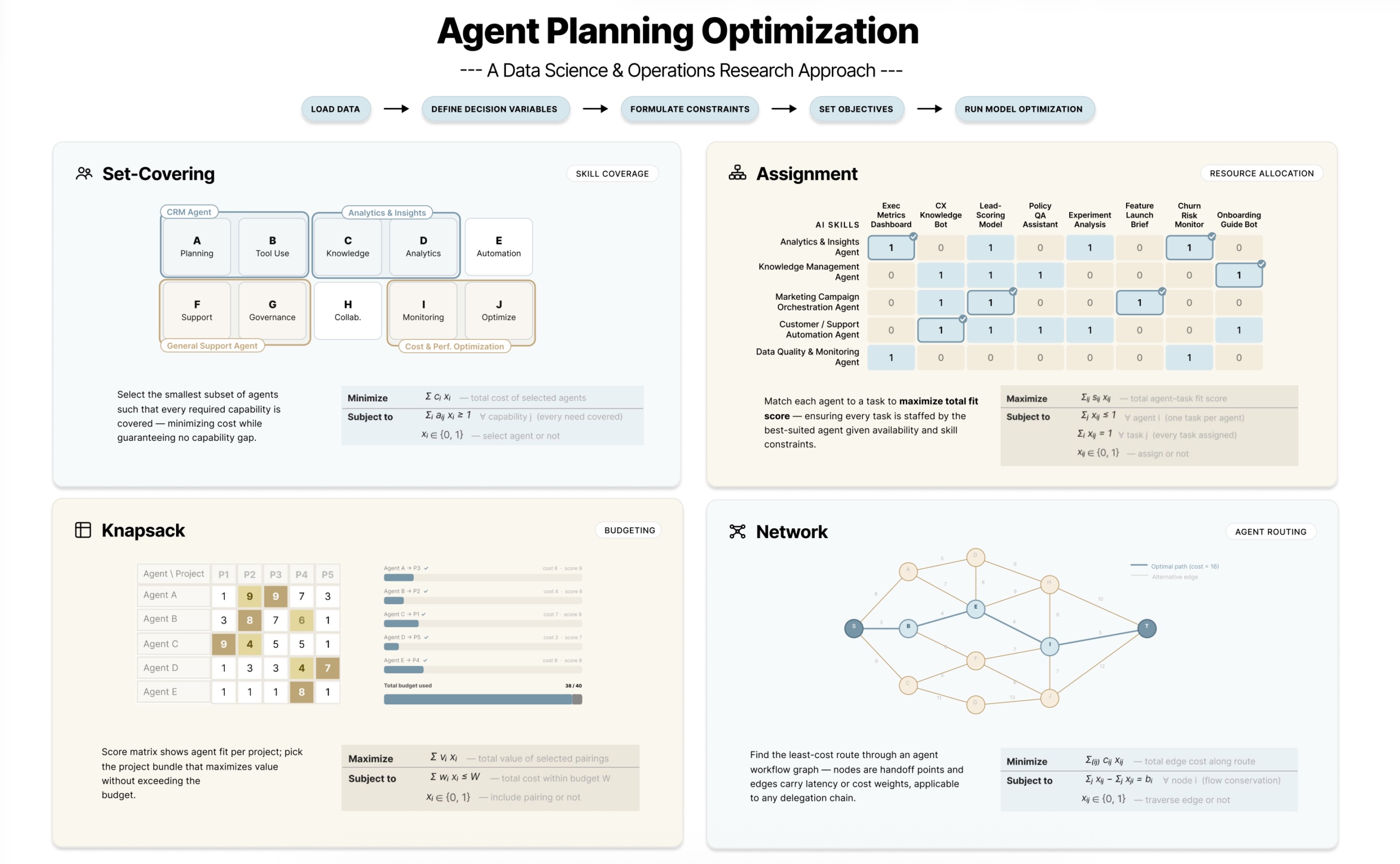
The article dangles four classic optimization patterns like shiny bait: Set-Covering, Assignment, Knapsack, and Network problems. Each one tackles a common AI agent headache.
Set-covering? It’s about finding the absolute minimum crew of agents to do all the necessary jobs. Like assembling the Avengers, but with less spandex and more spreadsheets.
Assignment problems? That’s figuring out who does what project for maximum bang for your buck. Think speed dating for your workforce, but with performance reviews.
Knapsack problems? This is your budget crunch. What’s the best combination of agents you can afford without going broke? A digital Marie Kondo for your AI hires.
Network problems? Designing the most efficient pipeline for agents to communicate and get things done without bottlenecks. Like building a subway system for your digital brain.
Gurobi: The Heavy Artillery
To make this all less theoretical, they trot out Gurobi. It’s an enterprise-grade solver. Basically, it’s the hulking brute that actually crunches the numbers when the math gets too big for your calculator.
They show off some Python code. It’s not for the faint of heart, but it demonstrates how you define variables, set constraints, and tell Gurobi what you want it to achieve. It’s a reminder that this isn’t just academic noodling; it’s code you can run.
Here’s a bit of that code, defining the crucial decision variables for the set-covering problem:
## variables
X = model.addVars(agents, lb=0, ub=1, vtype=GRB.BINARY, name="x")
This little snippet says, ‘For each agent, create a variable that can only be 0 or 1. It’s either in, or it’s out.’ Simple, elegant, and the foundation for solving complex puzzles.
A Dose of Reality: Beyond the Hype
Here’s the thing. This isn’t magic. OR requires data. Clean, accurate data. And models. You can’t just point Gurobi at a mess and expect it to spit out brilliance. You have to model the problem. And that’s where the data scientists earn their keep.
And the Python examples? They’re proof-of-concept. Real-world deployments will be infinitely more complex. They’ll involve hybrid systems, constantly shifting requirements, and the perpetual battle against ‘edge cases’ that somehow constitute 90% of your problems.
But the underlying principle is solid. We’re moving beyond just building AI that can do things, to building AI that does things optimally. It’s about efficiency, cost-effectiveness, and actually achieving business goals. Not just playing around.
This shift from mere capability to optimized execution is, frankly, overdue. We’ve been so enamored with what AI can do, we’ve often forgotten to ask if it’s doing it in the most sensible way possible. OR provides that sensible way. It’s the cold, hard logic that AI has often lacked, injecting a much-needed dose of pragmatism into the sometimes-flighty world of artificial intelligence.