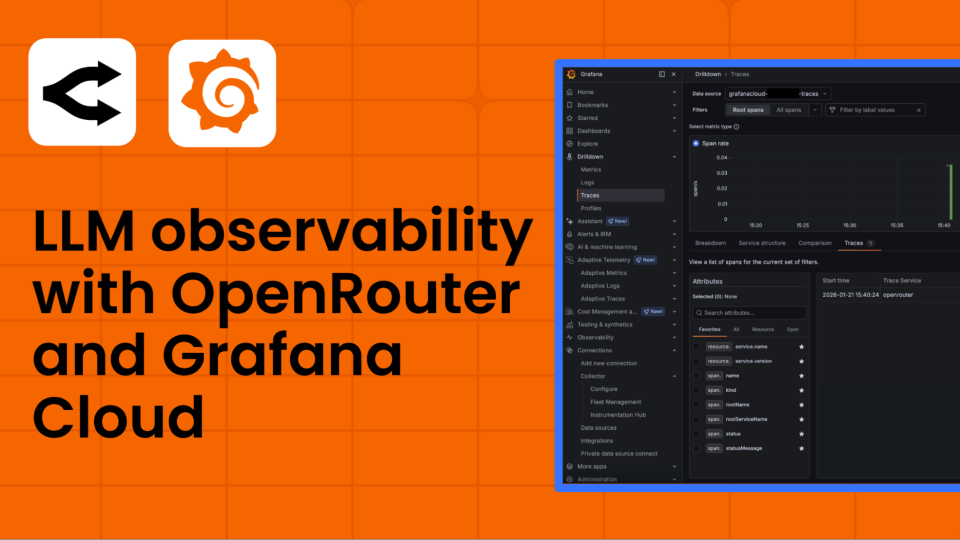
Spot a dev team huddled around a Grafana dashboard at 2 a.m., cursing as token costs spike from some rogue Claude fallback.
That’s the scene now. OpenRouter and Grafana Cloud are teaming up to bring observability to LLM-powered applications—finally dragging these probabilistic monsters into the light. Or so they say. Chris Watts, OpenRouter’s Head of Enterprise Engineering, pitches it as the fix for teams drowning in invisible AI workloads. But let’s cut the fluff: LLMs aren’t your grandpa’s monolithic Rails app. They’re fickle beasts, spitting variable outputs, guzzling tokens unevenly, and failing in ways that don’t even trip HTTP 500s.
OpenRouter’s unified API? Smart move. One integration for hundreds of models from OpenAI, Anthropic, Google, Meta. They handle load balancing, fallbacks, routing. No juggling API keys like a circus act. But production hits, and suddenly you’re blind. Costs balloon. Prompts time out mysteriously. Enter Broadcast: zero-code tracing that pipes OpenTelemetry spans straight to Grafana Cloud. No SDK. No latency hit. Dashboard tweak, done.
Look.
It captures the good stuff—model requested vs. served, provider, input/output tokens, costs in USD, time-to-first-token, errors, even your custom metadata like user IDs. Traces land in Grafana’s Tempo backend via OTLP. Then? TraceQL queries, dashboards, alerts. Familiar turf if you’re already on Grafana.
“Whether you’re routing requests across multiple AI providers, managing costs across dozens of models, or debugging why a particular prompt is timing out in production, observability is no longer optional for LLM-powered systems.”
Watts nails it there. Straight from the post. But here’s my twist—this echoes the early 2010s microservices mess. Remember New Relic bursting onto the scene, making distributed tracing a no-brainer? Teams went from “WTF is slow?” to pinpointing that one Postgres query. LLMs demand the same, yet they’re worse: non-deterministic. Same prompt, different day, different drivel. Broadcast gives signals, sure. But predicting quality? Nah. My bold call: this sparks “prompt observability” tools next—tracing how tweaks ripple through generations. OpenRouter’s ahead, but watch competitors pile on.
Why Chase LLM Observability Now?
Costs, dummy. Route across models, and GPT-4o mini feasts while Haiku starves. Traces break it down by model, key, user. One team built a dashboard slicing spend like sushi. No more “whoops, $10k on fallbacks.”
Latency profiles? Brutal truth. Total time hides the pain—TTFT drags user experience, tokens/sec flags slow models. Non-deterministic fails? Rate limits, truncations, garbage outputs that “succeed” but suck.
Custom logging? Nightmare maintenance across providers. Infrastructure-layer tracing wins. Broadcast does it automatically. Clever.
But.
Corporate spin alert. OpenRouter’s promo reeks of “we built it, worship us.” Grafana integration? Nice, but OTLP is standard—anyone could pipe in. They’re first-mover, though. Skeptical eye: lock-in via dashboard config. Switch routers? Retrace everything.
Does Grafana Make LLM Chaos Bearable?
Dashboards shine. Span rates, errors, durations at a glance. Drill in: prompt, completion, tokens—all there. Real use? Cost viz, yeah. But debugging? Spot a flaky provider—fallback to Anthropic saves the day, traces prove it.
Teams attach metadata—session IDs, flags. Suddenly, “power users burning cash” dashboards emerge. Alerts on token spikes? Gold.
Here’s the thing—a sprawling mess of LLM pains: variable behavior across providers (Claude’s verbose, Gemini’s cryptic), fallback roulette (did it hit the cheap model or premium?), quality gates failing silently. Broadcast logs it all, but interpretation? On you. Grafana’s great for metrics, less for semantic search on prompts. Need SLOs on “hallucination rate”? Build your evals atop traces. Possible, not plug-and-play.
Prediction time. This becomes table stakes by 2025. Every router apes it. But OpenRouter’s edge? Hundreds of models, real traffic. Grafana users (millions) get LLM tabs overnight. Hype? Some. Help? Absolutely.
Real-World Gotchas They Won’t Admit
Customer-facing chatbots. Traces reveal: 20% failovers due to OpenAI rate limits, Haiku cheaper but slower TTFT. Dashboard flags it—team swaps routing rules. Boom, 30% cost drop.
Debug timeouts? Span timings dissect: queuing? Provider lag? Generation crawl? Fixed a production oof for one startup.
Yet limitations lurk. No response quality metrics baked in—hallucinations slip through. Costs? USD only; multi-currency teams convert manually. Custom metadata? Attach it, or bust.
And scale. High-volume? Traces bloat storage. Grafana Cloud bills by ingest—watch that tab. Free tier? Laughable for prod.
Skeptic’s verdict: Solid step. Not panacea. Pairs best with evals frameworks like LangSmith. OpenRouter pushes infrastructure obs; app-layer still yours.
Short para. Works.
Deeper now, weaving history: Back when AWS Lambda launched, cold starts killed us. Tools like Datadog traced invocations. Same vibe—infra signals first. LLMs mirror serverless unpredictability, but with cognition. Broadcast’s your Datadog for AI routers. Ignore at peril.
Teams love cost breakdowns. One attached user tiers—freeloaders exposed. Alerts on model drift: if GPT fallback spikes, ping Slack.
Why Does This Matter for Developers?
No code changes. Huge. Prod apps instrumented day one. Focus builds, not logs.
Grafana fans? smoothly. Others? OTLP to any backend—Honeycomb, say.
But PR polish hides: variability persists. Traces show what happened, not why output sucked. Next frontier: eval spans.
Wrapping messy: It’s good. Buy the dip on obs fatigue.
🧬 Related Insights
- Read more: Agent Sprawl: The Tech Debt That’s Already Burying Your AI Dreams
- Read more: 30,000 npm Packages a Day: GitHub’s Fight to Stop Supply Chain Poisoning
Frequently Asked Questions
What is OpenRouter Broadcast?
Zero-code feature auto-tracing LLM requests to OTLP endpoints like Grafana Cloud—tokens, costs, timings, no app changes.
How does OpenRouter work with Grafana Cloud?
Config dashboard once; traces flow to Tempo. Query with TraceQL, dashboard costs by model/user, alert on spikes.
Is observability needed for LLM apps?
Yes—blind ops lose money fast. Tracks tokens, fails, latencies traditional metrics miss.