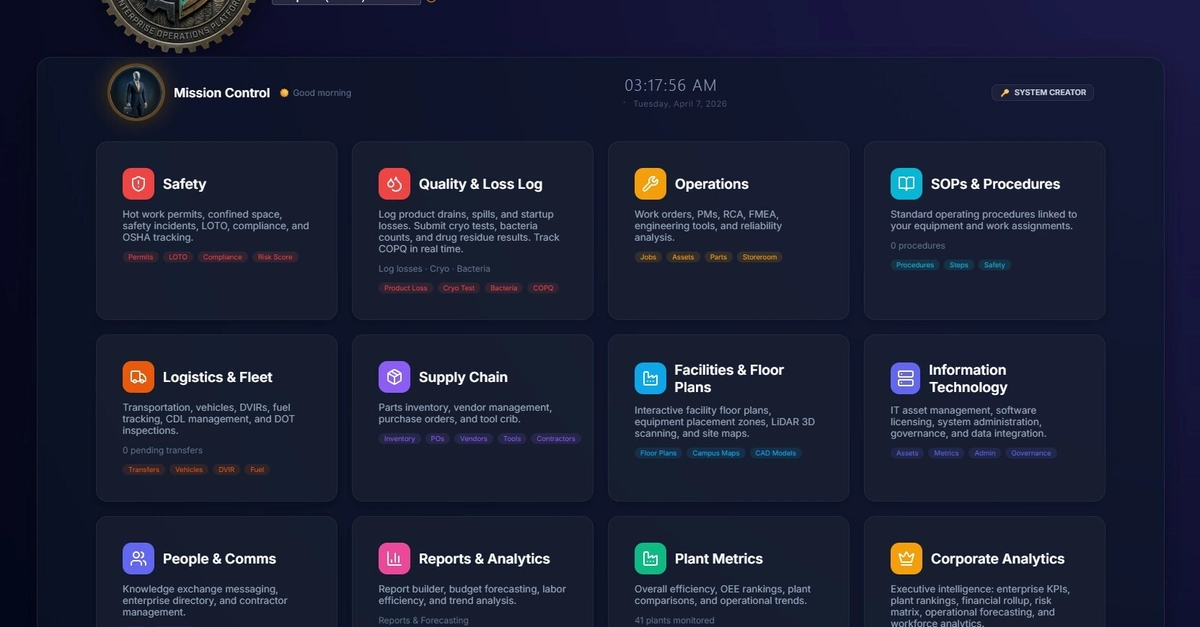
Alarms screeching at 3 AM, coolant spraying like a bad horror flick — that’s the plant floor reality that forged Trier OS.
This isn’t some vaporware dream. It’s a full-stack, open-source industrial operating system, self-hosted, air-gapped, born from 33 years of hands-in-the-grease expertise. And get this: one guy built it in 33 days, AI as his turbocharged sidekick.
Trier OS.
Say it three times. It’s the antidote to those soul-crushing enterprise software suites that factories pour millions into, only for operators to sabotage them with workarounds. You’ve seen it — clunky interfaces, endless subscriptions, zero customization. Plants opt out. Productivity tanks.
But.
Here’s the spark. The creator — call him the Factory Whisperer — did every job: operator, supervisor, manager. Watched the failures loop like a glitchy GIF. So he built Trier OS to fix it all.
What Makes Trier OS a Plant Floor Beast?
Under the hood? A Monaco IDE baked right in — operators (authorized ones) scribble code, sandbox it, hot-reload into live production. No IT priest rituals required.
Then the Deterministic Simulation Engine. Replays historical logs against your tweaks, math-proves it won’t nuke the assembly line. Imagine surgery with a perfect rehearsal — zero surprises.
Friction Cost Engine tallies the dollar hit from UI shifts pre-deploy. Brutal honesty: that flashy button? Costs $50k in retraining. Don’t ship stupid.
3D GIS via Cesium maps your whole campus — assets glowing in spatial glory. Mobile barcode scanning hits iOS, Android, Zebra rigs with WebRTC magic. EDR-safe local mode on sqlite3, full offline PWA, rollback paradise, CMMS/MES mashup.
349,000 lines. 1,378 modules. Documented to death.
It’s like giving factory workers a Swiss Army knife that thinks.
How Did AI Pull Off This 33-Day Miracle?
AI didn’t invent Trier OS. It accelerated it.
“With AI assistance I was able to build this in 33 days. But here’s the thing — AI didn’t know what to build. That came from three decades of watching plants operate, fail, and adapt.”
Boom. That’s the quote that hits like a wrench to the skull. Domain knowledge — the greasy, edge-case-riddled blueprint — that’s irreplaceable human gold. AI? The hammer that swung 10x faster.
Think back to the PC revolution. Mainframes ruled, priestly admins in suits. Then desktops hit: cheap, hackable, everywhere. Factories now? Trapped in MES/MOM mainframes from Siemens or Rockwell — $$$$$ licenses, vendor lock-in.
Trier OS is the Linux of industrial ops. Open-source kernel for your plant. Self-host it, tweak it, own it. My bold call: in five years, 20% of heavy industry runs variants. AI’s platform shift makes solo warriors like this feasible — yesterday’s moonshot, tomorrow’s standard.
But here’s my skeptic hat (yeah, even futurists wear ‘em). Corporate PR would spin this as ‘disruptive innovation.’ Nah. It’s revenge of the operators. No hype, just code that works when the line’s humming at 2x speed.
Why Does Trier OS Matter for Developers?
Devs, listen up. This isn’t toy code. It’s battle-tested for high-stakes: downtime costs $10k/minute. Yet it’s open-source — fork it, contribute, glory.
The real win? Creator’s manifesto: free the software budget, hire in-house devs. No more offshore SaaS slaves. Local talent customizing Trier OS onsite. Jobs boom. Operators get tools they love. Plants run leaner.
Picture it — your React skills mapping 3D assets, or Node sim engines predicting failures. Heavy industry devs? Scarce. Pay? Fat. Trier OS cracks the door.
And the air-gapped angle? Cybersecurity paranoia in factories is real — Stuxnet flashbacks. This runs disconnected, EDR-compliant. No cloud roulette.
Short para punch: It’s hiring fuel for programmers.
Now, wander with me. I’ve chased AI hype from GPT-1 to now — agents, fine-tunes, the works. But Trier OS flips the script: AI as accelerator for deep domain plays. Not replacing experts, amplifying ‘em. That’s the shift. Factories next? Hell yes. Like EVs zapping Detroit’s gas guzzlers, this zaps legacy MES.
Friction Cost Engine alone — genius. Quantifies UX debt in dollars. Devs, build this into your stack. Plants save millions; you get street cred.
Is Trier OS Too Good to Be True?
Skepticism time. Solo build in 33 days? Smells fishy. But 349k LOC documented screams legit. No SaaS pivot bait — pure open-source.
Edge cases? 33 years baked in. Sims catch the weird: valve sticks at 40% humidity, batch fails on Tuesday shifts. AI prompted the boilerplate; human scripted the chaos.
Critique: Docs better shine, or it’ll fade like 90% OSS projects. Community ignition key. But with that feature buffet? Ignition likely.
Bold prediction — my unique twist: Trier OS sparks an ‘industrial dev economy.’ GitHub forks spawn sector specials: pharma, auto, chem. AI agents auto-customize. By 2028, it’s the OS under 10% of U.S. manufacturing. Why? ROI screams.
Operators won’t opt out. They’ll tattoo it.
The analogy? Early web servers — Apache open-sourced the stack, birthed a dev explosion. Trier OS does that for SCADA/MES. Wonderstruck yet?
🧬 Related Insights
- Read more: Flutter Web’s Spatial Grid Crushes Particle Lag
- Read more: AI Coding Tools Are About to Repeat Software Engineering’s Epic Fail
Frequently Asked Questions
What is Trier OS?
Trier OS is a self-hosted, open-source platform for plant operations — think full OS for factories with IDE, sims, 3D maps, and more, no subscriptions.
How was Trier OS built in 33 days?
33 years plant floor wisdom guided it; AI handled the coding grind, but domain expertise defined every feature.
Can Trier OS replace enterprise manufacturing software?
Absolutely — it’s designed to, saving millions on licenses while letting plants customize with in-house devs.
