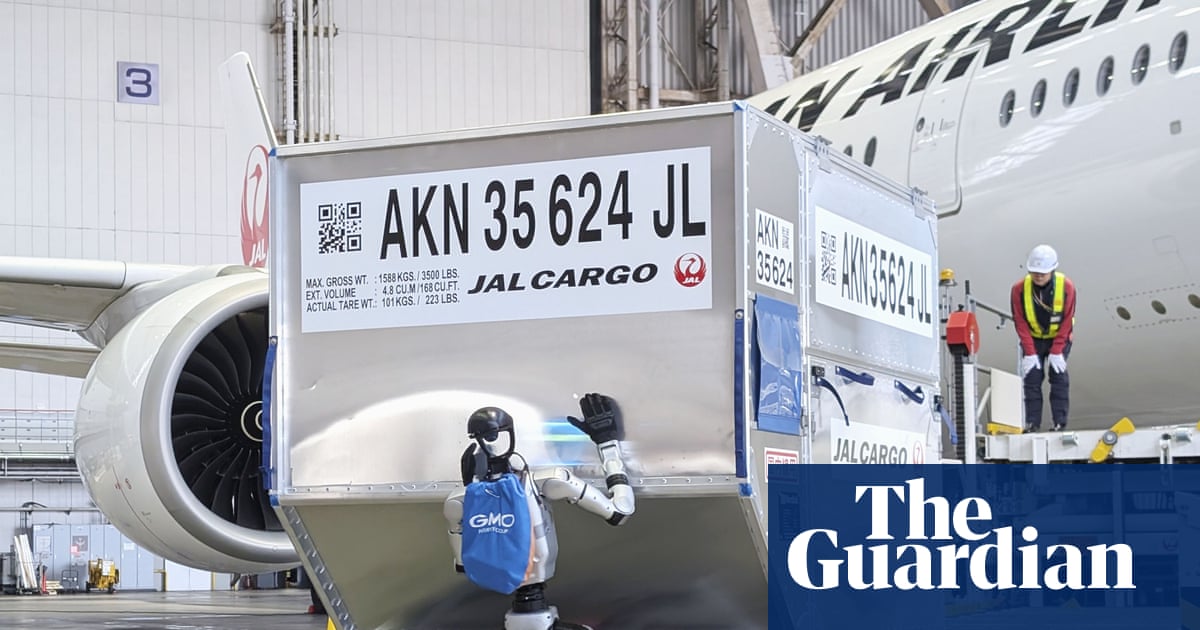
Here’s a number that’ll make you choke on your morning coffee: Japan expects to need over 6.5 million foreign workers by 2040. Let that sink in. While they’re busy wringing their hands about an aging population and a shrinking native workforce, what do they do? They strap some metal legs onto a cargo-moving gadget and call it progress.
Japan Airlines (JAL), in cahoots with GMO Internet Group, is rolling out these… humanoid robots, apparently manufactured by some outfit called Unitree in Hangzhou. Starting in May, these 130cm tall automatons will be tentatively “pushing” luggage and cargo around Haneda Airport, a place that juggles more than 60 million passengers annually. The official line? It’s a trial to ease the burden on human employees, who, we’re told, are facing a chronic labor shortage exacerbated by a tourism boom. You know, the usual Silicon Valley-esque song and dance.
What’s truly hilarious is the demonstration. Picture it: a slightly wobbly robot, looking like it just rolled off a cheap assembly line, awkwardly nudging a piece of luggage onto a conveyor belt. It even waves. To whom? The void? An unseen, likely equally bewildered, human colleague? It’s less ‘Rise of the Machines’ and more ‘When Do We Get Paid?’
Who’s Actually Making Money Here?
Let’s cut through the PR fluff. JAL Ground Service President Yoshiteru Suzuki chirps about how robots will “inevitably reduce the burden on workers and provide significant benefits to employees.” Right. Because a robot that needs constant recharging and can’t handle “safety management” tasks is exactly what your overworked baggage handler has been dreaming of. It’s a classic move: trot out the shiny new tech, claim it’ll help the little guy, while the real goal is cutting costs and finding ways to reduce dependency on actual humans. Who benefits most? The companies manufacturing these robots, of course, and JAL by eventually needing fewer flesh-and-blood workers.
This entire rollout feels like a band-aid on a gaping wound. Japan is staring down a demographic cliff, and their answer is to hire robots to do what the perpetually underpaid, physically exhausted ground crew have been doing for years. It’s like giving a glass of water to someone drowning. Sure, it’s something, but it doesn’t address the fundamental problem.
Is This Just Fancy Forklifts on Legs?
Look, I’ve been around the block with these automation promises. We’ve seen robotic arms in warehouses, autonomous vehicles promising to change logistics, and now… baggage handlers. The crucial difference here is the ‘humanoid’ aspect. Why humanoid? Because it allows them to slot into existing workflows that were designed for humans. It’s a clever way to make the transition seem less disruptive, but it also means these robots are still incredibly limited. They’re not reinventing the wheel; they’re just putting wheels on a human-shaped box.
The Unitree H1, for instance, can operate for two to three hours at a time. Two to three hours. That means a constant ballet of robots heading back to their charging stations, leaving gaps in the operation. And don’t even get me started on the weather. Snow? Heavy rain? Will these delicate machines be able to handle it, or will we see humans scrambling back out there?
My suspicion? This is less about a profound technological leap and more about a cost-saving measure dressed up in futuristic drag. It’s the same old story: find a problem (labor shortage), offer a tech solution (robots), and pray the PR outweighs the reality of clunky, expensive machines that can’t quite do the job.
While airports appear highly automated and standardised, their back-end operations still rely heavily on human labour and face serious labour shortages.
Tomohiro Uchida, president of GMO AI and Robotics, nails the corporate justification. Yes, back-end operations are still manual. And yes, they have shortages. But is a robot that can push a suitcase the actual solution, or just the start of a longer, more insidious plan to replace human workers entirely? I’ve seen this playbook before. It usually ends with fewer people employed and more money in the pockets of the few.
This experiment will likely continue until 2028, and then what? If it “works” by simply reducing head count and keeping the planes moving most of the time, expect to see these bumbling bots popping up at airports worldwide. It’s a depressing thought, but hey, at least they’ll have a great view of the tarmac, provided their batteries don’t die.
Will These Robots Take My Job?
This is the million-dollar question, isn’t it? For baggage handlers, the direct threat is real. If these robots prove even marginally effective and cost-efficient compared to human labor, companies will absolutely push for more of them. However, the current limitations (recharging, complex tasks, safety management) mean a complete replacement is still a ways off. It’s more likely to be a hybrid model for the foreseeable future, with humans still doing the critical and complex jobs.
What Can These Robots Actually Do?
In this trial, the robots are primarily tasked with moving travelers’ luggage and cargo on the tarmac. They can ‘push’ cargo onto conveyor belts. JAL and its partners are also exploring using them for tasks like cleaning aircraft cabins. They are capable of operating continuously for two to three hours before needing to recharge.
Is Japan’s Labor Shortage Really That Bad?
Yes, Japan’s demographic crisis is severe. An aging population and a declining birthrate mean the country faces a shrinking workforce. This is compounded by increasing tourism, creating a demand for labor that the domestic population cannot meet. The government is grappling with how to address this, with immigration being a politically sensitive topic.