What if your slick LLM-powered app is secretly torching your budget — and you have no clue why?
Observability for LLM-powered applications isn’t some nice-to-have anymore. It’s the firewall between your AI dreams and a nightmare of runaway costs, flaky outputs, and provider roulette. OpenRouter, that unified API gateway to every model under the sun, just hooked up with Grafana Cloud via their Broadcast feature. No code changes. Traces auto-sent. Sounds dreamy, right? But let’s poke it.
Here’s the setup. OpenRouter routes your prompts across OpenAI, Anthropic, the whole circus. They handle fallbacks, balancing — you build. Fine. But production? Tokens fly, latencies spike, bills balloon. Enter Broadcast: OpenTelemetry traces piped straight to Grafana, capturing model deets, token counts, costs in USD, even your custom metadata. Zero SDK. Dashboard config only.
Why Chase LLM Observability Now?
Teams drown in novelty. Traditional metrics? HTTP codes, latencies — yawn. LLMs add token guzzling, model whims, non-deterministic flops. Same prompt, GPT-4o spits gold; Haiku chokes. Fallbacks? Good luck tracing which clown served it.
And costs. Oh, the costs. A sneaky shift to pricier models, and poof — budget gone. Chris Watts, OpenRouter’s head honcho, nails it:
“Whether you’re routing requests across multiple AI providers, managing costs across dozens of models, or debugging why a particular prompt is timing out in production, observability is no longer optional for LLM-powered systems.”
Spot on. But is Broadcast the silver bullet?
Look, we’ve been here before. Microservices era: Everyone promised observability would tame the beast. Zipkin, Jaeger — dashboards galore. Yet sprawl won. Alerts buried devs. History whispers: Tools like this shine for baselines, flop on root causes. LLMs? Non-determinism laughs at traces.
Short answer? It scratches the itch.
But here’s my unique dig: This smells like PR spin on inevitable infrastructure debt. OpenRouter isn’t inventing observability; they’re commoditizing it for AI middlemen. Bold prediction — in six months, we’ll see forks, because Grafana-only lock-in won’t fly for Kubernetes diehards.
Does Broadcast + Grafana Actually Work?
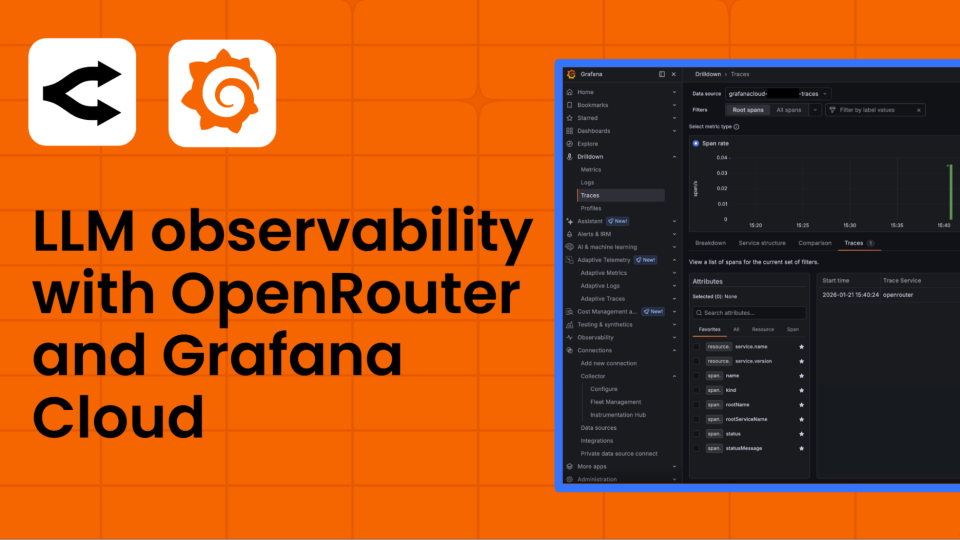
Plug it in. Dashboard tweak, OTLP to Grafana Cloud’s Tempo backend. Traces roll: input/output tokens, time-to-first-token, gen speed, errors like rate limits or truncates.
Dashboards pop. Span rates. Error breakdowns. Drill-downs reveal prompts, completions — all OTEL semantic-conventioned for AI. Custom tags? User IDs, flags — yours.
Real-world? Cost viz rules. Breakdowns by model, key, user. One team (snippet cut off in promo, typical) tracks customer-facing chatbots. Prevents bill shocks.
Latency sleuthing. Why’s that prompt lagging? Model? Provider? Trace says.
Failures. Not just 500s — subtle crap like hallucinated refusals.
Skeptical aside — it’s infrastructure-layer magic, dodging app-code logging hell. Smart. But Grafana Cloud? Paid. OSS Tempo exists, sure, but cloud convenience costs. And OTEL? Bloat risk if you’re lean.
Punchy truth: Great for mid-scale. Scale to millions? Custom sampling incoming.
Teams swear by it. Cost dashboards. A/B model tests via traces. Alert on token spikes.
But wander with me — variability. Traces log what happened, not why Claude flubbed ethics today. Quality gates? Still your problem. Hallucination detectors? Bolt-on.
Dry humor: It’s like giving a drunk driver a black box. You see the crash. Fix the hangover? Nah.
The Hype Trap in AI Infra
Corporate spin screams “zero instrumentation.” Heroic. But reality — you’re trusting OpenRouter’s traces. Provider quirks? Filtered? Metadata limits?
Historical parallel: Early AWS CloudWatch. Promised all-seeing eyes. Delivered metrics soup. Devs bolted Prometheus. Same here — Grafana’s king, but expect ecosystem sprouts.
Unique insight: This accelerates model agnosticism, weaning off single-provider cults. Prediction: By 2025, 70% enterprise LLM stacks route like this. OpenRouter wins quiet.
Critique time. Promo cuts off at “customer-facing cha” — sloppy. Hype feels rushed.
And non-dets. Traces spot patterns, not predict ‘em. RAG fails? Trace won’t debug your vector store.
So, game-changer? For routing pros, yes. Solo hackers? Overkill.
Bottom line. Broadcast bridges LLM observability gap — admirably. But don’t sleep on app-layer needs. It’s table stakes, not triumph.
🧬 Related Insights
- Read more: Open Banking’s Clunk for Humans, Gold for AI Agents
- Read more: Dinosaurs Devour Webpages in This Maniacal Chrome Extension
Frequently Asked Questions
What is OpenRouter Broadcast?
It’s auto-tracing for OpenRouter API calls, sending OTEL spans to Grafana Cloud or others, no code required.
How does Grafana integrate with OpenRouter for LLMs?
Via OTLP to Tempo; dashboards track tokens, costs, latencies out-of-box.
Is observability essential for production LLM apps?
Yes — or watch costs explode and bugs hide in non-determinism.
