When a founder’s trauma becomes your competitive advantage
A $40,000 mortgage became a $60,000 debt. Then foreclosure. Then nothing.
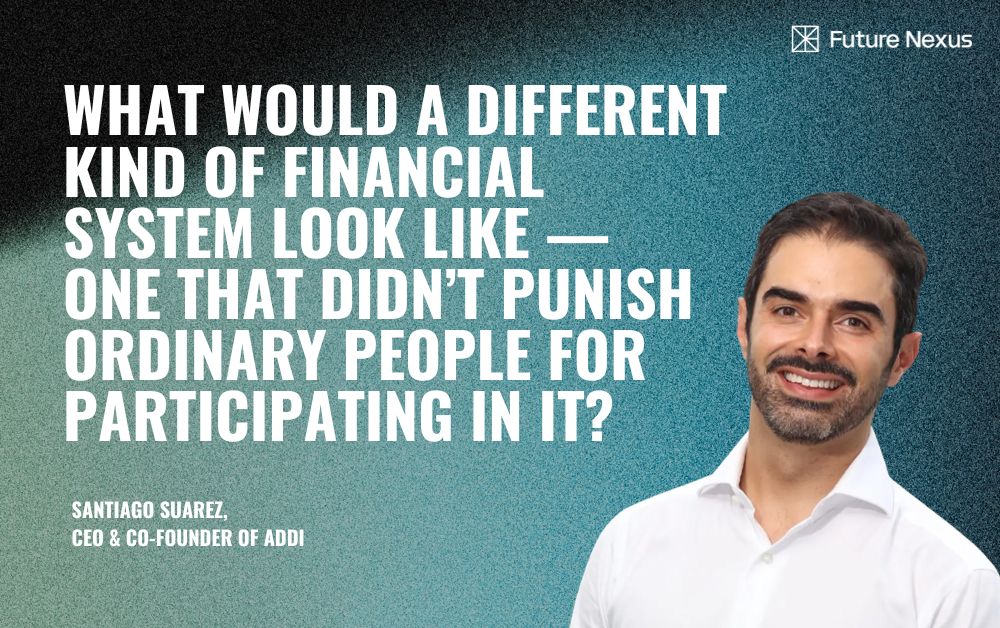
That’s Santiago Suarez’s origin story—and it’s the reason Addi, a Colombian credit and buy-now-pay-later platform, exists at all. Not because venture capitalists smelled a market opportunity. Not because someone read a McKinsey report. But because one person watched his family’s life implode under a financial system engineered to extract wealth from the desperate.
Here’s what most fintech founders won’t admit: they’re solving for scale and returns. Suarez solved for fairness first. That distinction matters more than it should.
In 1999, Colombia experienced what Suarez calls the country’s equivalent of the 2008 U.S. crisis—except worse, the worst in 70 years. Interest on interest compounds. His family lost the apartment, the car, the home computer. “I thought that was just so fundamentally unfair,” he told us. Three decades later, that feeling never left.
Colombia’s banking system is still rigged. Addi decided to break it.
When Suarez returned to Colombia after 15 years in the U.S. (including Yale), he expected something to have changed. It hadn’t.
Three banks control 70% of assets. Fees are embedded everywhere—even checking your balance online costs money after two logins. ATM withdrawals from your own bank incur charges. “To this day, there’s no single account in Colombia that’s 100% no-fee,” Suarez said. Only one in five Colombians can access credit. Less than one in 10 have a credit card.
“Only one in every five Colombians has access to credit, and less than one in 10 have access to a credit card. It’s an extremely exclusionary system.”
The system doesn’t just exclude people—it punishes them. Suarez watched his own father pay $40 for a $9 breakfast spread across 36 credit card installments. That’s not a bug in the system. That’s the entire point.
Most fintech founders would’ve launched a copycat product from the U.S., slapped Spanish on it, and called it innovation. Suarez didn’t. He asked a different question: What if credit actually helped people instead of trapping them?
Why building local beats building bigger
Addi’s strategy rests on a principle that sounds obvious until you watch startups abandon it: fit the product to the place, not the place to the product.
Three pillars. First: clarity of purpose—the company’s mission is to “create pride and abundance among Colombian consumers and businesses.” That north star isn’t motivational wall art. It dictates everything from product design to merchant partnerships.
Second: technology as a cost advantage. Colombia regulates interest rates tightly. That forces traditional banks to hide revenue in opaque fees or simply exclude people. Addi built lean from day one—best-in-class cost to serve, minimal headcount. The result? The company is net income profitable while offering 0% interest options and responsible installment plans. “No one wants to pay for a T-shirt in 12 installments, right?” Suarez said. “We don’t let you overextend yourself.”
Third: world-class people solving local problems. The team includes Amazon, Capital One, and eBay veterans paired with deep Colombia expertise. But—and this matters—Addi resisted the urge to copy models from Brazil, Mexico, or the U.S. Instead, it invested heavily in building a two-sided ecosystem tailored to Colombia: merchants on one side, consumer experience on the other.
Is Addi actually winning, or is this just good PR?
The numbers suggest it’s real. Over 35,000 transacting merchants. 3 million active customers. Over 100% year-over-year revenue growth for five straight years. $1.3 billion in annualized gross merchandise value. $200 million in annual recurring revenue.
But here’s what might matter more: one in every 10 Colombian adults has an active Addi relationship. That’s not market penetration. That’s market dominance in a single country of 50 million people.
Early on, Colombia’s largest merchant wanted to use Addi—but only as white-label, without Addi’s branding. Suarez turned them down. The decision was brutal and probably cost the company millions. But it made a point: Addi’s brand isn’t a feature; it’s the entire business model. Consumers need to know they’re being treated fairly. That only works if they know who’s treating them fairly.
The unsexy truth Silicon Valley ignores
Addi’s story exposes something venture capital doesn’t want to admit: building a fair financial system in an emerging market can be more profitable than building a predatory one. You don’t need to charge $40 for a $9 breakfast. You don’t need to hide fees. You don’t need to exclude 80% of the population.
Suarez has proven that a different model exists. And he did it not by disrupting fintech globally, but by obsessing over a single country’s broken plumbing.
That’s the part that should scare traditional banking. Not because Addi will go global (it might, or it might not). But because someone looked at a system designed to extract wealth from ordinary people and asked: what if we built something else instead?
And then he did.
🧬 Related Insights
- Read more: X’s New Crypto Kill Switch: Can Auto-Locking Stop the Scam Epidemic?
- Read more: Inside the Stablecoin Yield Standoff: Why Congress Can’t Pass Crypto’s Biggest Bill
Frequently Asked Questions
What does Addi actually do? Addi is a Colombian buy-now-pay-later and credit platform that lets consumers purchase from merchants and pay in short, interest-free installments. Unlike traditional Colombian banks, it charges no hidden fees and is designed to prevent over-indebtedness.
Is Addi profitable? Yes. According to Suarez, the company is net income profitable while offering 0% interest products—a rarity in markets with high interest rate regulations.
Will Addi expand outside Colombia? Addi has focused entirely on Colombia so far, resisting the temptation to copy-paste its model elsewhere. While Suarez built a “world-class company,” he’s been deliberately local-first rather than growth-at-all-costs.