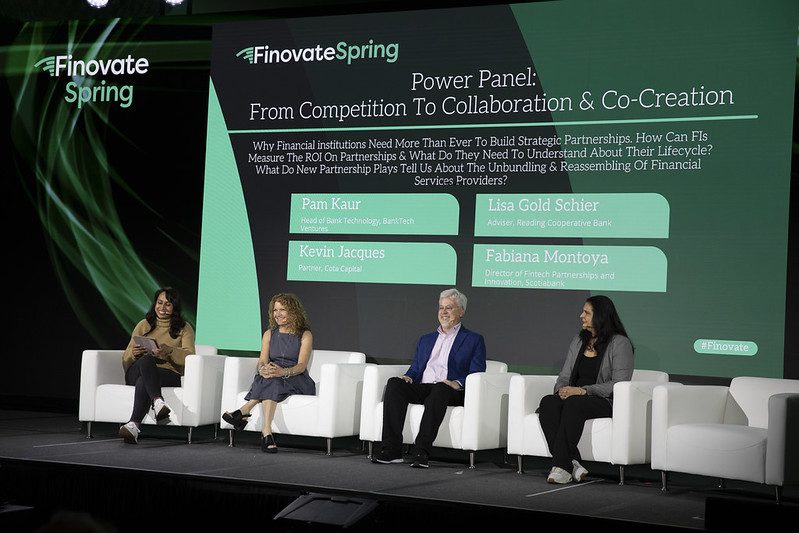
San Diego’s about to get very crowded. May 5 to 7, FinovateSpring 2026 descends on sunny California, and the fintech crowd is bringing their hottest takes on agentic AI, stablecoins, embedded finance, open banking, and a few other ideas they’re all pretending to understand.
Tickets are moving fast. Which tells you something important: people are hungry for answers. Because right now, the fintech industry is juggling about eight different existential questions at once, and nobody wants to admit they’re still figuring out the answers.
Let’s break down what’s actually getting airtime—and more importantly, what it means.
Why Agentic AI Is Eating Everyone’s Lunch (And Your Call Center)
Agentic AI isn’t just “AI with better prompts.” These systems make autonomous decisions. They complete tasks independently. They don’t need a human rubber-stamping every move. That’s the whole point—and also why it’s terrifying people.
“The AI that got you to 65% call resolution will never get you to 80%.” That’s the subtext of at least three sessions on the FinovateSpring agenda, and it’s brutal honesty wrapped in corporate speak.
What they’re really saying: your current AI implementation is already obsolete, and you know it.
The conference is drowning in agentic AI tracks—“From Plateau to Compound,” “AI, Everything, Everywhere, All at Once,” “Invisible Infrastructure, Visible Results.” (That last one’s particularly funny. “Invisible”? Try invisible to the C-suite until it breaks something.) The sessions range from hands-on workshops to a full keynote on agentic commerce reshaping retail banking. Fraud detection, credit risk assessment, investment automation—agentic AI is already doing this work. The question isn’t whether it works. It’s whether you’re ready to let it.
Community banks and credit unions are apparently winning here. There’s literally a session called “AI on a Shoestring” dedicated to them. Which either means small institutions are scrappy enough to deploy faster, or they have fewer lawyers saying no. Probably both.
Stablecoins: The “Legitimate” Crypto That Everyone Still Doesn’t Trust
Here’s where things get political. Stablecoins used to be DeFi’s weird cousin. Now they’re trying to be respectable—cross-border payments, remittances, store of value. Boring stuff. Useful stuff.
But there’s friction. The GENIUS Act is apparently causing “commercial struggles” for stablecoin platforms, according to the conference schedule. Translation: regulation is starting to bite, and nobody knows if the game is worth playing yet. There’s also a power panel about deposits: “How Can Banks & Credit Unions Win the Battle for Deposits” when stablecoins, challenger banks, and a booming stock market are all competing for the same cash?
The implicit confession here is obvious. Banks are worried. They should be.
Stablecoins offer regulatory clarity (if you squint hard enough) and price stability (mostly). For institutions, they’re a way to dip a toe into blockchain without the wild volatility of Bitcoin. But the policy environment is still mushy. That’s why you’ll get a fireside chat about the frontier rather than a victory lap.
Embedded Finance: When Your Bank Lives Inside Someone Else’s App
Embedded finance used to be framed as “how non-financial companies steal banking services.” Now fintech’s reframing it: “How can banks expand by living in places they don’t own?”
It’s a smart pivot, honestly. Banks reach new customers. Shopify, Uber, and whoever else offers financial services without building the infrastructure themselves. Everyone wins. Except traditional banking distribution networks, which are slowly becoming obsolete.
The conference is giving this trend serious panel real estate, but the sessions aren’t listed in detail here. Which is interesting. It’s like embedded finance has already won the ideological battle—nobody’s debating whether it’ll happen anymore. They’re just debating execution.
Open Banking in America: Still Stuck in Neutral
Europe and Australia have open banking figured out (mostly). America’s still arguing.
Section 1033 of the Dodd-Frank Act—the rule that says consumers can access their own financial data—should have settled this. Instead, it’s created a decade of legal uncertainty. Banks don’t know how much data they have to share. Fintechs don’t know what they’re allowed to build. Consumers don’t know what they’re entitled to.
Meanwhile, the market-driven approach (read: “nobody’s making us do this”) has left the US lagging. FinovateSpring’s tackling this with sessions on “A Heat Check on the Open Banking Opportunity.” Heat check. Not a victory celebration. A temperature check.
That tells you everything about where America stands on this one.
Fraud’s Getting Smarter (So Is the Technology Fighting It)
AI-versus-AI arms race in financial crime. Your fraud detection system uses AI. So do the criminals. Neither side is winning decisively—they’re just both getting faster and more expensive.
The emerging consensus at the conference: don’t fight fraud alone. Collaboration beats isolation. Banks are finally sharing threat intelligence instead of treating fraud like a competitive disadvantage they need to hide.
It’s embarrassing that it took this long. But here we are.
Hyperpersonalization: Knowing Your Customer Better Than They Know Themselves
With more data and better analytics, banks can finally deliver personalized products. Not “Dear Valued Customer” personalized. Actually personalized. Meet them at home, on mobile, wherever. The right product at the right time.
It sounds great. It also sounds like a data privacy lawsuit waiting to happen. The conference is exploring how to make this work without creeping people out, but that tension isn’t fully resolved in the schedule.
The Subtext Nobody’s Saying Out Loud
Here’s what’s really going on at FinovateSpring: fintech is running out of “next big things” to chase. Agentic AI, stablecoins, embedded finance—these aren’t new concepts anymore. They’re becoming operational realities. The conversations have shifted from “will this work?” to “how do we implement without breaking stuff?”
That’s actually healthy. It means the industry’s maturing. But it also means the easy wins are gone. What’s left is harder, slower, messier work.
The banks and fintechs that will actually win aren’t the ones collecting the most swag at the conference. They’re the ones in back rooms right now, quietly building operational infrastructure around agentic AI, figuring out stablecoin economics, and getting their data pipelines clean enough for real personalization.
The conference is useful for hearing about these trends. But execution happens elsewhere—in the unglamorous work of engineering, compliance, and organizational change management.
Still, if you’re in fintech and you’re not in San Diego that week? You’ll hear about it anyway. Everyone will be talking about it for months.
🧬 Related Insights
- Read more: Ethereum Foundation’s $93M Staking Play: Yield Farming Crypto’s Way Out of the Treasury Trap
- Read more: Coinbase and Linux Foundation Launch x402: The Payment Protocol That Could Rewire How AI Agents Buy Stuff
Frequently Asked Questions
What is agentic AI and why does it matter for banking?
Agentic AI systems make autonomous decisions and complete tasks independently without constant human oversight. In banking, it’s already being used for fraud prevention, credit risk assessment, and call center automation. The trend at FinovateSpring is moving beyond the 65% effectiveness plateau—systems now need to reach 80%+ performance to justify deployment.
Will stablecoins replace traditional banking deposits?
Not imminently. But they’re a genuine threat to deposit bases. The GENIUS Act and ongoing regulatory uncertainty are slowing adoption. However, as regulatory clarity improves, stablecoins will become standard rails for cross-border payments and serve as a stable medium of exchange. Banks need a strategy now, not later.
Why is open banking still behind in the US compared to Europe?
The absence of a regulatory mandate makes it market-driven. Section 1033 exists but creates ongoing uncertainty. Europe and Australia have clearer mandates, which accelerated adoption. American banks have less incentive to open data access voluntarily, keeping the US lagging by 3-5 years.
