Your legal team just got faster at the wrong work.
That’s the uncomfortable truth buried in the latest industry data, and it explains why corporate legal departments are simultaneously going all-in on AI and getting almost nothing back. We’re talking about a stunning gap: 52% of legal teams now use AI tools, according to the ACC/Everlaw survey. Yet only 7% report any reduction in total matter cost. That’s not a quirk. That’s a warning sign the industry is solving the wrong problem entirely.
And it matters because the actual money—the real budget-crushing weight—isn’t sitting where the tools are pointing.
The $500K Problem That No Copilot Solves
Picture this. A head of legal operations at a global manufacturer oversees 500 lawyers processing over a thousand NDAs annually. The chief legal officer mandated a shift to AI. The team evaluated three major copilot platforms. Lawyers liked all of them. Productivity metrics looked good on paper.
But here’s where it gets brutal: the backlog didn’t budge. Turnaround time to the business stayed flat. Outside counsel overflow spend? Exactly the same as twelve months earlier.
This isn’t isolated. A hospitality group’s legal team drowns in franchise agreement renewals. A consumer goods company fields 60 to 80 legal emails daily, with a senior lawyer burning 45 minutes each morning just sorting triage. A tech firm processes 5,000 legal requests monthly with a team that hasn’t grown in two years. Same pattern everywhere.
“The problem is that a tool does not change who does the work. The lawyer still picks up the request, opens the tool, reviews the output, and sends the response. You have made an expensive resource slightly faster at inexpensive work.”
There’s the diagnosis. You’ve made a $300-an-hour lawyer 20% faster at $30-an-hour work. Congratulations—you’ve optimized the symptom while the disease rages on.
Here’s what blows most people’s minds: the actual cost structure of an enterprise legal department looks almost nothing like where the software spend goes. Technology budgets run £100K to £300K annually. But the real hemorrhaging? The spend on getting routine work done—outside counsel, ALSP contracts, managed services, plus salary cost allocated to repetitive tasks—is 10 to 50 times larger. For every pound spent on legal software, ten to fifty are spent on legal services.
Tools solve a real problem. They genuinely deliver speed gains for individual lawyers. But it’s the wrong problem.
The Moment Everything Changes
One global enterprise was days away from signing a major copilot contract. Then the head of legal operations stopped and asked a different question.
“I don’t want to look at DPAs and NDAs anymore,” they said. “I want it done. And I still want control.”
That sentence represents a fundamental shift in thinking—and it’s spreading fast across the market. They weren’t asking for a faster tool. They were demanding the work leave their lawyers’ desks entirely, while maintaining playbook governance and oversight.
Coherent Corp’s CLO described their experience with Eudia in a way that caught everyone’s attention: “Eudia is not a software provider. It is headcount I don’t have to hire.”
At a recent legal ops event in London, a senior in-house counsel from a FTSE 100 company used a phrase that resonated so hard the scheduled 20-minute panel ran nearly two hours: “engine room.” Agents handling the 80% of high-volume, low-complexity requests while lawyers focus on the complex work that actually requires judgment. Not faster lawyers. Invisible workhorses.
That’s the moment the conversation pivots.
What “Agentic Services” Actually Means (And Why It Matters)
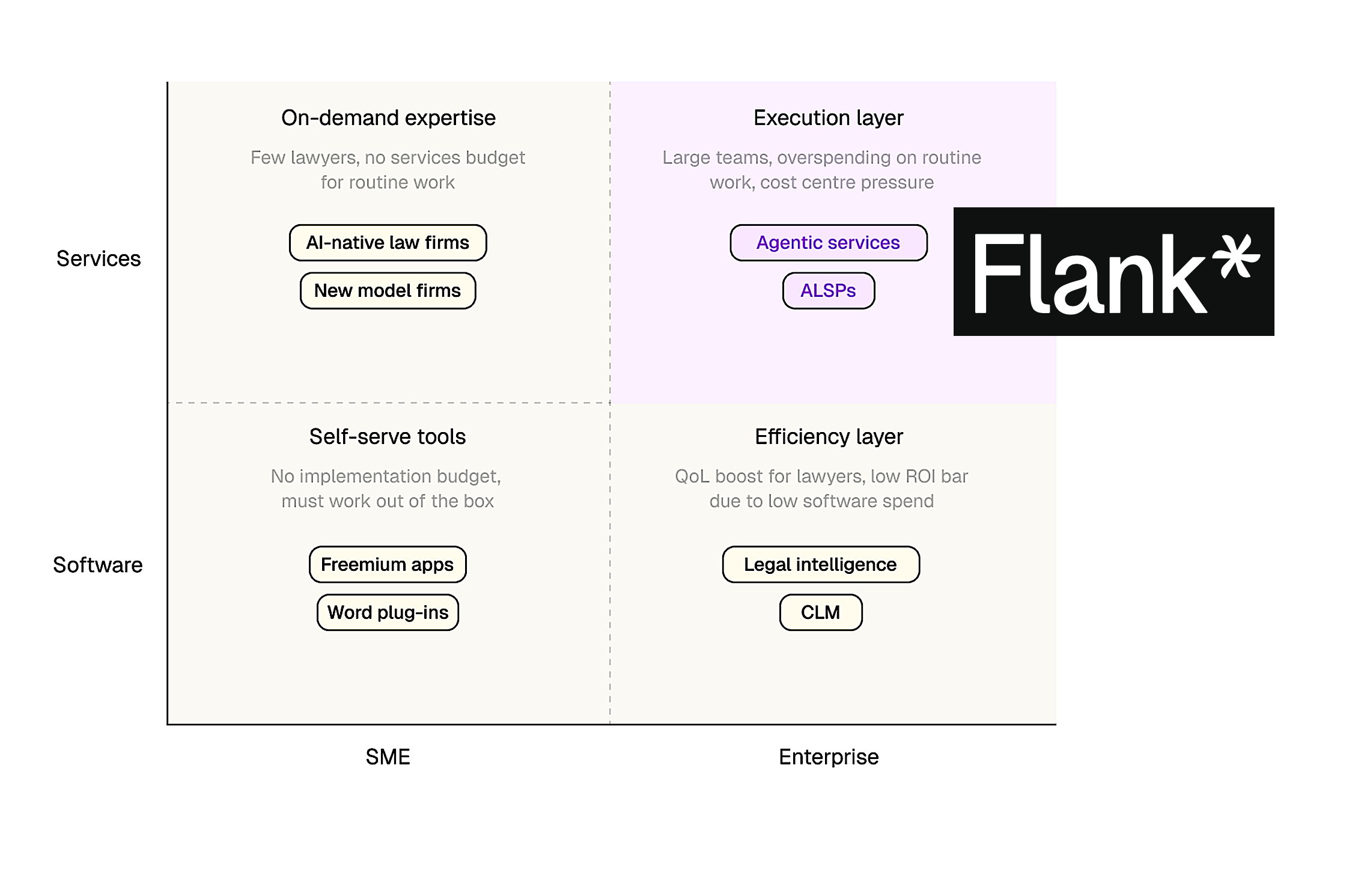
Let’s be clear about the distinction, because the market is still confused. Most legal AI right now lives in what you’d call the software quadrant—the lawyer remains the operator. They use the tool. They review the output. They send it. Faster, yes. Transformative? No.
Agentic services operate in an entirely different universe.
You’re not buying a tool. You’re buying an outcome. Contracts reviewed. Intake triaged. NDAs turned around. The routine volume never reaches a lawyer’s desk. A lawyer supervises only the exceptions.
For enterprise buyers, the supervision model becomes the strategic lever. Some want their own internal lawyers reviewing every exception. Others prefer a law firm partner managing the entire service on their behalf. Still others are comfortable with a vendor’s supervision team, provided the playbooks and decision rules stay in-house. The flexibility matters because what buyers actually want is service-level economics with institutional governance.
The ALSPs—alternative legal service providers—have been doing this for years using cheaper humans in India or the Philippines. What’s changed is ruthlessly simple: AI now delivers the same service at a fraction of the cost, or absorbs dramatically more volume without proportional hiring. Some ALSPs are building agentic capabilities internally. Others are partnering with AI vendors. The law firms are watching. The big software companies are scrambling.
But here’s the thing that makes this genuinely fascinating from a platform perspective: we’re watching an entire industry transition from a tool-centric model to a services-centric one. It’s like the shift that happened when mainframe computing moved to cloud—not because the tools got marginally better, but because the economics of delivery fundamentally changed.
The Enterprise Reckoning
When a buyer stops asking “Which copilot should we license?” and starts asking “Who does this work under our supervision?”, the entire game changes.
They’re not looking for incremental productivity gains anymore. They’re looking for throughput transformation. They want the work moved off the desk. They want cost elimination, not cost reduction. They want governance they can control without needing to hire.
This is why the gap between adoption and impact exists. Most enterprises bought tools when they needed to buy services. And most vendors sold tools when they should have been building supervision models at scale.
The question for 2025 isn’t whether AI can help lawyers work faster. It’s already done that. The question is whether vendors and law firms can architect a supervision and governance layer that lets enterprises actually use these capabilities to reshape their legal operations.
The ones who figure that out won’t be selling software licenses.
They’ll be selling outcomes.
🧬 Related Insights
- Read more: Cindy Cohn Drops Truth Bombs on The Daily Show: EFF’s Endless Privacy Siege Against Big Tech’s Data Gravy Train
- Read more: Anthropic’s Back-to-Back Leaks Hand Rivals Claude Code’s Blueprint
Frequently Asked Questions
What’s the difference between legal AI tools and agentic services? Tools make lawyers faster at their current work. Agentic services move the routine work entirely off lawyers’ desks with automated handling and human supervision of exceptions only. Tools are software you use; agentic services are work that gets done.
Why do 52% of legal teams use AI but only 7% save money? Most teams bought tools to optimize who was doing the work, but didn’t change what work was being done or who was doing it. A faster expensive resource at routine work doesn’t cut costs—it just makes the expensive resource slightly less idle.
Can ALSPs and law firms provide agentic services? Yes, and increasingly they will. ALSPs have supervised low-cost humans for years; now they’re replacing humans with AI agents under the same supervision model. Law firms are partnering with AI vendors to offer the same. The supervision layer is the competitive advantage, not the technology.
What does “supervision” actually mean in agentic services? It means human review of exceptions—work the AI agent flagged as outside its playbooks or confidence thresholds. Not every output, just the edge cases. This keeps the enterprise’s governance intact while moving the bulk volume automatically.
