At 3 a.m. on a Wednesday, a retail trader stares at a chart showing bitcoin locked between $65,000 and $67,000 for the third straight week, and realizes the enemy isn’t volatility anymore—it’s boredom.
Everyone talks about bitcoin’s 45% plunge from its October peak. Price pain. Sharp, visible, real. But there’s another kind of damage happening in cryptocurrency markets right now, one that doesn’t make headlines but grinds harder: time pain. The slow, sideways, range-bound conditions that exhaust both bulls and bears through sheer lack of direction. And if the data is right, bitcoin investors are only in the early innings of experiencing it.
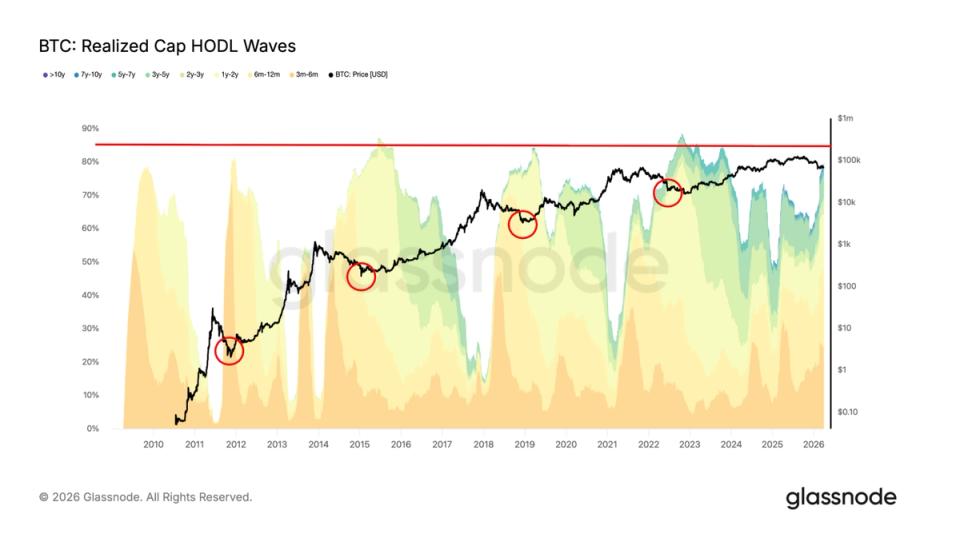
The distinction matters because it explains why so many market watchers are confused. On one hand, long-term holder accumulation patterns suggest a maturing bear market—we’re at 80% of supply held by investors who’ve been sitting for six months or longer, approaching the 85% threshold historically seen at bear market bottoms. That’s the good news. On the other hand, past cycles show that once a price floor forms, several months of consolidation typically follow before any sustained recovery kicks off. That’s where we might be headed.
When ‘Boring’ Becomes a Weapon
Price pain and time pain aren’t the same thing, and the difference is crucial for understanding what comes next.
Price pain is obvious: the 2008-style crash, the sharp 30% drawdown in a single day that forces weak hands out and triggers margin calls. Time pain is slower. It’s the market that oscillates within a tight range. It’s the lack of conviction, the muted futures activity, the sense that nothing is happening even though technically the market is still open. One breaks your conviction through shock. The other does it through exhaustion.
“Bear market bottoms have coincided with long-term holders controlling at least 85% of supply. Typically, price bottoms form first, and only several months later does long-term holder supply approach these high levels.”
Bitcoin is currently trading below $66,000, down roughly 3% in the past 24 hours. That’s not a crash. That’s a sigh. And the technical data—specifically Glassnode’s Realized Cap HODL Waves metric—tells a story about what happens after the sigh.
Why Long-Term Holders Don’t Signal Immediate Recovery
Here’s where most people misread the data.
Long-term holder supply climbing toward 85% looks bullish on the surface. It suggests that smart money has accumulated, that the weak have been shaken out, that we’re near a bottom. But there’s a temporal wrinkle everyone glosses over: historically, price bottoms precede these supply thresholds by months. Not days. Not weeks. Months.
What does that mean in practice? It means bitcoin could have already hit its floor price—or be very close. But the recovery? That’s not starting tomorrow. The market could bounce around $60,000–$70,000 for another four, five, six months while long-term holders finish accumulating, while retail investors lose patience and capitulate, while the entire psychological weight of nothing happening wears down even believers.
This is the actual trap. Not the price level. The timeline.
Is Bitcoin Consolidating or Collapsing?
The behavioral signals right now are mixed, which is exactly what you’d expect in a mature bear market.
Derivatives data shows growing bearish positioning: negative funding rates (suggesting traders are betting on downside), rising open interest in altcoins like Solana, and put options trading above calls. That’s not confidence. Meanwhile, altcoins—especially DeFi and AI-focused tokens—are experiencing tactical rallies on low liquidity. This is textbook consolidation behavior: the market is still searching for a real direction, and when there’s no direction, capital gets shuffled into whatever’s trendy or liquid.
Bitcoin’s tight range near $67,000 looks stable until you realize stability right now is just the market taking a breath. Historically, these periods precede either a sharp move down (catching the last weak holders) or a grind higher into a proper recovery cycle.
The Patience Premium
So what’s the actual implication for investors?
If you’re long bitcoin and you’re banking on a near-term spike, the data suggests you’re going to experience more time pain than price pain. The coins are concentrated in the right hands—long-term holders are at 80%, close to the 85% threshold. That’s bullish for eventual recovery. But eventual could mean months of ranging, watching your portfolio flatline, seeing headlines declare bitcoin “dead,” and questioning whether you should’ve sold at $60,000 instead of hodling.
The dangerous investor right now isn’t the one who buys at $60,000. It’s the one who bought at $50,000, who’s been holding for months, and who’s watching the market do absolutely nothing. That person is exhausted. And the data suggests there are millions of them.
What This Means for the Broader Crypto Market
Bitcoin’s consolidation phase has spillover effects that most analysts underestimate.
Altcoins are rallying on low liquidity, which means the capital rotation isn’t driven by conviction—it’s driven by desperation for any upside while bitcoin sleepwalks. The moment bitcoin finds a real floor and starts a sustained move higher, that capital rotates right back. This isn’t a sign of altcoin strength. It’s a sign of a market waiting.
And derivatives positioning—puts above calls, negative funding, muted volume—tells you traders aren’t bullish or bearish. They’re defensive. They’re hedging. They’re protecting downside while they wait for the next narrative that might actually move the needle.
The bear market isn’t over because the recovery hasn’t started. And the recovery hasn’t started because the market hasn’t finished its consolidation. And consolidation takes time—months of it.
🧬 Related Insights
- Read more: The Custody Revolution: Why Real-Time Asset Mobility Is Now Crypto’s Killer Feature
- Read more: Franklin Templeton Buys Into Crypto With 250 Digital Acquisition—Here’s Why It Matters
Frequently Asked Questions
When will bitcoin hit bottom? Based on long-term holder accumulation (currently at 80%, historically 85% at bottoms), bitcoin may have already touched or be near a price floor. However, several months of sideways trading typically follow before a sustained recovery begins.
Why is time pain worse than price pain? Price pain forces capitulation quickly through sharp drops. Time pain exhausts investors through stagnation, testing psychological resolve over months. Both eventually shake out weak hands, but time pain is harder to endure because the enemy is boredom, not fear.
Should I buy bitcoin now if it’s consolidating? That depends on your timeline. If you’re a long-term holder (years), consolidation is irrelevant—you’re buying into a maturing bear market with accumulation by smart money. If you’re looking for a near-term rally, you could be waiting months for significant upside.