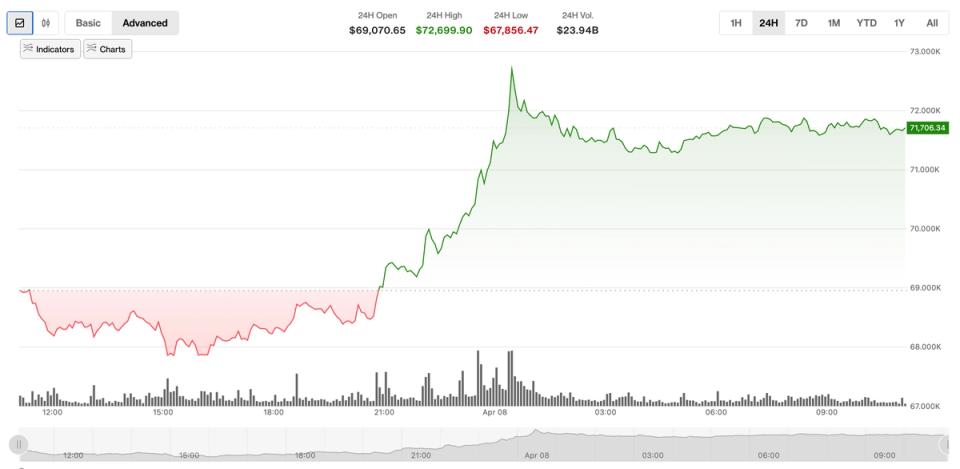
Everyone expected crypto to coast into the long weekend. A quiet Good Friday, some consolidation around $67K, maybe a slow grind toward higher prices as spring institutional flows continued their gentle march upward. Instead, we’re getting a masterclass in how markets can look healthy and sick simultaneously—and why the sickness might matter more.
Bitcoin didn’t break $67,000. That’s the headline. But the real story is buried two levels deeper, in the machinery beneath price action, where something more interesting—and more ominous—is happening.
The Institutional Money Keeps Flowing. So Why Should We Worry?
Let’s start with what looks good: Bitcoin ETFs attracted $22 million in net inflows this week. Steady. Consistent. The kind of institutional bid that’s supposed to be the new floor under crypto prices. For months, this narrative worked. Spot Bitcoin ETFs launched, asset managers added exposure, and the market rewarded that structural demand with a 50%+ rally from the November lows.
But here’s where it gets weird.
“Total apparent demand has flipped negative, with large holders distributing more than they accumulate.”
Let that sit for a second. Institutions are buying. Whales are selling. Actively, meaningfully selling. Data from CryptoQuant shows wallets holding between 1,000 and 10,000 BTC—roughly the tier where serious players concentrate their holdings—have shed nearly 188,000 Bitcoin since last year’s peak. That’s not noise. That’s distribution.
Almost half of all Bitcoin in circulation is now trading at a loss. Sitting in the red. Which means a lot of people (or algorithms managing a lot of money) are underwater and waiting for an exit. When you combine that underwater holder base with whales actively reducing position size, you’ve got the ingredients for a sharp correction if retail sentiment turns.
Oil at $120 Just Changed the Inflation Equation
Now throw in the macro wrench. Brent crude cracked $120 per barrel—levels we haven’t touched since 2008—because Trump just escalated the Iran situation and the Strait of Hormuz is effectively shut down. Oil that expensive does what it always does: it feeds back into inflation.
Europe’s already seeing 2.5% inflation. The Fed’s rate-cut narrative, which was supposed to be the tailwind under Bitcoin through mid-2026, just took a hit. Higher energy costs mean higher inflation expectations. Higher inflation expectations mean fewer rate cuts. Fewer rate cuts mean the asset that’s supposed to benefit from loose monetary policy—that’s Bitcoin—loses its main structural support.
Institutions didn’t suddenly stop buying Bitcoin because of one morning’s oil spike. But they also won’t be the cavalry riding in to catch it if prices drop. They came for the yield and the structural bid. That bid survives a pullback, sure. But it doesn’t survive a repricing of the entire macro regime.
The Liquidity Problem Nobody’s Talking About
Here’s the thing that might matter most: it’s Good Friday. Markets are closed. Crypto’s supposedly 24/7, but on holidays like this, volume thins out to a whisper, and you get these weird dynamics where small moves on low volume can feel like the beginning of something bigger.
Thin liquidity + whale distribution + macro headwinds + retail that’s half underwater. You do the math.
This isn’t a prediction. This is a setup. The ingredients for a sharp move exist. Whether that move happens today, Monday, or next week depends on what happens in the Middle East or if somebody leaks a hawkish Fed comment into a thin market.
Why This Matters More Than Price Action
Bitcoin’s been behaving like it’s decoupled from macro. This week suggests it’s not decoupled—it’s just been lucky. The institutional bid has been strong enough to offset underlying weakness in retail and whale positioning. But institutional flows are structural, not directional. They’ll continue through a 20% pullback without breaking a sweat.
What you’re watching is whether that structural bid is actually a floor or just a temporary prop. The whale distribution suggests professional money knows something—or at least thinks it does. The flipped demand curve suggests it’s not retail panic; it’s organized, methodical selling from people with size.
That’s the divergence worth paying attention to.
What to Watch Monday
U.S. nonfarm payrolls are scheduled for 8:30 a.m. ET. The expectation is 48K new jobs, which would be… fine. Weak, but fine. If we see a big miss there, that could actually support Bitcoin (more rate cuts). If we see a beat, that’s more hawkish, more headwind.
The ISM Services PMI follows. Markets are holding their breath on anything that tweaks the rate-cut timeline. That’s the real crypto trigger now—not the Fed fund rate itself, but expectations of what it’ll be in six months.
There’s also ETHGlobal happening in Cannes, which means there’ll be some noise from the altcoin crew, but honestly, nobody’s paying attention to governance votes when oil’s at 2008 levels.
The Bigger Picture
Crypto’s in this strange position where it’s simultaneously validated by institutional capital and undermined by macro forces bigger than any crypto-native narrative. That’s not new—crypto’s always been subject to the broader economy. But it’s a reminder that “institutional adoption” doesn’t mean “structural insulation from macro risk.”
Institutions own Bitcoin now. They’re not panic-selling. They’re just not fighting gravity either. And with half the float underwater, gravity’s getting stronger.
Stay alert. The weekend’s long, Middle East’s hot, and liquidity’s thin. That’s a combination that tends to move markets—usually not in the direction you want.
🧬 Related Insights
- Read more: Bitcoin’s Consolidation Trap: Why Bearish Bets Are Rising Even as Altcoins Rally
- Read more: LatticeFlow AI’s Peter Tsankov on Why AI Governance Just Became a $5 Billion Problem
Frequently Asked Questions
Why is Bitcoin down if institutions keep buying? Institutional ETF inflows are steady but small ($22M weekly). Meanwhile, large Bitcoin holders are actively selling 188,000 BTC worth. Institutional money is consistent but not powerful enough to offset organized whale distribution, especially with macro headwinds.
How does oil at $120 hurt Bitcoin? Expensive oil drives inflation expectations higher. Higher inflation reduces the probability of the interest rate cuts that were supposed to fuel Bitcoin’s rally. It’s not a direct price mechanism—it’s a narrative and expectations mechanism that can reprrice assets quickly.
Is this the start of a bigger crash? Not necessarily—yet. But the structure is set up for one: whale selling, half the supply underwater, thin holiday liquidity, and macro uncertainty. A catalyst (weak jobs data, Middle East escalation, or a hawkish Fed comment) could trigger sharp selling in thin conditions. The risk is asymmetric right now.