Ever wonder why Bitcoin stops moving and suddenly everyone acts shocked that altcoins start running? It happens more often than you’d think, and it usually means something interesting—or catastrophic—is about to happen.
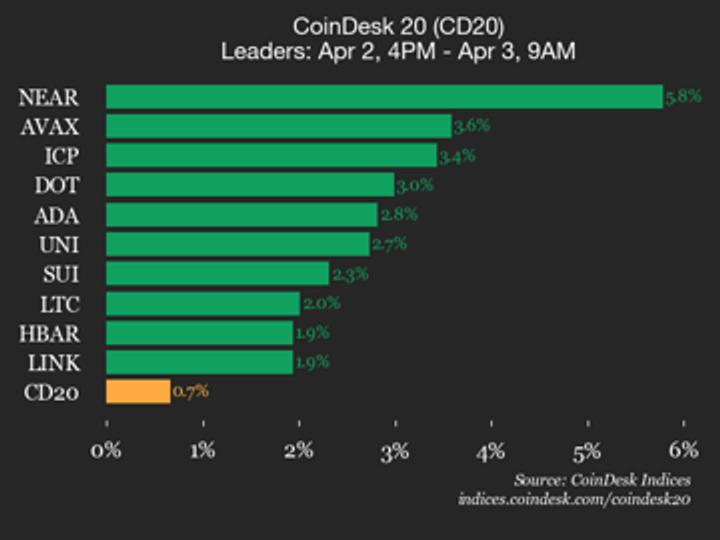
The latest CoinDesk 20 update tells a familiar story: Bitcoin’s flat at exactly 0.0% gains while NEAR Protocol is up 5.8% and Avalanche’s climbing 3.6%. The index itself is up 0.7%, and 19 of 20 assets are in the green. Sounds bullish, right? Except here’s the thing that nobody’s talking about: this is exactly what a two-tier market looks like, and history suggests it rarely ends well for the laggards.
When Bitcoin Goes Quiet, Something’s Actually Happening
Look, I’ve been covering this space long enough to know that Bitcoin’s flatness is never actually flatness. It’s a pivot point. It’s where institutional traders are deciding whether to hold or rotate into riskier bets. And when Bitcoin’s doing absolutely nothing while everything else is printing gains? That’s when the story gets interesting.
The CoinDesk 20 is up just 0.7%—barely a ripple. But the distribution is skewed. You’ve got momentum leaders like NEAR and AVAX carrying the load, while Bitcoin and Stellar Lumens (XLM) sit at zero. That’s not healthy breadth. That’s not a market with genuine conviction. That’s a market where the smart money might be testing whether it can pump mid-cap and large-cap alts without dragging Bitcoin along for the ride.
I’ve seen this pattern before. 2017 had it, 2021 had it. What typically follows is either a sharp Bitcoin breakout that pulls everything higher—or a correction that hits the alts first and hardest because they lack the liquidity buffer that Bitcoin has.
Is This Rotation Real or Just Noise?
Here’s what the CoinDesk 20 doesn’t tell you: which of these moves are driven by actual adoption and which are driven by algorithmic momentum chasing?
NEAR’s been building infrastructure in the Solana shadow. Avalanche has a real developer ecosystem. But a 5.8% daily gain? That could be anything. It could be a genuine technical breakout. It could be a whale moving through a thin order book at 3 a.m. UTC. It could be use traders front-running some newsletter that went out this morning.
“Nineteen of 20 assets are trading higher.” That sounds bulletproof until you realize one of those assets—Bitcoin itself—is the liquidity benchmark that everyone else depends on.
Bitcoin’s job in this index is to be the anchor. When Bitcoin’s moving sideways and everything else is dancing, the anchor’s either too heavy or everyone’s rowing in different directions. Both scenarios get messy eventually.
The Privacy Wars Are Coming (And This Matters More Than Today’s Gains)
While everyone’s watching the daily percentage moves, CoinDesk Research just dropped something that actually matters long-term: a breakdown of privacy architectures in crypto. Zcash and encryption-based models are strengthening. Obfuscation-based approaches are falling apart. Why? Because machine learning and blockchain data analysis are improving faster than privacy tech can keep up.
This isn’t flashy. It won’t show up in today’s CoinDesk 20 snapshot. But if you’re holding assets with weak privacy models, you just got a heads-up that metadata leakage is becoming a structural problem, not a theoretical one. The report maps five major privacy approaches. You should probably know which bucket your altcoin sits in before the market prices in that risk.
Who’s Actually Winning Here?
Let me be direct: in a market where Bitcoin’s flat and mid-caps are spiking, the winners are the traders who bought NEAR and AVAX yesterday and are selling into this momentum today. The losers are the people who think this move means Bitcoin’s broken or that altseason is finally here.
Bitcoin’s been flat a thousand times before. Sometimes it leads to explosive upside. Sometimes it leads to a 20% correction. The CoinDesk 20 being up 0.7% tells you the market’s slightly positive, not that it’s confident. When Bitcoin moves 5.8%, then we can talk about real conviction.
Until then, watch the volume. Watch whether Bitcoin breaks above or below its recent range. And for God’s sake, don’t chase NEAR just because it had a good day. That’s how you end up buying at the top of someone else’s profit-taking.
🧬 Related Insights
- Read more: Stablecoins Hit $315B, Congress Gets Close on Crypto Rules, Alabama Joins DAO Legal Club
- Read more: X’s Crypto Crackdown Won’t Stop the Scammers—Here’s Why
Frequently Asked Questions
What does the CoinDesk 20 index actually measure? It’s a broad-based index of 20 major cryptocurrencies traded across multiple platforms globally. It tracks price movements across the major assets, not just Bitcoin. Think of it like the S&P 500 for crypto—useful for gauging overall market direction, not for picking winners.
Why is Bitcoin flat while altcoins rise? Usually means traders are rotating out of Bitcoin into higher-risk, higher-volatility assets. It can signal either a market rotation into riskier bets or a warning sign that conviction is weakening. History shows this pattern often precedes either a sharp Bitcoin breakout or a correction that hits alts harder.
Should I be worried about privacy coins if blockchain analysis is improving? Yes, if you’re holding assets with weak privacy models. Encryption-based approaches (like Zcash) are holding up. Obfuscation-based approaches are degrading structurally. If your altcoin’s privacy story depends on hiding data rather than encrypting it, that’s a risk that’s going to get priced in eventually.