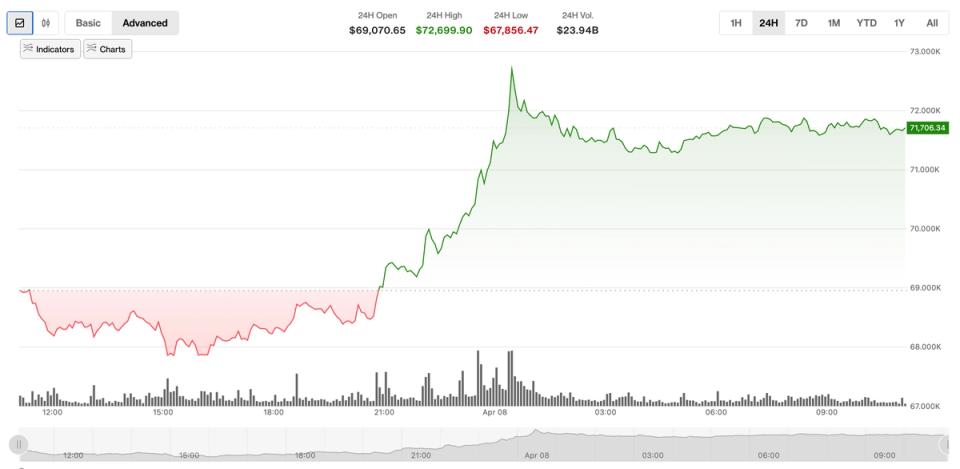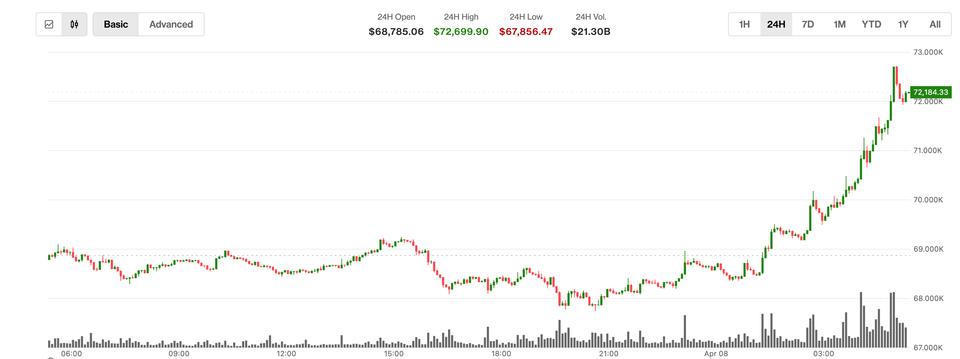
Bitcoin’s trapped between a rock and a technical pattern.
The world’s largest cryptocurrency is locked in a bear flag—a chart pattern that screams “lower prices coming”—and the stakes are higher than the cheerleaders want you to believe. While mainstream narratives tout Bitcoin’s resilience amid geopolitical chaos and crude oil hitting 2008 highs, the actual data tells a quieter, darker story: traders are losing faith.
Let’s start with what’s actually happening. Bitcoin has been range-bound between $60,000 and $73,000, which sounds stable until you realize it’s stable the way a tightrope walker is stable—one wobble away from disaster. Aksel Kibar, a chartered market technician, doesn’t mince words about where this ends if the pattern plays out.
“Breakdown of the lower boundary will be the signal for a possible move toward $52,500.”
That’s a $7,500 drop from current support levels. Not catastrophic in percentage terms, but psychologically? Brutal. And the technical setup makes it plausible.
Why $76K Is the Line in the Sand
Here’s the thing about bear flags: they’re confirmation patterns, not warning patterns. By the time one forms, the damage is already baked in. Bitcoin’s 1-day chart shows not one, but two of these setups, with the second actively rejecting every rally since February 8th. Every time BTC bounces toward the overhead trendline (sitting around $76,000), sellers show up like clockwork.
For the pattern to break—and for bulls to retain credibility—Bitcoin needs to close above $76,000 for 2-3 consecutive days, then hold it. Not test it. Hold it. And then retest the $75,000 trendline to flip it from resistance into support. That’s a three-step dance, and right now, Bitcoin is stumbling at step one.
Without that move, the path of least resistance points downward, with $60,000 as the primary backstop and nothing but air and liquidations below it.
The Liquidity Trap Nobody’s Talking About
Here’s what makes Kibar’s $52,500 prediction worth considering: the liquidation cascade. Hyblock’s data shows a nasty concentration of use longs sitting in the $63,000-$65,000 range. Break through there, and you’re not just testing support—you’re triggering a mechanical sell-off as margin calls force positions closed.
Below that? A gap. Dead space. The next meaningful cluster of long positions doesn’t appear until $57,500-$56,000. So if Bitcoin falls through $65K, expect a fast elevator ride toward mid-$50K territory. It’s not a prediction based on sentiment; it’s a forecast based on where actual money sits.
And here’s the kicker: open interest remains pinned below $20 billion—a level not seen since early February when Bitcoin was trading $79,000. That’s not bullish. That’s not even neutral. Traders are reducing their bets. When open interest drops that far, it usually means consolidation before a big move. And given the technical setup, that move looks more likely to be down than up.
The Catalyst Question: What Happens When Nothing Happens?
Bitcoin traders are waiting. Not hoping—waiting. There’s a difference. Hoping is emotional; waiting is the result of conviction evaporating. The article notes that “traders search for capital flow or narrative-related factors that would push them into larger directional bets.” Translation: nobody’s confident enough to take a real swing either direction.
But here’s the uncomfortable truth: if no catalyst emerges—no geopolitical shock, no macro revelation, no regulatory clarity—Bitcoin will continue its $10,000 range grind. And in a sideways market, technical patterns matter more, not less. Without a narrative to fight the technicals, the technicals win.
The negative funding rates that some traders view as “buying opportunities” haven’t produced conviction bounces. The spot and futures markets show flat demand across the board. This isn’t accumulation disguised as weakness. It’s apathy with an edge of fear.
The Uncomfortable Reading of the Room
Bitcoin’s price action isn’t majestic defiance against a hostile macro backdrop. It’s boring stagnation at a support level that may not hold. Yes, $60,000 has attracted buyers repeatedly. But “attracted” doesn’t mean “will keep attracting.” Support levels break. That’s literally how new lower prices happen.
The bear flag pattern is now confirmed. Kibar’s $52,500 target sits on a liquidity gap. Open interest is collapsing. And rallies into resistance are getting sold. None of this is secret information. Every major trader sees it. So the question becomes: why would they fight it?
If $76,000 doesn’t turn into a multi-day support zone soon, expect Bitcoin to test $60,000 again—and possibly break it. Anything below that becomes a free-fall into uncharted territory for this cycle.
The narrative is that Bitcoin is “holding strong” despite the chaos. The chart says Bitcoin is balanced on a knife’s edge, waiting for one of three things: a legitimate rally through $76,000, a catalyst that shifts trader psychology, or a cascade down to the $52,500s.
Two out of three of those outcomes are bearish. Odds matter.
🧬 Related Insights
- Read more: Why Crypto’s Iran War Reprieve Won’t Last—And Why That’s Good News
- Read more: Bitcoin’s Institutional Strength Masks a Deeper Crack: Why Good Friday Could Get Ugly
Frequently Asked Questions
What does bear flag pattern mean for Bitcoin?
A bear flag is a technical pattern suggesting lower prices are likely coming after a price drops and consolidates. For Bitcoin, the confirmed pattern indicates sellers control the narrative and that rallies will likely be sold into resistance around $76,000.
Will Bitcoin fall to $52,500?
Technician Aksel Kibar predicts $52,500 is possible if Bitcoin breaks below the $60,000 support level, especially given concentrated liquidations between $63,000-$65,000. However, predictions aren’t guarantees—Bitcoin could hold support or rally through resistance instead.
Why is Bitcoin’s open interest dropping?
Open interest below $20 billion suggests traders are reducing use positions and losing conviction. This typically signals either a big move is coming or traders expect continued sideways trading. Combined with the bear flag, it hints at downward momentum building.