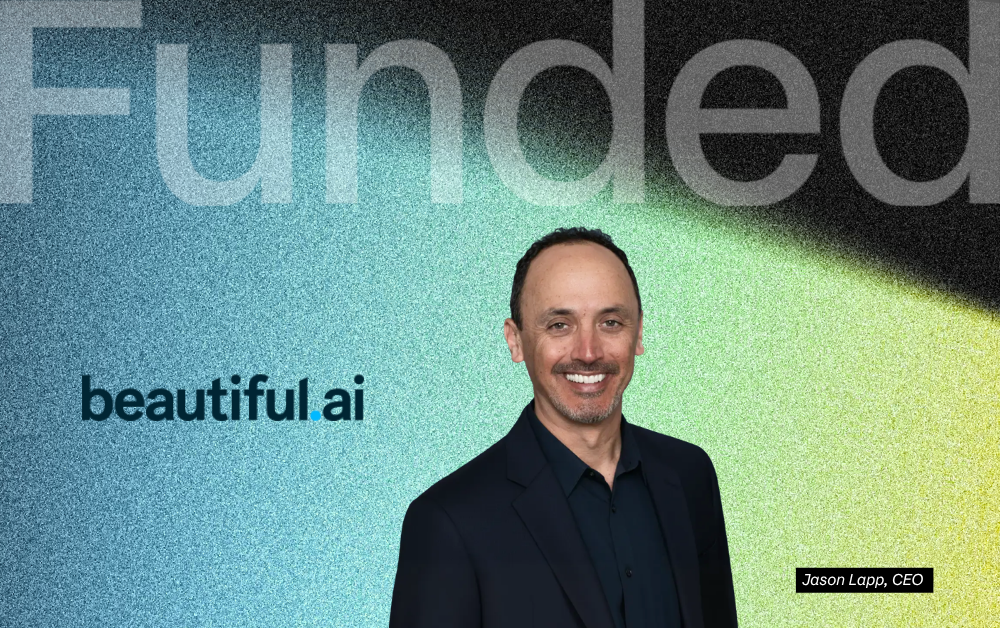
Jason Lapp is sitting in a conference room somewhere, and he’s just watched a senior executive generate a polished 20-slide deck from a three-sentence prompt in under four minutes. No Frankenstein cuts-and-pastes from Google Slides templates. No midnight formatting nightmares. Just input, refinement, done.This is what $45M in non-dilutive capital from General Catalyst’s CVF fund just bought Beautiful.ai room to scale.
But here’s what matters: this isn’t another “AI writes your emails faster” story. Beautiful.ai is attacking a specific architectural problem in how knowledge work actually happens — the gap between thought and output.
Why the Draft Phase Is a Waste of Time
Most productivity tools assume you know what you want before you start building it. You open PowerPoint or Figma, stare at a blank canvas, and then spend 40% of your time on busywork instead of thinking. Alignment. Hierarchy. Color consistency. Repositioning that one chart that got bumped when you added a new title.
Beautiful.ai flips this. You tell it what you need. It generates the structure, applies brand rules, pulls in the right format — all at once. Then you iterate through conversation, not menus.
“We built an AI product that actually creates what you ask for to help professionals turn ideas into polished, high-impact presentations quickly, in a way that fits naturally into how they already work.”
That’s CEO Lapp’s framing, and it’s actually precise. “Naturally into how they already work” is the buried lede. The company isn’t forcing users into a new workflow. It’s intercepting an old one and removing the friction.
Does the Math Actually Check Out?
Beautiful.ai claims users save a median of three hours per week. Senior leaders? Four hours. Frequent presenters cut roughly two hours per deck, translating to $20,000 in annual productivity value per user at typical rates.
That’s the kind of number that makes CFOs listen. And it’s working — the company’s got over 100,000 business customers, including names like Rakuten, Cvent, and Meltwater. These aren’t startups testing a cool toy. These are enterprises running this through procurement.
But here’s the skepticism: those hour-savings estimates come from Beautiful.ai itself. They’re real — you can measure the time delta. But there’s a survivor bias baked in. Heavy users save four hours per week because they’ve built Beautiful.ai into their workflow. Someone who tries it once and goes back to PowerPoint? The numbers collapse. The company isn’t claiming that gap doesn’t exist. Just that it’s not what they measure.
What’s Actually New Here
The latest release is where things get interesting. Beautiful.ai added three core capabilities:
Localization in 15 languages. This is enterprise play. You can’t scale globally without this. It’s table stakes now, not a feature.
A developer API. This is the architectural shift nobody’s talking about. A developer API means Beautiful.ai stops being a tool you open in a browser and starts being a component in other workflows. Imagine Salesforce pulling Beautiful.ai into Einstein, or Slack generating decks from conversations. The API is how that happens.
Mobile creation tools. This is the one that actually matters for adoption. Most presentation tools assume you’re at a desk. Beautiful.ai’s betting that the future of work is the person on a flight opening their phone and building a deck for tomorrow’s 9 AM. It’s not radical, but it’s honest about how people actually work.
Is This Just Better Canva?
No — and the distinction matters.
Canva generates output. Beautiful.ai generates structures. Canva is about making things look good. Beautiful.ai is about making things exist faster, then making them look good. It’s one layer deeper in the thinking process.
That’s why the conversational editing interface is doing real work. You’re not clicking buttons to move elements. You’re talking to the tool like it’s a designer in Slack. “Make the second bullet point bigger.” “Change the color scheme to match our brand.” “Pull in the Q3 numbers from the attached file.”
This is the actual architectural shift: AI that understands intent, not just syntax. Canva can’t do that at scale. Neither could PowerPoint. Beautiful.ai’s entire bet is that understanding what you’re trying to do is harder than doing it.
Why Non-Dilutive Capital Matters Here
$45M as non-dilutive funding (likely debt or revenue-based financing) tells you something about Beautiful.ai’s financial health. This company’s already profitable or near it. They didn’t need investor money to survive — they raised it to expand.
That changes the math. No dilution means the founders keep voting control and upside. It also means they’re not under pressure to hit growth targets on someone else’s timeline. This is the capital structure of a company that believes it can sustain itself while scaling. That’s rare for AI tools right now.
The Productivity Measurement Problem
Here’s what keeps me skeptical: productivity software is measured in feels as much as hours. Beautiful.ai saves you three hours per week. But does it make you better at your job, or just faster at a task that shouldn’t take as long anyway?
The company would argue it’s the same thing. More time thinking about content means fewer presentations that suck. That’s probably true. But there’s a world where Beautiful.ai is just helping us do the same mediocre work 40% faster.
That’s not a complaint about Beautiful.ai specifically. It’s a reminder that productivity gains in knowledge work are almost always local, not systemic. You save three hours on presentations. Those three hours don’t disappear. They get filled by something else.
The real question is whether teams using Beautiful.ai are smarter about what they’re presenting, not just how fast they present it.
What’s Next
The API is where this gets interesting. Once Beautiful.ai becomes a component instead of an application, adoption curves flatten and then climb again. You’re not competing with PowerPoint anymore. You’re embedded in 50 enterprise workflows.
That’s a different business model. That’s infrastructure.
🧬 Related Insights
- Read more: 96 Companies Racing to Own the Car OS—But Only 4% of Vehicles Are Ready for It
- Read more: Coinbase’s Stablecoin Bet: Why a Senate Deal on Yield Could Reshape Crypto’s Future
Frequently Asked Questions
How much time does Beautiful.ai actually save? Users report a median of three hours per week. Senior leaders report closer to four hours. For frequent presenters, that’s roughly two hours per deck. Real productivity savings exist, but they’re highest for heavy users who’ve integrated it into their workflow.
Can Beautiful.ai replace PowerPoint? Not yet, and probably not ever in the way PowerPoint works. Beautiful.ai is better at generation and structure. PowerPoint is better at granular control and offline work. Many teams use both. The API announcement suggests Beautiful.ai’s heading toward being embedded in workflows rather than replacing them entirely.
What does the $45M non-dilutive funding actually mean? It means Beautiful.ai likely uses revenue-based or debt financing rather than equity investment. This preserves founder control and suggests the company is already generating meaningful revenue. They’re scaling, not surviving.
