54 years. Exactly.
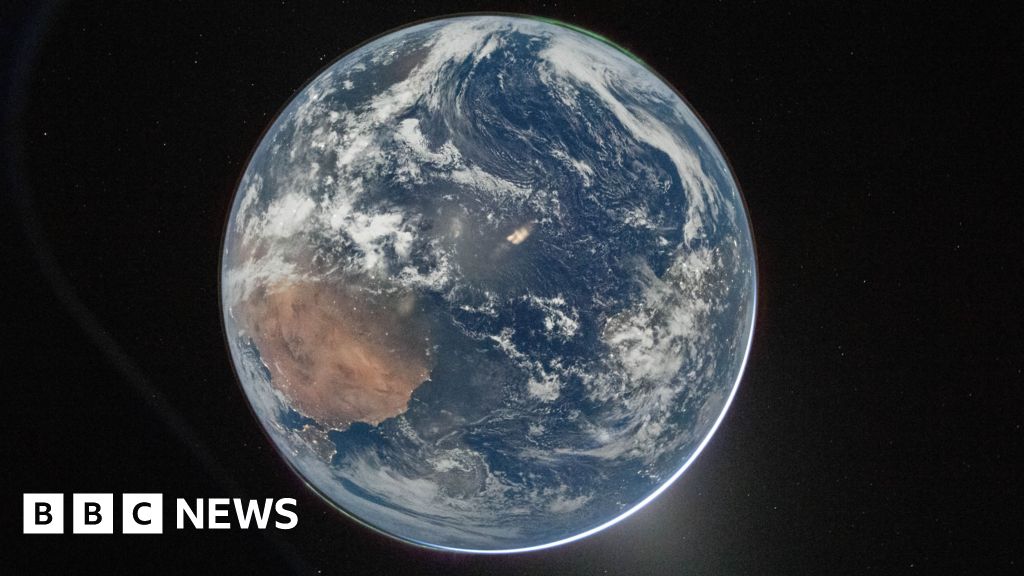
That’s the void between Apollo 17’s last deep-space gaze at home and the Artemis II crew’s fresh “Hello, World” snapshot—a high-res Earth portrait snapped after their trans-lunar burn.
Why This Earth Image Hits Different in 2026
Look, NASA’s shared these pics with the usual fanfare, but peel back the glow: commander Reid Wiseman wrestled Orion’s windows like a dev debugging a finicky API. Exposure settings? Tricky at this distance. “It’s like walking out back at your house, trying to take a picture of the moon,” he radioed Houston. That raw frustration—it’s human, messy, the opposite of polished PR reels.
The shot frames the Atlantic’s endless blue, atmosphere’s razor-thin glow eclipsing the sun, green auroras spiking the poles. Upside down, yeah—western Sahara and Iberia left, South America’s east flank right, Venus winking bottom-right. Spectacular? NASA’s word. But here’s my take: it’s a brutal reminder of Earth’s architectural fragility. One thin atmospheric layer. No backups.
And the crew? Glued to those windows post-burn, snapping away until smudges forced Wiseman to beg for cleaning tips. Mission specialist Jeremy Hansen chimed in: “We are getting a beautiful view of the dark side of the Earth, lit by the Moon.”
“We’ve come so far in the last 54 years, but one thing hasn’t changed: our home looks gorgeous from space!” — NASA, channeling that Apollo nostalgia.
How’d They Pull Off the Shot from 200,000 Miles Out?
Trans-lunar injection. That’s the beastly engine burn slingshotting Orion from Earth parking lot to lunar loop. Early Friday, flawlessly executed—four astronauts now hurtling 200,000-plus miles, first humans outside low orbit since ‘72.
Wiseman’s hurdles? Distance crushed detail; auto-exposure flopped. Think smartphone cams versus Hubble-grade optics, but handheld through portholes. They adapted, real-time. Night-day terminator sliced another frame clean; city lights twinkled in full dark, humanity’s footprint etched electric.
But zoom out—Orion’s tech stack evolved wildly from Apollo. No Saturn V behemoth; this is SLS/Orion, reusable dreams in DNA thanks to SpaceX cross-pollination. NASA’s not saying it outright, but these images scream architectural shift: modular, sustainable deep-space ops. Apollo was one-and-done; Artemis loops back for splashdown April 10.
Short path ahead. Far-side Moon flyby April 6. No landing—yet. That’s III.
Is Artemis II Just Apollo Redux, or a Real Leap?
Feels familiar, right? Side-by-side with Apollo 17’s 1972 Earthrise vibe. Same marble, shinier wrapper. But dig deeper—this ain’t nostalgia porn. It’s proof of persistent systems engineering grit.
Crew’s banter? Gold. Window grime from nose-breaths. Exposure hacks mid-flight. Parallels my unique angle: spaceflight’s like legacy code refactor. Apollo’s film rolls? Cute. Now digital sensors, AI-assisted pointing (quietly), radiation-hardened chips. Underlying shift? Software-defined missions. Orion’s flight computer crunches trajectories that’d melt ’70s iron. And auroras? Climate data windfall, poles alive green against black.
Critique the spin, though. NASA’s “gorgeous home” tweet glosses risks—radiation, burn precision, reentry hell. Bold prediction: these pics fuel dev boom in space sim tools. Unity/Unreal for VR training? Expect Artemis datasets to turbocharge orbital renderers.
Terminator shots mesmerize—the light-dark knife-edge, cities pulsing. Why care? Reminds us: from up there, borders vanish. Tech unites.
One punch: We’re back.
Why Does This Matter for Tomorrow’s Space Race?
Architectural pivot. Post-Apollo hiatus? Shuttle low-orbit treadmill. Now? Lunar gateway ambitions, Mars whispers. Artemis II tests the stack: life support loops, comms latency, photo tech as proxy for science payloads.
Crew—Wiseman, Hansen, et al.—aren’t tourists. Engineers in suits. Their pics? Diagnostic gold. Window clarity affects sensor calibration; exposure tweaks preview exoplanet hunters.
Historical parallel: Apollo images birthed Earthrise environmentalism. These? Could spark orbital data economies. Imagine devs scraping aurora feeds for ML models.
**
🧬 Related Insights
- Read more: CortexLab Exposes the Hype in ‘Brain-Like’ AI: A New Benchmark That Actually Measures It
- Read more: BlackSwanX Unleashes 374 Fighting AI Agents to Hunt Market Crashes
Frequently Asked Questions**
What is Artemis II mission?
NASA’s first crewed Artemis flight: four astronauts loop the Moon, no landing, testing Orion for deep space—returns April 10.
When were the Earth images taken?
Right after trans-lunar injection burn early Friday, en route to Moon far-side flyby.
How does Artemis II compare to Apollo?
First humans beyond low orbit since ‘72; modern Orion vs. Apollo capsules—sustainable, software-heavy, but same awe-struck Earth views.
