We’ve all felt it, haven’t we? That growing disquiet as we juggle a dozen browser tabs, each housing a specialized AI tool—one for writing, another for coding, a third for image generation, a fourth for deep research, a fifth for automation. The AI market, ostensibly designed to streamline our lives, has instead created a fragmented, expensive, and frankly, exhausting digital ecosystem. What if there was a single pane of glass, a unified AI operating system that could actually do things, not just spin up text?
That’s the audacious promise of Abacus AI. It’s not just another chatbot; it’s pitching itself as an end-to-end AI work system. Think less ChatGPT, more a digital chief of staff, capable of churning out code, building apps, and even running persistent agents that never sleep. But in a market saturated with impressive-sounding, yet often narrow, AI solutions, does Abacus AI actually transcend the hype, or is it another ambitious project destined to become just another tab?
Abacus AI’s core differentiator lies in its ambition to consolidate. The narrative is simple: why pay for and manage separate subscriptions for a writing assistant, a coding co-pilot, an automation platform, and an image generator when one system can theoretically do it all? This isn’t just about convenience; it’s about tackling the inherent inefficiencies and escalating costs of the current AI tool sprawl.
The Unified Brain and the Active Agent
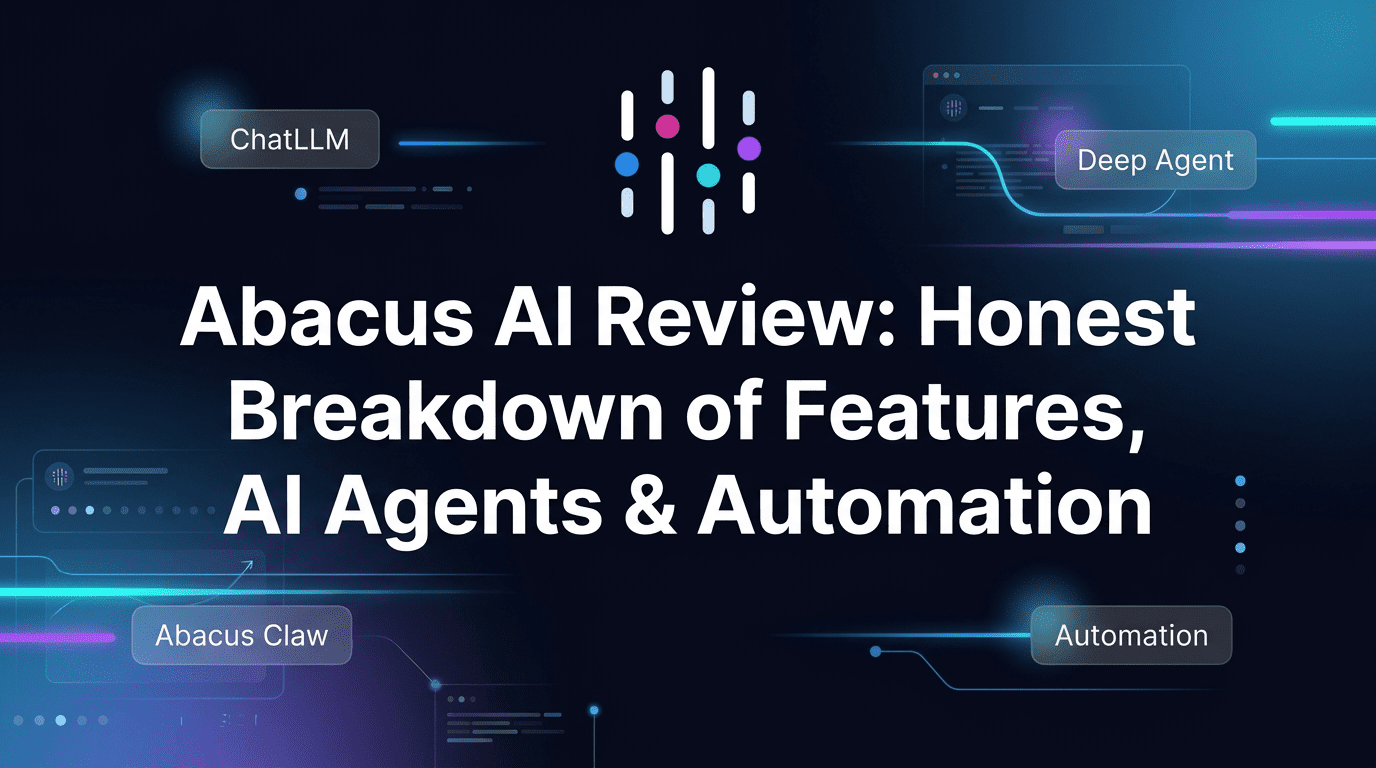
At the heart of Abacus AI is what they call ChatLLM. Forget picking and choosing between GPT-5.5, Claude 4.6, or Gemini 3.1. ChatLLM acts as an intelligent orchestrator, granting access to a constellation of leading large language models. This allows users to tap into the strengths of different models without the friction of switching interfaces. It’s a clever architectural move, abstracting away the model selection headache that many power users now face.
But the real story, the one that’s snagging attention, is the Abacus AI Agent. This isn’t your typical AI that regurgitates information. It’s designed for execution. Need market research done? It’ll browse. Want a presentation built? It’ll assemble it. Need a functional application coded and deployed from scratch? It claims to do that too. This shift from information retrieval to task completion is a significant architectural leap, and if it holds up under scrutiny, it could redefine what we expect from our AI tools.
The Abacus AI Agent is like a person who actually does things for you. It browses the web does market research builds presentations and even codes and deploys applications from scratch. This agent does not just give you advice it actually does the work.
Then there’s Abacus Claw. This is where the concept of persistence comes into play. Unlike session-based chatbots that forget their context when you close the window, Claw is designed to be an “always-on” entity within your messaging platforms like Slack and WhatsApp. Imagine an agent that remembers past conversations, learns from ongoing interactions, and can be invoked asynchronously without the need to re-initiate a new session. This addresses another major pain point: the ephemeral nature of current conversational AI.
Vibe Coding: From English to Deployed App
For founders and developers, Vibe Coding sounds like a dream. The idea is straightforward: describe the website or tool you want in plain English, and Abacus AI handles the rest—building, hosting, and deploying it. This abstracts away significant layers of technical complexity, potentially democratizing app creation and accelerating development cycles. Whether it can reliably translate nuanced English descriptions into strong, production-ready code remains the critical question, but the ambition is undeniable.
Is it Really Cheaper? The Credit System Conundrum
The pricing structure, hovering around $10-$20 per user per month, initially appears attractive. However, the platform operates on a credit system for more intensive tasks like video generation or running complex agents. This is a common strategy, but it introduces a layer of unpredictability. While it prevents runaway costs on basic usage, users need to carefully monitor credit consumption, which can make budgeting more of an educated guess than a precise science. It’s a trade-off: lower base cost for variable consumption charges.
Who Is This For? The Power User’s Playground
Abacus AI is explicitly targeting power users: founders, analysts, developers, and operational teams who need their AI to produce tangible, finished work, not just generate text snippets. This isn’t a tool for casual users seeking a simple chatbot experience. Its breadth of features means there’s a learning curve. Expect to invest time understanding its capabilities and workflows, as it’s positioned as a tool that demands engagement rather than passive consumption.
A Historical Parallel: The Operating System vs. The App
Think of Abacus AI not as a single application, but as an attempt at an AI operating system. For years, we relied on individual desktop applications—Word for writing, Excel for spreadsheets, Photoshop for image editing. Then came integrated suites like Microsoft Office, offering a more cohesive experience. More recently, the cloud has brought us SaaS platforms. Abacus AI feels like the next evolutionary step, aiming to be the foundational layer that orchestrates diverse AI capabilities, much like an OS manages hardware and software resources.
This integrated approach, while powerful, does come with its own set of challenges. The sheer number of features can be overwhelming, and the “all-in-one” promise often means that individual components, while functional, might not always match the specialized polish of best-in-class standalone tools. The architecture must be incredibly sophisticated to manage such a diverse workload efficiently.
Why Does This Matter for Developers?
For developers, Abacus AI represents both an opportunity and a potential disruption. The Vibe Coding feature, if it lives up to its billing, could significantly lower the barrier to entry for prototyping and even full-scale development. It suggests a future where the conceptualization and implementation phases of software development are dramatically compressed. The Abacus AI Agent, capable of coding and deploying applications, also signals a shift in developer workflows. Instead of writing every line of code, developers might increasingly focus on guiding, validating, and refining AI-generated output, becoming more like architects and less like manual laborers.
Furthermore, Abacus Claw’s persistent nature hints at more sophisticated developer tooling, where AI assistants can monitor codebases, suggest fixes proactively, and manage ongoing tasks without constant human intervention. This moves AI from being a reactive tool to a proactive partner.
However, this integration also raises questions about the future demand for traditional coding skills. Will the ability to describe an app in English render years of learning to code obsolete? Probably not entirely, but it will undoubtedly reshape the skillset required, emphasizing prompt engineering, AI system integration, and high-level architectural design over granular implementation details.
Is Abacus AI the Future of AI Work?
Abacus AI is more than just a collection of AI features; it’s a bet on a unified AI architecture. The market is ripe for such a consolidation. The current fragmented landscape is inefficient and costly. By integrating chat, complex agent execution, persistent conversational memory, and rapid app development into a single platform, Abacus AI is attempting to build the foundational layer for a new era of AI-powered productivity. It’s an ambitious undertaking, and while the learning curve is steep and the credit system warrants careful attention, the potential to replace a dozen specialized tools with one cohesive system is compelling. For those willing to dive deep, Abacus AI might just be the integrated AI work system we’ve been waiting for.